Reflections on CG Jung’s – Flying Saucers, A Modern Myth of Things Seen in the Skies. Part 1
Introduction
As it is widely known, Carl Jung’s fields of study included many topics that could be considered outside of the traditional Psychology and Psychiatry areas. He was interested in understanding any field that impacted human consciousness and the psyche, including parapsychology and other phenomena in the fringes of human thought, and he never shied away of analyzing any topic with an open mind.
Perhaps one of his lesser known publications was the one related to the topic of Flying Saucers, phenomena that became popular in the culture during the mid 1940’s. Jung started collecting information on the subject around 1946, paying attention to newspaper reports, and all kinds of statements by dedicated study groups, and scientific and military authorities. As it was the case with any topic that interested Jung, he read every available book and opinion on the subject available at the time, and he became both curious and preoccupied with the subject. Jung wrote a letter to a friend in 1951, in which he mentioned the following:
“ I’m puzzled to death about these phenomena, because I haven’t been able yet to make out with sufficient certainty whether the whole thing is a rumor with concomitant singular and mass hallucination, or a downright fact. Either case would be highly interesting. If it’s a rumor, then the apparition of discs must be a symbol produced by the unconscious. We know what such a thing would mean seen from the psychological standpoint. If on the other hand, it is a hard and concrete fact, we are surely confronted with something thoroughly out of the way. At a time when the world is divided by an iron curtain – a fact unheard of in human history – we might expect all sorts of funny things, since when such a thing happens in an individual it means a complete dissociation, which is instantly compensated by symbols of wholeness and unity. The phenomenon of the saucers might even be both, rumor as well as fact. In this case it would be what I call a synchronicity. It’s just too bad that wo don’t know enough about it.” (Jung, 1964, p. vii).
These comments by Jung rise several interesting elements that are worth analyzing. First of all, we can immediately notice that Jung is taking this phenomena seriously, and considers that is a topic that is worth analyzing in more detail, even if it is just a rumor, in which case he points out that this could very well be ‘a symbol produced by the unconscious’, and gives a potential reason the dissociation possibly created in individuals due to the heavy stress generated by the global political conditions, particularly the recent implementation of the iron curtain that divides the world, and the beginning of the cold war. Per the Jungian view of the psyche behavior, when affected by heavy stress, the individual (and social) psyche might find a relief by dissociating, and finds compensation by looking (or creating) symbol of ‘wholeness and unity”. And as a second potential situation, Jung considers the possibility of having a synchronicity, in which the individuals are affected by the stress of global conditions AND these phenomena are also real physical elements appearing at the same time.
This paper will summarize the ideas that Jung presented in the early days of the “flying saucer” phenomena, providing with a clear example of Jung’s open mind and relentless curiosity to analyze and better understand all human psyche related conditions, even when most of the scientific and governmental establishments were unwilling to provide credibility to these events. We will also see how most of the ideas and conclusions provided by Jung are still valid today, and can still be applied as reference for further study.
Jung’s first interest in studying the “Flying Saucers” phenomena
From the early days of the appearance of the “flying saucer” phenomena in the mid 1940’s, Jung realized the psychological challenges that this situation presented. His main question, similar to most serious observers of the phenomena was “If these objects were real or if they are a mere fantasy product”; followed immediately by the questioning: “If they are real, exactly what are they? If they are fantasy, why should such a rumor exist?” (p. 3).
Jung describes how he came up with “an interesting and quite unexpected discovery”, resulting from his first article published on the subject in 1954, for the Swiss weekly Die Weltwoche. On this publication, Jung presented a skeptical point of view to the phenomena, but at the same time, he was respectful of the opinions provided by the large number of specialists that were given credibility to the subject. Four years later, in 1958, Jung’s article was discovered by the global media, and the information was widely spread, but was distorted to indicate that Jung was a “flying saucer believer.” Jung then issued a note of clarification mentioning his true skeptical opinion, but this clarification received no interest by the global press. This situation taught Jung the way curious way that people was reacting to the phenomena, and he indicates: “one must draw the conclusion that news affirming the existence of UFOs is welcome, but that skepticism seems to be undesirable. To believe that UFOs are real suits the general opinion, whereas disbelief is to be discouraged. This creates the impression that there is a tendency all over the world to believe in saucers and to want them to be real, unconsciously helped along by a press that otherwise has no sympathy with the phenomenon.” (p. 3).
This curious reaction was enough for Jung to merit his interest to study the flying saucers, and was the first reason for Jung to become interested in the subject, starting from his first question: “Why should it be more desirable for saucers to exist than not?”
The End of an Era
Immediately after deciding to engage in the study of “flying saucers” (this is the term widely used in the early days of the phenomena, and Jung uses it most of the time, although he also uses the term ‘UFOs’. Here I will use both terms following Jung’s method). Jung understood that this was a highly subjective phenomena, and similar to other studies he made, his main challenge was going to be how to apply scientific structures to bring this phenomena into the formal academia and science umbrella. He mentions: “These rumors, or the possible physical existence of such objects, seem to me so significant that I feel myself compelled, as once before (*) when events of fateful consequence were brewing for Europe, to sound a note of warning. I know that, just as before, my voice is much too weak to reach the ear of the multitude. It is not presumption that drives me, but my conscience as a psychiatrist that bids me fulfil my duty and prepare those few who will hear me for coming events which are in accord with the end of an era.” (Jung, 1964, p. 5).
In regards to the end of an era, Jung is referring to the ancient Egyptian and Greek history that calls for “psychic changes that occur at the end of a Platonic month and the beginning of another,” generating “changes in the constellation of psychic dominants, of the archetypes or ‘gods’ as they used to be called, which bring about, or accompany, long lasting transformation of the collective psyche.” He is referring to the change from the rise of Christianity, or the era of Pisces, and how humanity was nearing the great change when entering the age of Aquarius, sometime around the end of the 20th Century and the beginning of the 21st Century.
On an interview for Die Weltwoche in 1954, Jung aligns his conclusions of the phenomena with those of Edward J. Ruppelt, the chief of the American Air Force’s project for investigation of UFO reports, which determines that “something is seen, but one doesn’t know what.” But the next comment raises quite an important element: “It is difficult, if not impossible, to form any correct idea of these objects because they behave not like bodies, but like weightless thoughts.” (Jung, 1964, p. 6). This surprising conclusion comes from the fact that some objects that are observed are supported with radar signatures, but many of the visual observations are not detected by the radar systems, therefore questioning their physical existence. This definition of “weightless thoughts” has very important ramifications that extend until recent theories, and is particularly impactful, given the myriad of further observations that somehow appear to support the possibility that the objects behave with what appears to be a tight connection to observer’s thoughts and consciousness. It seems that Jung brought up early some level of engagement existing between the objects early called “flying saucers” and human consciousness.
Keeping with Jung’s consideration of the apparent connection of these objects and human consciousness, he points out that “the longer the uncertainty lasted, the greater became the probability that this obviously complicated phenomenon had an extremely important psychic component as well as a possible physical basis.” And also, Jung indicates: “Such an object provokes, like nothing else, conscious and unconscious fantasies, the former giving rise to speculative conjectures and pure fabrications, and the latter supplying the mythological background inseparable from these provocative observations. Thus there arose a situation in which, with the best will in the world, one often did not know and could not discover whether a primary perception was followed by a phantasm or whether, conversely, a primary fantasy originating the unconscious invaded the conscious mind with illusions and visions.” (Jung, 1964, p. 7). Indeed, the fact that this phenomenon combines conscious and unconscious elements, it is not possible, at least for now, to identify its origin, being potentially first some type of physical observation that generates an unconscious reaction that helps build up and strengthen the effect, or vice-versa, if a fantasy based element of the unconscious gives an opening for the psyche to build up some type of physical reality. As most of Jung’s ideas and reflections, this concept appears to be quite ahead for its time, and resonate even with today’s theories of the UAP phenomenon. Reflecting in more detail on Jung’s reflections by mid 20th Century, we will see that the knowledge of the UAP phenomenon has not advanced that much, and remains as much a mystery as it was in Jung’s times. In addition to the two possible situations identified by Jung, he also adds the possibility that these two conditions could be tied via a synchronicity, which means that this events could be meaningful coincidences that connect a physical phenomenon with an archetypal psychic process.
Perhaps the most important point that we find here is that Jung at no point questions the credibility of the experiencers of the “flying saucer” phenomena, and he identifies potential sources, both physical and psychical that deserve further analysis and detailed study. As we will see more and more through this analysis of Jung’s work, we will find that after more than 60 years, the phenomena still remains a mystery, no matter the advances in human science and technology.
Jung’s Initial Analysis of the UFO’s as Rumors
Very early in Jung’s analysis, he recognizes that there is not much that he can offer to evaluate the UFO phenomena as a potential physical reality. He understands that this analysis of material elements needs to be led by the scientific community, using its measurement and test techniques. However, Jung sees his value added in analyzing the phenomena by studying its psychic aspects, and the psychological elements that generate that such a phenomena can grow and expand in society, starting from specific rumors.
The first real situation of the phenomena is that whether physical or psychical, it is already expanded and continues to rapidly expand in the different regions of the world. The natural assumption if the phenomena has a material reality is to reject it, and consider that is the result of somebody’s illusions, fantasies, or lies. Clearly people that make these types of reports must have something wrong in their heads!
If we follow this line of thought, the next step is to consider that the phenomena is based on stories and rumors, which must have a psychical source rather than a material source.
The difference, however, with mere rumors, is that these phenomena appear to have a basis on people’s visions, which Jung calls “a visionary rumor.” To explain this, Jung mentions that this type of rumor “is closely akin to the collective visions of, say, the crusaders during the siege of Jerusalem, the troops at Mons in the first World War, the faithful followers of the pope at Fatima, Portugal, etc. Apart from collective visions, there are on record cases where one or more persons see something that physically is not there.” (p. 8).
All of these examples of collective visions have a very strong numinous, psychical and spiritual basis, such that large groups of people end up directly observing certain objects and visual effects. Jung, however, even if he does not question or rejects these events, he also points out that “Even people who are entirely compos mentis (having control/mastery of one’s mind) and in full possession of their senses can sometimes see things that do not exist.” (p. 9). The difference with visionary rumors is that they need to include some level of “unusual emotion” and the reason why they grow into visions or delusions has a source of stronger excitations, therefore, have their origin on a deeper source.
The first sources considered for this phenomenon occurred during the second half of World War II. First with the observation of mysterious projectiles and rockets in Sweden, which were attributed to the Russians; and second with the so called “foo fighters” or lights that flew closely to the allied bombers over Germany, but then finding out that these objects were also following the German airplanes. In both cases, the real sources of these two events were never clarified. After the first use of atomic bombs, in 1945, the sightings started occurring immediately in the United States. Due to inability to identify an earthly origin for the objects, and also not understanding how the objects were able to demonstrate such amazing performance abilities, the rumor grew to include the assumption that the objects had an extra-terrestrial origin, and even to represent a possible threat to humanity. Jung describes: “The motif of an extraterrestrial invasion was seized upon by the rumor, and the UFO’s were interpreted as machines controlled by intelligent beings from outer space. The apparently weightless behavior of spaceships and their intelligent, purposive movements were attributed to the superior technical knowledge and ability of the cosmic intruders….It also seemed that airfields and atomic installations in particular held a special attraction for them, from which it was concluded that the dangerous development of atomic physics and nuclear fission had caused a certain disquiet on our neighboring planets and necessitated a more accurate survey from the air.” (p. 11).
Regardless of their apparent focus on military installations, Jung recognizes that: “Nobody really knows what they are looking for or want to observe…Their flights do not appear to be based on any recognizable system. They behave more like groups of tourists unsystematically viewing the countryside, pausing now here for a while and now there, erratically following first one interest and then another….” (p. 11)
Jung’s summary of the “flying saucer” phenomena as appeared in the 1950’s is quite complete, and once again, the details he indicates are very close to descriptions that can be found today. Jung continues his summary of the descriptions at the time by saying: “Sometimes they appear to be up to five hundred yards in diameter, sometimes small as electric street-lamps. There are large mother ships from which little UFO’s slip out or in which they take shelter. They are said to be both manned and unmanned, and in the latter case are remote controlled. According to the rumor, the occupants are about three feet high and look like human beings or, conversely, are utterly unlike us. Other reports speak of giants fifteen feet high. They are beings who are carrying out a cautios survey of the earth and considerately avoid all encounters with men or, more menacingly, are spying out landing places with a view to settling the population of a planet that has got into difficulties and colonizing the earth by force. Uncertainty in regard to the physical conditions on earth and their fear of unknown sources of infection have held them back temporarily from drastic encounters and even from attempted landings, although they possess frightful weapons which would enable them to exterminate the human race. In addition to their obviously superior technology they are credited with superior wisdom and moral goodness which would, on the other hand, enable them to save humanity.” (p. 11).
While Jung was eager here to provide the most complete description available for the phenomenon by then. He maintained a healthy skepticism about the popular assumptions held at the time. He recognizes that the rumors of the time, particularly related to the physical elements of the events, contain “the essentials for an unsurpassable ‘science-fiction story’” (p. 12) but, while keeping himself up to date on all the reports published globally, he continued to leave the physical portions of the phenomenon to the aerospace experts, and he continued his focus on the psychical source and its impact in the human consciousness. His thoughts at this time recognize the existence of thousands of UFO reports, and their impact in generating the “visionary rumor”, which objectively analyzed make room for an “impressive collection of mistaken observations and conclusions into which subjective psychic assumptions have been projected.” (p. 12). Is on these projections that Jung focuses his analysis, using his expertise on the human psyche and the development of myths and mind-generated effects.
Psychological Projections as Potential Sources of the UFO Phenomenon
In order for the phenomenon to be a result of a psychological projection, it requires a psychical cause. Jung recognizes that given the worldwide incidence of these observations must mean that the phenomenon has an “extensive causal basis”; and the first conclusion should be that “When an assertion of this kind is corroborated practically everywhere, we are driven to assume that a corresponding motive must be present everywhere too.” (p. 13).
The ’visionary rumors’ that Jung mentions, may originate from external sources and circumstances, but they need a basis of “an omnipresent emotional foundation” which given the reach of this phenomenon must be a “psychological situation common to all mankind.” Therefore, Jung concludes here that “The basis for this kind of rumors an emotional tension having its cause in a situation of collective distress or danger, or in a vital psychic need.” (p. 13).
Given the geo-political situation in the world in the mid 20th Century, Jung believes that the specific condition generating strain in the world population is a result of the policies and behavior of the Soviet Union, and their unpredictable consequences. The real possibility of a nuclear war with global consequences. Jung indicates:
“In the individual, too, such phenomena as abnormal convictions, visions, illusions, etc. only occur when he is suffering from a psychic dissociation, that is, when there is a split between the conscious attitude and the unconscious contents opposed to it. Precisely because the conscious mind does not know about them and is therefore confronted with a situation from which there seems to be no way out, these strange contents cannot be integrated directly but seek to express themselves indirectly, thus giving rise to unexpected and apparently inexplicable opinions, beliefs, illusions, visions, and so forth. Any unusual natural occurrences such as meteors, comets, “rains of blood,” a calf with two heads, and such like abortions are interpreted as menacing omens, or else signs are seen in the heavens. Things can be seen by many people independently of one another, or even simultaneously, which are not physically real. Also, the association-process of many people often have a parallelism in time and space, with the result that different people, simultaneously and independently of one another, can produce the same new ideas, as has happened numerous times in history.” (Jung, 1964, p. 13).
In some cases, events affecting large groups of people collectively, produce almost identical effects, the visions and interpretations result very similar, mainly affecting the individuals that are the least inclined to believe in the phenomena. When this occurs, the unconscious is presented with something that is completely unknown, and it resorts to drastic measures, to be able to rationalize the perceived information. In these situations, the unconscious generates a projection, and extrapolates the information perceived into an object, that reflects some previously hidden information from the unconscious. Regarding projections, here Jung provides a very interesting comment: “Projection can be observed at work everywhere, in mental illness, in ideas of persecution and hallucinations, in so-called normal people who see the mote in their brother’s eye without seeing the beam in their own, and finally, in extreme form, in political propaganda.” (p. 14).
Projections can be found in individuals, with source in the person’s conditions, and can have deeper collective sources as well. Individual projections can be generated by personal repressions, and elements hidden in the individual’s unconscious that can become present given specific environmental triggers.
Regarding Collective projections, Jung describes:
“Collective contents, such as religious, philosophical, political, and social conflicts, select projection-carriers of a corresponding kind – Freemasons, Jesuits, Jews, Capitalists, Bolsheviks, Imperialists, etc. In the threatening situation of the world today, when people are beginning to see that everything is at stake, the projection-creating fantasy soars beyond the realm of earthly organizations and powers, into the heavens, into interstellar space, where the rulers of human fate, the gods, once had their abode in the planets. Our earthly world is split into two halves, and nobody knows where a helpful solution is to come from.” (p. 14)
Here we have presented the first approach by Jung to understand a possible source of the “flying saucer” phenomenon. While is written right after World War II and in the early stages of the cold war, we can find implications that can still be applicable today. Even with all of the technological improvements that humanity has witnessed in the past 60 years, the phenomenon remains, and the understanding of it remains more or less at the same level. We have experienced thousands more events of the phenomena, our science has given some structure to the different events by categorizing the “close encounters” according to their intensity, the extraterrestrial hypothesis remains popular, and multidimensional and time traveler possibilities have been added. Also, the possibility of all of the hypothesis being present is of consideration, but there is really not much additional real knowledge that can be presumed. The psychological conditions described by Jung so far are also still valid as a potential part of the phenomena. We will continue to analyze the rest of Jung’s works on “flying saucers” in the following writings.
References
Jung, C. G. (1964) “Flying Saucers – A Modern Myth of Things Seen in the Skies” , extracted from Volume 10 of the Collected Works of C.G. Jung, “Civilization in Transition”, Bollingen Series, Princeton, NJ: Princeton University Press
Jung’s Psychological Typology
Jung’s studies regarding the opposites made him conclude that their origin could be found in “the polaristic structure of the psyche”, a characteristic that the psyche shares with all other natural phenomena. In the introduction to Mysterium Coniuntionis, Jung describes that “Natural processes are phenomena of energy, constantly arising out of a ‘less probable state’ of polar tension. This formula is of special significance for psychology, because the conscious mind is usually reluctant to see or admit the polarity of its own background, although it is precisely from there that it gets its energy.” (Jung, 1963, pp. xvi-xvii).
Jung’s Early Views on the Mind ~ Body Relationship
On his essay Psychological Typology, written in 1936, Jung starts his analysis on the nature of opposites by discussing the mind (or soul) ~ body relationship, and introduces the concept of “temperament”, which he relates to the earlier theory of the four “humours” which are: Melancholic, phlegmatic, sanguine, and choleric, and he defines temperament as the “sum-total of emotional reactions.”
For this purpose, Jung mentions:
“The whole make-up of the body, its constitution in the broadest sense, has in fact a very great deal to do with the psychological temperament, so much that we cannot blame the doctors if they regard psychic phenomena as largely dependent on the body. Somewhere the psyche is living body, and the living body is animated matter; somehow and somewhere there is an undiscoverable unity of psyche and body which would need investigating psychically as well as physically; in other words, this unity must be as dependent on the body as it is on the psyche so far as the investigator is concerned.” (Jung, 1971, p. 545).
This description seems to leave no doubt that Jung believed some type of dual nature of the body ~ mind relationship, and that both elements maintained a complementary relationship. However, later on the same paragraph, Jung indicates:
“What proved to be a good working hypothesis, namely, that psychic phenomena are conditioned by physical processes, became a philosophical presumption with the advent of materialism. Any serious science of the living organism will reject this presumption; for on the one hand it will constantly bear in mind that living matter is an as yet unsolved mystery, and on the other hand it will be objective enough to recognize that for us there is a completely unbridgeable gulf between physical and psychic phenomena, so that the psychic realm is no less mysterious than the physical.” (Jung, 1971, p. 543).
These observations by Jung give us some clear ideas of where his understanding was at that time, in 1936.
First of all, Jung is embracing the materialistic mental model, and more importantly, he is in reality rejecting the idea of having the body ~ mind relationship representing a complementary pair. That is, Jung is indicating that body and mind are separate entities. Also, as part of his reflection, Jung admits that both the psychical and the physical are both mysteries, therefore requiring more studies.
Even more, Jung continues to reinforce his view in more detail:
“The materialistic presumption became possible only in recent times, after man’s conception of the psyche had, in the course of many centuries, emancipated itself from the old view and developed in an increasingly abstract direction. The ancients could still see body and psyche together, as an undivided unity, because they were closer to that primitive world where no moral rift yet ran through the personality, and the pagan could still feel himself indivisibly one, childishly innocent and unburdened by responsibility.” (Jung, 1971, pp. 543-544).
So this paragraph shows how Jung is definitely accepting the materialistic paradigm, at least when he wrote these words in 1936, and not only that, but Jung is also indicating that the “undivided unity” of body and mind (psyche) is the view of pagan and primitive ancestors. Here, Jung is also including in his reflections, judgements regarding religion and morality points of view, which were strong elements of the dogma of his time.
On the following paragraph of Jung’s writing, he is making an effort to strongly differentiate the ancient and primitive cultures which were dominated by their emotions, with the “philosophical man” being the civilized and advanced human that demonstrated an advanced psyche. Jung seems to be completely absorbed by his position as “educated and sophisticated member of the Western culture”, when he continues writing:
“All passions that made his (the pre-philosophical man) blood boil and his heart pound, that accelerated his breathing or took his breath away, that “turned his bowels to water” – all this was a manifestation of the “soul.” Therefore he localized the soul in the region of the diaphragm (in Greek phren, which also means mind) and the heart. It was only with the first philosophers that the seat of reason began to be assigned to the head. There are still Negroes today whose “thoughts” are localized principally in the belly, and the Pueblo Indians “think” with their hearts – “only madmen think with their heads,” they say. On this level consciousness is essentially passion and the experience of oneness. Yet, serene and tragic at once it was just this archaic man who, having started to think, invented that dichotomy which Nietzsche laid at the door of Zarathustra: the discovery of pairs of opposites, the division into odd and even, above and below, good and evil. It was the work of the old Pythagoreans, and it was their doctrine of moral responsibility and the grave metaphysical consequences of sin that gradually, in the course of the centuries, percolated through to all strata of the population, chiefly owing to the spread of the Orphic and Pythagorean mysteries.” (Jung, 1961, p. 544).
These notes by Jung seem to be some of the most biased and entitled words that attempt to describe the evolution of the body ~ mind ~ soul relationship, as well as the seat of thoughts. It is clear once again here that Jung is completely dominated by his paradigm of Western-White cultured man, to the point that his comments sound not only ignorant but quite offensive. Rather than judging and labeling the “Negroes and Indians” living in his time as “archaic” and “primitive” because the first have their “thoughts localized in the belly” and the second “think with their hearts,” it would have been more valuable to analyze this findings with an open mind, as Jung normally did, and try to understand why could this be happening with these cultures. Today, when there is evidence that the “heart brain” and the “gut brain” are real, the observations obtained by Jung from the “primitive” cultures he describes do not appear to be out of line, but instead, well ahead of their time.
The positive thoughts that can be salvaged from these paragraphs are Jung’s observation that it was “the archaic man” who invented the dichotomies and discovered the pairs of opposites, such as good and evil, above and below, and odd and even. Therefore we can determine that the action of dividing nature into pairs of opposites has been present since the time of primitive tribes in the world.
The Origins of the Dualistic Mindset according to Jung
As I have mentioned previously, one of my philosophical obsessions has been to understand the reason why we humans divide the world in pairs of opposites, and then automatically we get polarized to one of these opposites. It continues to be an interesting human condition that occurs almost in any interaction among people, and how unfortunately this tendency becomes the beginning of a conflict in which two sides of an idea are debated, with two people defending their “right to be right” and with others normally being forced to take sides and build up the opposition of ideas, again, behaviors that become automatic and end up being ego-based discussions that have a high risk of being destructive.
In the works of Carl Jung, we find that the relationship of opposites is discussed very frequently, and is a central element of his studies of the Psyche. Jung’s works seem to have the most extensive and detailed analysis of the opposites, including their impact in human’s psychology and cognitive processes. The main discussion on opposites by Jung appears in his alchemical works, being a key phenomenon that occurs as part of the union of the masculine and feminine in the Alchemical Wedding. However, it is important to describe how Jung includes the opposites relationship all over his psychological works, starting from his analysis of the origin of the opposites paradigm in the human Psyche.
The Origin of the Opposition Paradigm
In 1955-1956, at the age of eighty, Jung published one of his most important books: Mysterium Coniunctionis, with its less known subtitle: An Inquiry into the Separation and Synthesis of Psychic Opposites in Alchemy. In this book, Jung provides a synthesis of his work in Alchemy and opposites for almost 30 years, starting with his reflections on the book: The Secret of the Golden Flower, an old Chinese manuscript introduced in the West by Jung’s friend Richard Wilhelm in 1929, and later discussed in Jung’s books: Psychology and Alchemy in 1944, Alchemical Studies also in 1944, The Psychology of Transference in 1946 and Aion in 1951. A review of all of these publications by Jung will show us how the relationship of opposites is a central element of his psychology, and a key factor in all of his work.
To provide us with his idea on the origin of the dualistic paradigm in the human psyche, Jung starts his discussion on the introduction to Mysterium Coniunctionis (1963) as follows:
“But, young as the psychology of unconscious processes may be, it has nevertheless succeeded in establishing certain facts which are gaining general acceptance. One of these is the polaristic structure of the psyche, which it shares with all natural processes. Natural processes are phenomena of energy, constantly arising out of a “less probable state” of polar tension. This formula is of special significance for psychology, because the conscious mind is usually reluctant to see or admit the polarity of its own background, although it is precisely from there that it gets its energy.” (p. xvi-xvii).
Key reflections from this paragraph include the concept that “all natural processes are phenomena of energy” and natural processes and the psyche share a “polaristic structure”. Jung also indicates that energy arises from “polar tension” and the critical description of how “the conscious mind is usually reluctant to see or admit the polarity of its own background”.
So the polaristic structure originates from the energy phenomena in nature which always includes two opposite poles, such as electricity (+ and – polarities) and magnetism (+ and – poles) and the conscious mind automatically rejects and does not admit that this polarity exists in all of nature and in itself, therefore forcing consciousness to choose one of the opposites, stay tied to that pole and reject the other pole.
Jung continues with his analysis providing the following detail:
“The psychologist has only just begun to feel his way into this structure, and it now appears that the “alchemistical” philosophers made the opposites and their union one of the chief objects of their work. In their writings, certainly, they employed a symbolical terminology that frequently reminds us of the language of dreams, concerned as these often are with the problem of opposites. Since conscious thinking strives for clarity and demands unequivocal decisions, it has constantly to free itself from counterarguments and contrary tendencies, with the result that especially incompatible contents either remain totally unconscious or are habitually and assiduously overlooked. The more this is so, the more the unconscious will build up its counterposition.” (Jung, 1963, p. xvii).
This interesting paragraph by Jung is telling us how by the time he was writing Mysterium Coniunctionis between 1955—1956, the field of psychology was just starting to look into the effect of the opposites in the human psyche, a phenomena that had been largely used by the alchemists. Jung is also letting us know how the conscious mind, or “conscious thinking” is not able to manage ambiguity, which means that the rational mind has to manage the pair of opposites by choosing one of them and either “overlooking” the other or by keeping the other opposite in the unconscious. This is a key point: When faced with a pair of opposites, the psyche will choose one of them to keep in the conscious mind and the other will be maintained in the unconscious; as Jung says: “The more this is so, the more the unconscious will build up its counterposition.” Which is basically indicating that the polarization will grow stronger unconsciously. This explains how the polarizing behavior occurs: when we are presented with the opposites, based on our pre-existing mindset, we choose one opposite and automatically (unconsciously) reject the other, and we can build up the rejection to the unchosen opposite to the point of radicalization, even if is done unconsciously. If we can imagine two or more people with different mindsets or backgrounds being presented with a pair of opposites, and one of the persons chooses one of the opposites and rejects the other while the second person chooses differently, we can see how a difference of opinion and potential conflict escalation will occur since both persons will unconsciously radicalize their opposites. Since the radicalization of the rejected opposite occurs on an unconscious level, we have no immediate way to rationalize what is happening and we end up potentially in conflict with the other person. This appears to be the basis for the conflict of radicalization among individuals.
On his book: Archetype of the Absolute: The Unity of Opposites in Mysticism, Philosophy, and Psychology, Drob (2017) provides a clearer description of this process as follows:
“Jung held that consciousness and reason produce the divide between the psyche’s opposing tendencies. This is because consciousness strives for clarity and unambiguity and must therefore free itself from contrary or opposing tendencies, which it either overlooks or suppresses. As a result, consciousness identifies itself with one pole of a divide and seeks to exclude, disparage or ignore its antithesis. Thoughts, feelings, and other psychic contents that are incompatible with the determinate thread of awareness are split off from the conscious mind.” (p. 232)
Since the world is constantly presenting pairs of opposites to us, we are always choosing sides based in our conscious mindsets, which will select, or “judge” each pair of opposites based in the background, culture, education, biases, religion and even the language that we have. Both Jung and Freud identified the language as an important element of this process, which is critical to note, as we have found how language is a limiting factor in our thoughts and behaviors. And, on the other hand, the rejected opposite is constantly being kept in the unconscious, or being rejected consciously without having a rational reason for the rejection.
This seems to be the most accurate explanation as to why humans end up polarizing the opposites, and even radicalizing the rejected opposites to the point of entering into conflict with other person’s point of view. It would be very valuable if we could remember that this process is constantly happening, and being able to recognize the unconscious polarization that is happening, in order to minimize the possibility of generating unnecessary differences between people, getting radicalized and escalate the conflicts.
I will continue to discuss more of Jung’s work on the opposites in the following writings.
Compensation, Integration and Coordination of Opposites
On his description of Coincidentia Oppositorum, Jung debates on the way that the relationship between opposites can be presented. He relates the unification of opposites to the Transcendent Function which is the key for the process of Individuation. First of all, it is important to clarify the meaning that Jung gave to the concept of Individuation.
Jung’s Individuation
The term Individuation, as defined by Jung’s psychology, is a prime example of the limitations of language. If we focus strictly on the meaning of the word, it is very easy to think that Individuation should mean a process in which the person achieves individual growth to differentiate him or herself from others, or a process in which fragmentation and self are nurtured over the collective.
However, it is important to analyze the meaning of the concept according to Jung’s intentions, which will describe to us the idea of combining a process of differentiation, but also a process of understanding the whole, and the relationship of the individual to the collective, therefore being an example of Complementarity, since is defining the dual nature of individual and collective elements (the relationship of the pair of opposites individual ~ collective).
The concept of Individuation and its meaning according to Jung is a key element in Jung’s psychology, and it appears many times through Jung’s writings. Sharp (1991) gives us a very detailed description of the concept as follows:
“Individuation. A process of psychological differentiation, having for its goal the development of the individual personality…. Individuation is a process informed by the archetypal ideal of wholeness, which in turn depends on a vital relationship between ego and unconscious. The aim is not to overcome one’s personal psychology, to become perfect, but to become familiar with it. Thus individuation involves an increasing awareness of one’s unique psychological reality, including personal strengths and limitations, and at the same time a deeper appreciation of humanity in general….In Jung’s view, no one is ever completely individuated. While the goal is wholeness and a healthy working relationship with the self, the true value of individuation lies in what happens along the way.” (pp. 67-69)
The description of Individuation defined by Jung as we can see, is not a simple description of individuality, but a complex set of relationships that define some of the key elements of being human. And if we pay attention to the definition, under the paradigm of Complementarity, we can observe not just a simple relationship between just one pair of opposites, but a group of relationships that define the path for humans to achieve growth. These relationships appear to imply several complementarities which all together form the individuated human, perhaps requiring a different description for Complementarity as something more like a Super-Complementarity or a Multiple-Complementarity, since we need to observe the relationships among complementary opposites and on a second level the relationship between several complementary “pairs” of opposites.
To unpack the definition, first we have the complementary pair: ego ~ unconscious, which is a pair of elements internal to the individual’s Psique; then we see a relationship between strengths ~ limitations again related to the individual, and as an additional relationship we have the pair whole ~ individual, that provides the connection of the person to the world. The description for Individuation determines an internal wholeness of the individual with him/herself, and an external wholeness of the individual with the world, such that the goal is to achieve a higher level of internal and external wholeness in order to achieve the Individuation, bringing even one more relation of opposites to the group: internal ~ external.
Therefore, the concept of Individuation gives us a complex complementary relationship between at least 4 sets of opposite pairs:
Ego ~ Unconscious —————————— Strength ~ Limitation
Whole ~ Individual —————————— Internal ~ External
Jung does not discuss Individuation this way, but mainly makes the point that individuation consists of both an internal/individual element and an external/collective element.
In his book: Psychological Types, Jung (1971) expands on this individual/collective need of Individuation as follows:
“…only a society that can preserve its internal cohesion and collective values, while at the same time granting the individual the greatest possible freedom, has any prospect of enduring vitality. As the individual is not just a single, separate being, but by his very existence presupposes a collective relationship, it follows that the process of individuation must lead to more intense and broader collective relationships and not to isolation.” (p. 448).
While Jung describes several approaches that can be implemented to achieve the union of opposites, it appears that individuation is the main method. An important part of Individuation is the element of “compensation”, which achieves the balance and integration of the opposites. The key element of Individuation is that its process includes a complementarity between the conscious and the unconscious (Drob, 2017, p. 198). Regarding the element of compensation, Jung also mentions: “Unconscious compensation is only effective when it co-operates with an integral consciousness; assimilation is never a question of “this or that,” but always of “this and that.” (Jung, 1966, p.156). We can observe how here Jung is using directly the language of Complementarity indicating the need for and and not only or.
By itself, the process of Individuation as developed by Jung is not just a simple concept that describes a growth in maturity or the achievement of a higher level of knowledge, and even if Jung does not seem to ever provide a clear definition of Individuation, we can observe that the way the concept is presented provides with a complex set of relationships, once again, showing the relationships between several opposite individual elements and the relationships between several pairs of these opposites, all of this following Jung’s preference of using a symbolic language. Drob (2017) gives us a view of this:
“Jung’s message seems to be that as one assimilates the significance of symbolic personifications and situations, one-sided conscious attitudes are critiqued and compensated for, and the individual moves closer to assimilating the archetype of the self – an archetype that is a coincidentia oppositorum. The process of individuation involves an encounter with, and assimilation of, aspects of both the personal and collective unconscious, specifically the individual’s shadow (elements of one’s personality that the individual has hitherto ignored, rejected, and detested) and the anima or animus (the aspect of oneself that embodies characteristics opposite to those one and society associates with one’s gender). The assimilation of the shadow is illustrated in The Red Book as Jung painfully comes to “accept all,” including the most repulsive desires and tendencies within humanity and his own psyche.” (p. 199).
In this description, we can once again observe how the concept of Individuation is not just a simple relationship of two opposite elements, but a complex relationship among several elements and several pairs. At least the following pairs of opposites are defined:
Personal unconscious ~ Collective Unconscious
Self ~ Shadow
Anima ~ Animus
These pairs of elements (opposites) are engaged on a complementary relationship with each other, and then, the pairs are also engaged with each other to structure a “Complex Complementarity” of three complementary pairs of opposites in order to form the framework of individuality as defined by Jung.
One more important aspect of this structure is that Jung describes several different relationships among the opposites. First of all, a “union,” “coincidence,” “interdependence” and “harmony” of the opposites, but also a “confrontation,” or “tension.” It is not just a simple relationship of “union” that brings up the relationship of the opposites. Some additional details provided by Jung on the opposites are: “[the] identity of opposites is a characteristic feature of every psychic event in the unconscious state…there is no energy unless there is a tension of opposites and…the psyche as an “energetic system” is dependent on this very tension.” And also: “The idea here is that without the opposites (Jung cites as examples beginning and end, above and below, earlier and later, and cause and effect) nothing could be manifest.” And finally, to provide even clearer perspective on the importance of the relationship among opposites, Jung says: “Life itself is the oscillation between the tension and overcoming of opposites; when they have been completely overcome, a person (for example, the Buddha in his final reincarnation) has no further reason to live on earth.” (Drob, 2017, p. 201).
The relationships of the opposites reflected in Jung’s philosophy make us realize that this relationship is dynamic, complex and non-dualistic. It is dynamic because is ever-changing, and the oscillation between the opposites is modified with time. It is complex because is not only a relationship among a single pair of opposites, but, as we have seen, it generally involves more than one pair, and probably at any given time it might require a different number of pairs, and for the same reason, is non-dualistic, having more than just two elements to coordinate.
The dynamic characteristic of the pair of opposites behavior indicates that the whole relationship is an ongoing flow that changes with time, meaning that life in general is an ongoing flow of opposite elements organized in pairs that form complex relationships and are defining our status in life and in nature, both physically and psychically. We will continue analyzing this concept of flow, and how it can affect our psychical well-being and our growth.
Reflections on Mysterium Conunctionis and The Alchemical Wedding – The Problem of Opposites in Alchemy and Psychology
Introduction
In the Foreword to Mysterium Coniunctionis, Jung describes how neurosis can be caused by dissociation of personality resulting from “the conflict of incompatible tendencies” or the problem of opposites, after repressing one of these opposites that generates only an extension of the conflict. Jung says that the therapist’s role is to have the opposites confront each other in an attempt to unite them permanently. This is a direct comparison of the process with the methods described by the alchemists. The psychological phenomenon of transference is the equivalent of the “alchemical wedding” found in the works of the alchemists. In the world of psychology, transference works to unite the opposites and eliminate neurosis, in the alchemical works the “alchemical wedding” unites the opposites of silver, feminine, the moon, with the gold, masculine and the sun, in the creation of the lapis Philosophorum or the representation of wholeness.
Since early times, humanity has seen nature with a dualistic lens, always attaching opposing labels to phenomena and human activities. We try to immediately identify if somebody is good or evil, the weather is hot or cold, etc. and we even forget sometimes that there is an infinite number of conditions between these opposite extremes. The psyche seems to be continually judging and assessing the conditions of the opposites in order to determine conditions of behavior, relationships and actions, and it is common to get to a level of conflict between the opposites that will affect the person’s psychological condition, and may result in chronic mental illnesses. Through history, there have been many philosophical, mythological and literature related works that tackle the issue of the conflict of opposites. One of these works is, the text called Aurora Consurgens, which was probably written by St. Thomas Aquinas in the thirteenth century, tries to combine the alchemical view with the Christian view in regards to the problem of opposites, Jung performed extensive studies of alchemy and tried to connect the parallels of alchemy and the human psyche behavior, and as part of his studies, he included the study of Aurora Consurgens. It is even considered that Jung discovered this work in modern times.
This paper will analyze the alchemical processes of the prima materia and the alchemical wedding, and will try to identify philosophical and psychological parallels that could help in further explaining these phenomena.
The Prima Materia
Jung describes the Prima Materia as the mother of the lapis, or filius philosophorum, as being the “matter of all things”. In its feminine aspect, the prima materia is “the moon, the mother of all things, the vessel, it consists of opposites, has a thousand names, is an old woman and a whore, as Mater Alchimia it is wisdom and teaches wisdom, it contains the elixir of life in potentia and is the mother of the Saviour and of the filius Macrocosmi, it is the earth and the serpent hidden in the earth, the blackness and the dew and the miraculous water which brings together all that is divided.” In a later paragraph Jung also describes how Luna (the moon) “is on the one hand the brilliant whiteness of the full moon, on the other hand she is the blackness of the new moon, and especially the blackness of the eclipse, when the sun is darkened.” (Jung, 1963).
Marie Luis Von Franz, in her translation of Aurora Consurgens, provides the explanation that the description of wisdom is an archetypal image that plays an important role in alchemical and patristic literature. She also indicates that the tree “is primarily an image for the prima materia which gradually unfolds during the transformation process and is sufficient unto itself.” The tree is the symbol of the individuation process “in the sense of living one’s own life and thereby becoming conscious of the self.” (Von Franz, 2000).
If we focus in the concept of wisdom being represented here in metaphorical terms, we could understand how wisdom can be considered both as a provider of light to achieve positive things, but also having the potential to provide darkness when is used to achieve evil things. The fact that the prima materia here is represented as a feminine entity parallels with many other mythological stories found in almost all cultures, where there always seems to be a character represented by a woman figure or a goddess, which is represented as capable of the utmost good but also of the most terrible evil actions. This figure of the goddess is one of the main representations of the union of opposites.
In his book, Psychology of the Transference, Jung references the Rosarium, in which there is a description called the death of the royal pair as follows:
“… let the residual body, which is called earth, be reduced to ashes, from which the tincture is extracted by means of water… After this is completed, you will know that you have the substance which penetrates all substances, and the nature which contains nature, and the nature which rejoices in nature. It is named the Tyriac of the Philosophers, and it is also called the poisonous serpent, because, like this, it bites off the head of the male in the lustful heat of conception, and giving birth it dies and is divided through the midst. So also the moisture of the moon, when she receives his light, slays the sun, and at the birth of the child of the Philosophers she dies likewise, and the death of the two parents yield up their souls to their son, and die and pass away. And the parents are the food of the son…” (Jung, 1969)
An important aspect described here is the appearance of the “substance which penetrates all substances” which brings resemblance to the concept of soul. Von Franz describes the idea presented by Thomas Aquinas of the soul “not only as the ‘form’ of the body but as a form which possesses its own substantiality and also imparts it. It can act creatively on its own account and is thus an ‘ens in actu’ (actual being). Matter, in itself formless, becomes invested with its actual properties only in so far as it receives form from the soul.” (Von Franz, 2000)
This concept of a “formless matter” which takes its properties from the soul has a close resemblance to the quantum physics concept in which matter achieves a physical state only through the observation process of a conscious being, and the wave-particle duality where the initial condition is a waveform and it becomes particle only after a measurement or observation is made. Also, the concept of a “substance which penetrates all substances” seems to resemble the concept of “ether”, which in classical pre-relativistic physics was supposed to fill all the empty space, including the space between the particles that formed matter. Even though the element of “ether” was abandoned after Einstein’s theories in the early 1900’s it seems to re-appear recently as the concept of “dark matter” which is supposed to form a vast percentage of the universe.
The Paradoxes in the Conflict of Opposites
The alchemists used many paradoxes in their work with the opposites and their union. Jung describes how these paradoxes appear mostly around the “arcane substance, which was believed to contain the opposites in uncombined form as the prima material and to amalgamate them as the lapis Philosophorum.” (Jung, 1963). Jung describes more paradoxes, such as “I am the black of the white and the red of the white and the yellow of the red”, or “Burn in water and wash in fire”, or Socrates’ quotation: “Seek the coldness of the moon and ye shall find the heat of the sun, as described in Tractatus Aristotelis, the opus is said to be “a running without running, moving without motion.” And as described in The Chymical Wedding: over the main portal of the castle two words are written: “Congratulor, Condoleo.” (Jung, 1963).
In several alchemical works, the opposites appear arranged in a quaternity such as the one formed by masculine/feminine and good/evil, and the union of these opposites was the most important work of alchemy. The element that unites the opposites is Mercurius, or “the mediator making peace between the enemies or elements, that they may love one another in a meet embrace”. Mercurius is an ambivalent element, as Jung describes by quoting Dorn: “Mercurius correspond to the Holy Ghost as well as to the Anthropos; he is as Gerard Dorn says: “The true hermaphroditic Adam and microcosm”: Our Mercurius is therefore the same (Microcosm), who contains within him the perfections, virtues, and powers of Sol (in the dual sense of sun and gold), and who goes through the streets (vicos) and houses of all the planets, and in his regeneration has obtained the power of Above and Below..” (Jung, 1963). In the Manichaean doctrine of the Anthropos, the dual form of alchemy is compared with the dual form of the figure of Christ. In his dual form, there is a Christ as savior of man (Microcosm) and the form of the lapis Philosophorum as savior of the Macrocosm. One of Christ’s forms incapable of suffering (impatibilis) and takes care of souls, and the other form of Christ is capable of suffering (patibilis) having a similar role to the concept of Mercurius. The element of Sol is considered the masculine and active half of Mercurius, and while Mercurius seem to exist only as an unconscious projection, it has a “duplex” nature, having an ascending or active part called the Sol, and a passive part called the Luna, which borrows the light from the sun. Jung assumes that the human psyche is a derivative of this representation, having the diurnal life of the psyche, or consciousness, and its necessary counterpart, which is a dark, latent and non-manifested side, or the unconscious. Therefore, Jung concludes that “the duality of our psychic life is the prototype and archetype of the Sol-Luna symbolism”(Jung, 1963).
It is very interesting to analyze the way in which the human mind structures the observation of the universe and natural phenomena with a dualistic lens, which is also used when observing psychological or moral aspects of human behavior. This condition has puzzled me for a long time, and I have been trying to understand the reason why humans, at least in western cultures, tend to see nature within a dualistic paradigm. For a long time I believed that all this way of looking at the universe in current times had its origins in the Newtonian theories, and that this view was forged by the influence of the works of Descartes, Leibinitz, and others that influenced Newton with his explanation of physical phenomena. Even if these theories have been around for 300 years, It puzzled me to think that all humans in the western cultures seem to work within this paradigm, even if they have or have not studied the concepts of Newtonian Physics. It is after reading the works of Jung, and much clearly after reading the Mysterium Conunctionis and other alchemical related works, that I understand that this human approach or dualistic lens to observing nature is a clear example of an archetype. The dualistic lens that is shared universally in humans seems to be an archetype that has been the result of the influence of old traditions and mythologies in the different western cultures including the Greek and Roman traditions, that made the basis for western knowledge. In reality, the scientific works of Newton just came to bring some structure to the paradigm, and fitted well within it.
The Conjunction
The element of conjunction or “coniunctio” is the main part of the alchemical process. The alchemists were mainly concerned with the union of substances, regardless of the names used for these substances, they hoped to achieve the union and obtain the goal of the work, which was to result in gold or any other symbolic equivalent. Jung describes how these substances always had by their own nature, a numinous quality to them, “which tended towards phantasmal personification.” He indicates that these substances were like living organisms that “fertilized one another and thereby produced the living being sought by the philosophers.” The alchemists observed these substances to have hermaphroditic characteristics, and the conjunction that they were looking for was the philosophical union of “form and matter”. (Jung, 1963).
Jung reminds us that the conjunction occurs in a medium, which is represented by Mercurius, “Only through a medium can the transition take place, and Mercurius is the medium of conjunction. Mercurius is the soul (anima), which is the mediator between body and spirit.” Also, Jung indicates that Mercurius is not just the medium of conjunction but is also “that which is to be united”, being “the essence of the seminal matter of both man and woman. Mercurius masculinus and Mercurius foemineus are united in and through Mercurius menstrualis.” Jung implies that this union is also represented in the concept of the unus mundus, and psychologically in the mandala, which he indicates that “symbolizes, by its central point, the ultimate unity of all archetypes as well as of the multiplicity of the phenomenal world, and is therefore the empirical equivalent of the metaphysical concept of a unus mundus.” (Jung, 1963).
Later in Mysterium Conunctionis, Jung determines that synchronicity is the parapsychological equivalent of the concept of the unus mundus and the mandala. He indicates that “Though synchronistic phenomena occur in time and space they manifest a remarkable independence of both these indispensable determinants of physical existence and hence do not conform to the law of causality. The causalism that underlies our scientific view of the world breaks everything down into individual processes which it punctiliously tries to isolate from all other parallel processes. This tendency is absolutely necessary if we are to gain reliable knowledge of the world, but philosophically it has the advantage of breaking up, or obscuring, the universal interrelationship of events so that a recognition of the greater relationship, i.e. of the unity of the world, becomes more and more difficult.” (Jung, 1963).
Here, Jung provides us with a fascinating reflection, in which he gives the scientific method its right importance as a tool to understand the universe, but also recognizes the existence of non-causal phenomena, which do not fit inside the scientific method, and are therefore non observable by it, as well as indicating the difficulty of the observation of the “greater relationship” and unity of the world through traditional science. It is impressive to find this type of reflection, giving both views of the universe their right place and value, in a mind that is the result of the rigid and strict knowledge structure of western science.
The Opposites of Male and Female
Jung describes that the relationship of male and female is the “supreme and essential opposition”, which results from the classical alchemical trinity that comes from the male resulting from Sulphur and Mercurius and the female resulting from Mercurius and Salt, which together bring forth the “incorruptible One” or the quinta essentia. (Jung, 1963). This quinta essentia is the nature of the anima, the aqua permanens, the lapis philosophorum. It is the one and indivisible (incorruptible, ethereal, eternal).
In his book, The Psychology of the Transference, Jung writes that the link between body and spirit is hermaphroditic, i.e. a coniunctio Solis et Lunae. Jung indicates that “Mercurius is the hermaphrodite pair par excellence. From all this it may be gathered that the queen stands for the body and the king for the spirit, but that both are unrelated without the soul, since this is the vinculum which holds them together. If no bond of love exists, they have no soul. In our pictures the bond is effected by the dove from above and by the water from below. These constitute the link – in other words, they are the soul. Thus the underlying idea of the psychic proves it to be a half bodily, half spiritual substance, an anima media natura, as the alchemists call it, an hermaphroditic being capable of uniting the opposites, but who is never complete in the individual unless related to another individual. The unrelated human being lacks wholeness, for he can achieve wholeness only through the soul, and the soul cannot exist without its other side, which is always found in a “You”. Wholeness is a combination of I and You, and these show themselves to be parts of a transcendent unity whose nature can only be grasped symbolically, as in the symbols of the rotundum, the rose, the wheel, or the coniunctio Solis et Lunae.” (Jung, 1969).
In the Alchemical Wedding of Christian Rosycross, the concept of the inversely proportional polarization of man and woman is discussed. It is said that “the vehicles of the male personality are differently polarized from those of the female: the mental body of the man is negatively polarized while that of the female is positively polarized: the astral body of the man is positively polarized, while that of the female is negative; the etheric body of the man is negatively polarized, while that of the woman is positive; and the physical body of the man is positively polarized, while that of the woman is negative. Given these conditions, it is clear that the two sexes need each other “absolutely, and must develop an extremely intelligent cooperation, so that their two areas of activity may merge harmoniously. This cooperation must unfold the norms of love and virtue….”. Also, this work points out that one of the meanings of the short stories and riddles in The Alchemical Wedding, is that many unbreakable karmic threads are woven in the course of human life through which people are drawn to each other and by which they are obliged to take certain decisions and courses of action. In all these cases the worthy candidate of the gnostic mysteries will decide on that standpoint and that course of action in which the self is always made subservient, in whatever way, to the highest interests of the other person involved, in accordance with the norms of the mysterious virtue. If you keep this law, you will transform all the sorrow you may experience on account of any limited material sacrifice to a high, serene joy. For all suffering is but temporary, while the victory of the soul is eternal.” (Van Rijckenborgh, 1991).
If we look at the relationship between male and female in the way Jung describes it as the supreme conflict of opposites, and their union can represent the ultimate level of achievement, we could relate this somewhat to Freud’s thought that humans motivation is basically sexual. In Jung’s theory, however, sex is only one part of the whole and the union needs to include the mind, spirit and soul, which means it is a union of a much higher level but at the same time is much more complicated to achieve. On the other hand, Jung separates the male and female opposites and describes in a simple way the union of these ‘pure’ opposites, but now we understand that each individual has both a male and female element, which makes the union of two individuals much more difficult, given that these opposites are not pure, but are a combination of both, and also are possibly changing within the individual as well. The condition of both male and female elements being present in the individual could very possibly account for some psychotic conditions, but most importantly, the conflict between the male and female opposites is much more complicated given the ever changing combination of male/female or right brain/left brain elements in the individual.
It seems that the conflict begins within each individual before it is transferred to external conflicts. The unus mundus condition is to be achieved individually and then with the external partner. The complementarity achieved by maintaining the internal balance and then achieving the external balance with the partner seems to be the way to find the wholeness expressed as the communion of “I” and “YOU”.
Conclusion
In Jung’s study of the alchemical works we can see several powerful ideas, both for therapy use as well as for a philosophical understanding of nature. While Jung uses a traditional dualistic lens, he brings into the picture the importance of everything in relationship to each other, as a whole. The union of the opposites and the description of how the male and female opposite union is the ultimate goal to achieve the equivalent of the alchemical goal, seems to represent the center of the psychological process of humans and of nature itself. There are many parallels from the concepts presented by Jung and the authors of alchemical works with the ideas of modern physics. Particularly the union of opposites and its relationship to concepts in quantum physics such as Bohr’s complementarity are worth to analyze more, and are excellent dissertation materials.
References
Jung, C. G. (1963). Mysterium Coniunctionis, Volume 14 of The Collected Works, Bollingen Series XX. Princeton, NJ: Princeton University Press
Jung, C. G. (1969). The Psychology of Transference. New York, NY: Routledge
Thomas, Aquinas, Saint (1225?) AURORA CONSURGENS, a document attributed to Thomas Aquinas on the Problem of Opposites in Alchemy. Edited by Marie-Louise Von Franz. Toronto, Canada: Inner City Books
Van Rijckenborgh, J. (1991) The Alchemical Wedding of Christian Rosycross. Esoteric Analysis of the Chymische Hochzeit Christiani Rosencreutz Anno 1459. Haarlem, The Netherlands: Rosekruis Pers
Jung on Opposites: Alchemical and Psychological Views
As mentioned before, much of Jung’s work is focused in analyzing the relationship of opposites. The way that the tension of opposites affect the human psyche was one of Jung’s main obsessions, both in his professional life as well as in his own personal struggles with depression and psychosis. Jung used several alchemical concepts to analyze the opposites and study their parallel with the human psyche. Some of the concepts found in Jung’s works are: unio mystica – mystic or sacred marriage, complexio oppositorum – opposites embodied in a single image, unus mundus – one world, coincidentia oppositorum – coincidence of opposites, the Philosopher’s Stone, and the coniunctio.
The Coniunctio
The concept of coniunctio is mainly found in Jung’s book: Mysterium Coniunctionis, as mentioned before written between 1955 and 1956. The description of the coniunctio as provided by Sharp (1991) as follows: “… literally ‘conjunction,’ used in alchemy to refer to chemical combinations, psychologically, it points to the union of opposites and the birth of new possibilities.” (p. 42).
Sharp also provides the reference to Jung’s description:
“The coniunctio is an a priori image that occupies a prominent place in the history of man’s mental development. If we trace this idea back, we find it has two sources in alchemy, one Christian, the other pagan. The Christian source is unmistakably the doctrine of Christ and the Church, sponsus and sponsa, where Christ takes the role of Sol and the Church that of Luna. The pagan source is on the one hand the hieros-gamos, on the other the marital union of the mystic with God.” Jung (1966).
The concept of hieros-gamos mentioned in this paragraph is also widely found in Jung’s works and it is a Greek term that means “sacred marriage.”
On the introduction to Mysterium Coniunctionis, Jung starts by indicating that “The factors which come together in the coniunctio are conceived as opposites, either confronting one another in enmity or attracting one another in love.” (Jung, 1963), following by a list of the main pairs of opposites used in the alchemical work:
Humidum (moist)/Siccum (dry) Frigidum (cold)/calidum (warm)
Superiora (upper, higher)/inferiora (lower) Spiritus-anima(spirit-soul)/corpus (body)
Coelum (heaven)/terra (earth) Ignis (fire)/aqua (water)
Bright/dark Agens (active)/patiens (passive)
Volatile (volatile, gaseous)/fixum (solid) Pretiosum (precious, costly)/vile (cheap, common)
Bonum (good)/malum (evil) Manifestum (open)/occultum (occult)
Oriens (east)/occidens (west) Vivum (living)/mortuum (dead)
Masculus (masculine)/foemina(feminine) Sol/Luna
Jung describes how these pairs of opposites form a “dualism” and “…often the polarity is arranged as a quaternio (quaternity), with the two opposites crossing one another, as for instance the four elements of the four qualities (moist, dry, cold warm), or the four directions and seasons, thus producing the cross as an emblem of the four elements and symbol of the sublunary physical world.” (Jung, 1963, p. 3).
The quaternity described by Jung is also found later on his concept of mental functions, in which the quaternity is formed by the two pairs of opposites: thinking ~ feeling and sensation ~ intuition, as well as the attitude type duality of: introversion ~ extraversion. These elements are present on every individual’s personalities in different levels, and some of their parts being in the conscious while other parts are present in the unconscious. If we observe the distribution of all these elements, we can define several complementary relationships between the individual elements, and then a second level of complementarity between the pairs, where the higher level of complementarity is formed by the conscious ~ unconscious.
This demonstrates us that complementarity is not just a simple relationship between a pair of opposites, but can expand into multi-level complementarities. As is the case with most every phenomena in nature, complementarity as seen by just being formed by one pair of opposites provides a very reductionistic view, and the reality of the relationships found is much more complex.
Opposite Attitudes
When analyzing the problems that arise from the polarization of the opposites, Jung was able to study this concept and to personally live its reality during the rise of Nazism in Germany. First of all, Jung was able to find that regarding the two attitudes of introversion and extroversion, one of them normally dominates the individual conscious experience and behavior while the other takes a compensatory (or complementary) position in the individual’s unconscious. The balance between these attitudes is changing constantly, even if one of the attitudes is dominant during normal conditions. There might be some influence or trigger (Jung does not mention if this can be internal or external, but most probably could be either) that may generate an unexpected, distressing, or impulsive thought or behavior (Drob, 2017, p. 208).
Drob (2017) has more details on this regard when he mentions:
“…each individual has both a conscious and unconscious attitude – the latter often appearing in fantasy and dreams. At times the two attitudes intermingle and it becomes difficult to ascertain which is conscious and which is unconscious. Conscious attitudes and functions dominate the individual’s experience and behavior unless and until they become over-emphasized, causing a compensatory drive to be set in motion by one’s opposing unconscious attitudes and functions.” (p. 208)
Before we get to discuss more details about Jung and his views on Nazism, we will prepare a framework to try and structure the conditions expressed here. First of all, we have discussed the introvert ~ extrovert pair of opposites, which has also mentioned as internal ~ external attitude related pair of opposites. This seems to be the beginning of an attempt to structure the attitude related sources using a reductionistic approach. While Jung always showed an open mind and was conscious of the risks of polarization, he obviously was embedded in the mechanistic paradigm, and would have to maintain some level of polarization tendencies, whether consciously or unconsciously. This is a risk that remains to this day in all of us, and we have to make an effort to observe when we are polarizing our thoughts. The full open-minded approach to maintain a balance between two opposites does not come easy to us.
A potential evolution of these (complementary) dichotomies can be expressed as follows:
Attitude towards a certain condition:
Internal ~ External (Reaction)
Introverted ~ Extroverted (Tendency)
Conscious ~ Unconscious (Reaction)
And to align these “Jungian” pairs of opposites with McGilchrist’s work we can continue the analysis with the following complementary pairs of opposites:
Jung ~ McGilchrist
Apollo ~ Dionysius (Archetype)
Reason ~ Transcendence
Self Mastery ~ Self Abandon
Left Hemisphere ~ Right Hemisphere
This framework present to us at least two important elements to consider: First of all, we need to remember that in all cases, the pair of opposites represent a continuum, and not only two isolated extremes. Using the paradigm of complementarity, we need to keep an: “either ~ or and both ~ and” attitude towards the analysis, and make sure we do not fall in the trap of just using “either ~ or” to perform the analysis. By clarifying this complementary approach to our analysis, we can propose the following ideas:
1.- The attitude towards the condition will always be in-flow between the different pairs of opposites. This flow is most probably ever-changing and dynamic
2.- No reaction is based completely on internal or external conditions, it will have portions of both external and internal influence, even if it might gravitate towards one of the opposites
3.- There is no pure “introverted” or pure “extroverted” tendencies, this is also a combination of both, with a tendency towards one of the extreme but always with a component of the other extreme
4.- Similarly, there is no pure “conscious” or pure “unconscious” reaction. A reaction, even if tending to be a conscious one, will have some component of unconscious bias, and vice-versa, an unconscious reaction will have a conscious element even if so small (We can argue that this is the case when the person is in an awake state, and the condition does not trigger the “fight/flight/freeze” limbic system – It might be easier to expect an unconscious element when the person is conscious than having a conscious element when the person is unconscious)
5.- The Archetype of Apollo and Dionysius represents the fight between the forces of reason (Apollo) and transcendence (Dionysius), developing another pair of opposites: reason ~ transcendence, or: self-mastery ~ self-abandon. This dichotomy was used by Nietzsche in his book: The Birth of Tragedy to show that a dynamic life would be “in-flow” between both self-mastery and self-abandon conditions (Schneider, 2013, p. 119)
6.- Regarding the dynamics among the two brain hemispheres, the apparent conclusion here is that whichever hemisphere is dominant in a specific individual, would maintain the elements of consciousness and reason, and the non-dominant hemisphere would maintain the elements of unconsciousness and transcendence
The overall conclusion of this analysis is that we are always behaving in a dynamic flow between the pairs of opposites, and there is influence or bias present at any given time which will affect our position between the opposites, consciously or unconsciously. To provide examples of this situation, Drob (2017) mentions how Jung criticized Nietzsche about his over-identification with the Dyonisian principle of transcendence, which generated a failure by Nietzsche of realizing a balance between the opposites. However, and as an example of how we are always fighting against different biases, Drob describes Jung’s bias toward the instinctual and mythological vs. the rational, which projected Jung in the dangerous direction of becoming an early sympathizer of Germany’s National Socialism. Drob (2017) describes a portion of one of Jung’s lectures in London in 1935 as follows:
“Would you have believed that a whole nation of highly intelligent and cultivated people could be seized by the fascinating power of an archetype? I saw it coming, and I can understand it because I know the power of the collective unconscious. But on the surface it looks simply incredible. Even my personal friends are under that fascination, and when I am in Germany, I believe it myself, I understand it all, I know it has to be as it is. One cannot resist it. It gets you below the belt and not in your mind, your brain just counts for nothing, your sympathetic system is gripped. It is a power that fascinates people from within, it is the collective unconscious which is activated… We cannot be children about it, having intellectual and reasonable ideas and saying: this should not be…An incomprehensible fate has seized them (the German people), and you cannot say it is right, or it is wrong. It has nothing to do with rational judgement, it is just history.” (p. 209)
With this description of the response towards the National Socialist movement in Germany, we can observe the flow of Jung’s psyche towards the unconscious and transcendental extremes, and we can observe the implicit presence of the biases that Jung held. If we consider that Jung was Aryan, wealthy and by that time already famous in Europe, we can discern his biases were in line with the intent of the National Socialist message. It most probably would have been different if Jung had been Jewish, middle class, and not a famous doctor. Later on, Jung distanced himself from Nazism, which was the right thing to do, but the early influence he received and accepted is a powerful example of the risks that can be present when forces in search of power utilize archetypal, populist, nationalist and almost hypnotic tools to influence people, A lesson that we should keep even in our current times.
Coincidentia Oppositorum : Carl Jung’s Philosophy on the Union of Opposites
There is much about the relationship of opposites that is present in Carl Jung’s works. Indeed, it has been discussed that Jung believed that the main task of psychology is to facilitate the achievement of the union of opposites. We have seen how much of the relationship of opposites is present in Jung’s work as part of his development of the concept of the Unus Mundus, as well as his analysis on the alchemical wedding, and in his book Psychology and Alchemy (1953), Jung describes the concept of Coincidentia Oppositorum, when he writes:
“The self is made manifest in the opposites and in the conflict between them: it is a coincidentia oppositorum. Hence the way to the self begins with conflict.” (p. 186).
The psyche, according to Jung, requires to integrate several pairs of opposites, such as the anima and animus (masculine and feminine), body and spirit, conscious and unconscious, persona and shadow, and good and evil, and the processing of the conflicts occurring between all of these opposite pairs, as well as their integration, are the main part of the individual’s process of individuation. Jung believed that it is the “transcendent function” which facilitates the integration of the opposites, through the action of symbols. Being this the case, it appears that we must pay close attention to the transcendent function and its operation in the psique, as a way to understand how to achieve the integration of opposites.
Before we dive deeper on the transcendent function, we should continue to explore Jung’s philosophy behind the coincidentia oppositorum. First of all, according to Drob (2017), Jung refers to Schiller in claiming that “the opposition between intellect and feeling, spirituality and sensual desire can be mediated and reconciled only via symbols” (pp. 182-183) this being the case since we are including conscious and unconscious elements, which therefore results in going beyond thought and reason concepts.
Providing great details to exemplify the symbolic need to reconcile the opposites, Jung describes the following in his book Symbols of Transformation (1956):
“ The hero who clings to the mother is the dragon, and when he is reborn from the mother he becomes the conqueror of the dragon (Here we must pay attention to the hero-dragon relationship which later was expanded so wonderfully by Joseph Campbell). He shares this paradoxical nature with the snake. According to Philo the snake is the most spiritual of all creatures; it is of a fiery nature, and its swiftness is terrible. It has a long life and sloughs off old age with its skin. In actual fact the snake is a cold-blooded creature, unconscious and unrelated. It is both toxic and prophylactic, equally a symbol of the good and bad daemon (the Agathodaemon), of Christ and the devil. Among the Gnostics it was regarded as an emblem of the brain-stem and spinal cord, as is consistent with its predominantly reflex psyche. It is an excellent symbol for the unconscious, perfectly expressing the latter’s sudden and unexpected manifestations, its painful and dangerous intervention in our affairs, and its frightening effects. Taken purely as a psychologem the hero represents the positive, favourable action of the unconscious, while the dragon is its negative and unfavourable action – not birth, but a devouring; not a beneficial and constructive deed, but greedy retention and destruction.” (pp. 374-375).
This paragraph includes so much information to unpack. First of all, the pair of opposites relationship identified between the hero and the dragon is important. Two key elements come to mind, first of all, in the hero journey, and the appearance of the dragon, it can be a common view that the hero and the dragon are independent from each other. The hero first has the courage to leave the Mother and go on the journey, where eventually will find, fight and triumph over the dragon. But is very easy to assume that the dragon is an external element to the hero, most probably some kind of obstacle or challenge that the hero finds on the journey, and which the hero eventually overcomes. The way that Jung is describing here the hero ~ dragon relationship makes both part of the same individual, a pair of opposites which both are elements of the individuals psique. The hero representing the courage and will power of the individual, and the dragon representing an internal limitation that the individual’s psique has constructed, most probably making reference to fear. The whole of the hero’s journey can be described as an internal journey in the psique of the individual, which will confront the hero part with the dragon, or fear part of his/her own psique.
The second key point here is that this description identifies two different possibilities: the internal hero journey and the external hero journey. Again, it is easy to assume that Campbell’s hero journey is strictly an external one, but Jung is describing here the existence of an internal hero journey, one that only the individual knows, and must overcome when facing internal fears.
Reflecting on this, we all seem to have two hero journeys that we are trying to complete at any given time, the external one, which is the journey of our life in the material world, which includes our careers, our relationships, and our actions, and the internal one, which is the journey in our psique, and includes our internal fears, mental models, traumas, complexes, etc. The persona/ego being the heroes in the external journey, while the unconscious and probably the shadow are the heroes in the internal journey.
This analysis brings us to another fascinating reflection made by Jung, and described on his book: Psychological Types (1971) as follows:
“On epistemological grounds, we are at present quite unable to make any valid statement about the objective reality of the complex psychological phenomenon we call the unconscious, just as we are in no position to say anything valid about the essential nature of real things, for this lies beyond our psychological ken. On the grounds of practical experience, however, I must point out that, in relation to the activity of consciousness, the contents of the unconscious lay the same claim to reality on account of their obstinate persistence as do the real things of the external world, even though this claim must appear very improbable to a mind that is “outer-directed.” It must not be forgotten that there have always been many people for whom the contents of the unconscious possessed a greater reality than the things of the outside world.” (p. 168).
Once again, so much to unpack from this reflection. The most important item being the similar value given by Jung to the objective reality of the conscious and the objective reality of the unconscious. Both being able to have the same validity but at the same time, both having the same lack of objective proof. Only depending on the individual focus being “outer-directed” or “unconscious directed.” The inability to attach objective reality to the external world aligns with the modern view of the nature of objective reality provided by Quantum Mechanics, but at the same time, by giving the same validity to the objective reality of the unconscious, perhaps proposing that the objective reality of the unconscious and the objective reality of the conscious are complementary, both potentially valid, and both potentially invalid, depending on the frame of reference. This analysis of the nature of reality in reference to the conscious and unconscious developed by Jung, brings him very close to the philosophy of Complementarity. Even more, in discussing once again the thinking and intuition elements, in Psychological Types, he indicates:
“ The conflict between the two “truths” requires a pragmatic attitude if any sort of justice is to be done to the other standpoint….The solution of the conflict of opposites can come neither from the intellectual compromise of conceptualism nor from a pragmatic assessment of the practical value of logically irreconcilable views, but only from a positive act of creation which assimilates the opposites as necessary elements of co-ordination, in the same way as a co-ordinated muscular movement depends on the innervation of opposing muscle groups. Pragmatism can be no more than a transitional attitude preparing the way for the creative way by removing prejudices. James and Bergson are signposts along the road which German philosophy – not of the academic sort – has already trodden. But it was really Nietzsche who, with a violence peculiarly his own, struck out on the path to the future. His creative act goes beyond the unsatisfying pragmatic solution just as fundamentally as pragmatism itself, in acknowledging the living value of a truth, transcended the barren one-sidedness and unconscious conceptualism of post-Abelardian philosophy – and still there are heights to be climbed.” (321).
One more analysis by Jung full of insight and wisdom. First of all, bringing pragmatism as a required tool in the solution to the conflict of opposites, while introducing a dichotomy by also saying that the solution cannot come from a pragmatic assessment or from an “intellectual compromise of conceptualism… but only from a positive act of creation which assimilates the opposites as necessary elements of co-ordination.” This “act of creation which assimilates the opposites as necessary elements of co-ordination” is very much a description of the concept of Complementarity, a tool or language that was not available to Jung at the time of his analysis. He makes reference to William James, but only in regards to the philosophy of Pragmatism, of which James was one of the main contributors, and connects the necessary “act of creation” required for the solution to the conflict of opposites to Nietzsche’s philosophy. It surely seems that the missing link here is the concept of Complementarity, which can be also related to the “heights to be climbed” described by Jung.
One sure thing that is present through all of Jung’s reflections, is the presence of the pairs of opposites in conflict both in the conscious and unconscious realms, as well as the conflicts among these opposites and the possible approaches to a solution, which later become the central element of the philosophy of Complementarity. While the connection to James is strictly related to the philosophy of Pragmatism, this connection might point out to the beginning of an indirect dialogue between Jung and James that is worth researching. But also, introduces the reference to Pragmatism, which is an approach that I believe can deliver a greater value in the practical application of Complementarity, and will be a discussion I will bring up later in these writings.
Complementarity: A Generative Principle
A thesis presented by Bao et. al. (2017) shows the opportunity to look to complementarity as a tool that can be helpful in looking at the relationship between the arts and cognitive neuroscience, therefore having complementarity as a useful creativity tool. This analysis looks into the neurocognitive processes, the role of language and the language bias (an element that was recognized by Bohr as a limiting factor in his development of complementarity), and the role of perceptions.
Bao et. al. present the thesis that complementarity can be used “as a generative principle on a practical level when artists and scientists work directly together which can lead to new insights and broader perspectives on both sides.” (2017, p. 1)
This is a good example of the advantage of looking at complementarity as a pragmatic tool to enhance creativity, and to once more achieve the synergy of collaboration between two completely different fields, such as art and scientific cognitive processes.
Historical Framework of Complementarity as a Generative Principle
In order to provide a simple metaphor to describe complementarity as a generative tool, Bao et. al. (2017) mention the old Chinese reflection: “Nobody can clap with one hand only” (p. 2). This reflection, as simple as it sounds, provides a good description of complementarity, to be able to implement an action there is a good probability that collaboration among at least two entities is required. In this case is the simple action of two hands, but for any action, a person will require the coordination of two or more systems in the body, such as cognition, vision, motor systems, etc.
Bao et. al. (2017) indicate that to the best of their knowledge there has been no previous analysis of the concept of a necessary complementarity with respect to beauty and aesthetic appreciation…within a scientific context” (P. 2). The work of Gustav Fechner, the founder of Psychophysics is referenced, to describe how complementary was not considered, but on the contrary, Fechner focused on the asymmetric relationship between the whole (gestalt) and the parts that complete the whole. This analysis is tied to Fechner’s hypothesis of the mind ~ body relationship which we will discuss in other section.
Some additional historical elements are presented by Bao (2017), including some of the Greek sources, confirming as we have mentioned earlier that it was Heraclitus the first to bring the complementarity description into philosophy, as follows:
“Plato was not even the first to stress complementarity as a principle; it was Heraclitus who said that we discover health because of disease, satisfaction because of hunger; to be awake goes together with sleeping, to be old with young, to be good with bad, or to be male with female. Unity is created by opposing elements in their relations.” (p. 2)
It is interesting to see how the reflection concludes that unity is created by the relationship of the opposing elements, rather than treating the opposing elements as proof of separation and lack of coordination, from the early reflections of the Greek philosophers, this relationship between the opposites is seen as a unity.
A very important concept is brought up by Bao et. al. (2017) by making reference to the German poet Heinrich von Kleist, who 200 years ago wrote an essay titled: “On the gradual creation of thoughts while talking” in which von Kleist brings up the benefit of talking to another person as an aid to clarify and even create new thoughts, therefore, being an effective tool for creativity. Bao et. al. comment:
“The other person does not have to be a specialist at all, and should not even comment on what one is saying. The mere physical presence of another human being is sufficient to trigger the thought processes and may lead to a conclusion one could not reach alone. This would be indeed a prime example of complementarity as a creative principle.” (p. 2).
This is quite an interesting concept that defines a connection between thought and language. It seems that the mere action of describing in words the thoughts will generate and build up to larger and more complete ideas, while also showing the benefit of having the contact with another person. This situation will add to the ability to improve the creative mind and grow ideas even more. It is not unusual to find people that, as part of their creative process, engage in self conversation, as if talking to another person, to expand and grow their thoughts.
The historical analysis presented by Bao et. al (2017) shows that there is evidence of the use of complementary approaches in thought patterns in both ancient Western and Eastern cultures, even if these two did not influence each other, concluding that “the complementarity principle …reflects a basic human trait in dealing successfully with the physical and the social world.” (p. 3).
As another example of complementarity as a generative principle in history, Bao et. al. mention the concept presented by the philosopher Immanuel Kant in his Critique of Pure Reason: “Gedanken ohne Inhalt sind leer. Anschauungen ohne Begriffe sind blind. Daher ist es ebenso notwending, seine Begriffe sinnlich zu machen, als seine Anschauungen verstä ndlich zu machen“ which translates into: Thoughts without content are empty, perceptions without notions are blind. (p. 3).
As we have mentioned before, Western culture has maintained a materialistic paradigm and the dogma of the scientific method for the past 300 years. One of the principles of this paradigm has been the use of the concept known as “Occam’s Razor” which insists in looking for the simplest explanation to phenomena as the absolute truth. This concept is quite opposite to Complementarity, which requires a more complicated thought pattern. However, a good reflection based on a different, “complementarity based” paradigm would say: let’s look for both ~ and options, simple, complicated and in-between possibilities, and not reject any option just because is not the simplest. Quite possibly this approach will give us more robust solutions, with longer term effectivity. As mentioned before, nature is both simple and complicated, by insisting in forcing the simplest answer to all problems, we are limiting our possibilities, and also having to solve the same problems many times.
Complementarity Historical Framework
From Ancient Greece to Modern Times
The test of a first-rate intelligence is the ability to hold two opposed ideas in the mind at the same time, and still retain the ability to function.
- F. Scott Fitzgerald
The first indications of the appearance of the concept of Complementarity in Western Culture is found in the town of Ephesus in ancient Greece, also known as the birthplace of Western Philosophy. Heraclitus (540-480 B.C.) is probably the first philosopher that described that “the world could not exist without the clash of opposing currents” (Kelso & Engstrøm, 2008, p. 19). There is also evidence that prior to the Greeks, shamans from indigenous tribes in Siberia held the belief that nature was divided “into two coexistent worlds, the physical and the spiritual.” In older cultures, like the Chinese, there is clear evidence of the use of the concept, as it is found in the Tao te Ching (600-400 B.C.E) which indicates: “The Tao begets one. One begets two. Two begets three. And three beget the ten thousand things. The ten thousand things carry yin and embrace yang. They achieve harmony by combining these forces.” (Kelso & Engstrøm, 2008, p. 20).
In modern times, Complementarity, as mentioned before, has been mainly tied to quantum physics and the work of Niels Bohr in the work related to the duality wave ~ particle as part of the development of the quantum model of the atom. There is quite strong evidence that Bohr was able to bring Complementarity into Physics due to his previous education in Psychology, mainly received from his mentor, Professor Harald Høffding and his cousin, the Psychologist Edgar Rubin, with basis on the ideas of the great Danish philosopher Søren Kierkegaard. Regardless, of how much influence did Bohr get from Psychology, there is also evidence that the American Psychologist William James worked with the concept in the last part of the 19th Century in the analysis of the condition of split consciousness.
In order to develop his main work in physics: the “Copenhagen Interpretation of Quantum Mechanics”, Bohr had to step away from the Classical Physics paradigm, action that was courageous and risky. The keepers of the Dogma of Physics, including Albert Einstein, consistently rejected Bohr’s work, and Einstein never accepted Bohr’s work. No matter how many challenges Quantum mechanics has had in the past hundred years, this theory continues to be proven right, and is one of the two major pillars of Physics, together with Einstein’s Relativity. The Copenhagen Interpretation of Quantum Mechanics has its basis on the Complementarity found in the dual nature of light, which establishes that light maintains the characteristics of a wave AND of a particle simultaneously, depending on the method of measurement that is being used.
Bohr always considered that Complementarity was much more than just a tool to be used in Quantum Physics, and in the last 40 years of his life he focused his efforts in expanding the knowledge of Complementarity in other fields of human knowledge. His efforts achieved limited results, the most important being his influence on Biology through Francis Crick, co-discoverer of the DNA structure, and Max Delbrück, considered the father of the field of Microbiology. By the end of the 20th Century the Concept of Complementarity has evolved into other methods, particularly Coordination Dynamics and Metastability, which are used mainly in Neuroscience and Brain system analysis (Kelso & Engstrøm, 2008).
The power of the idea of the use of complementary pairs, and the mental model of Both/And and Integration, rather than Either/Or and Differentiation, has been limited.
The Encouraging Work of Frank Wilczek
In 21st Century science, the concept of Complementarity has received limited interest. As much as Quantum Physics, has been proven time after time, including its most mysterious phenomena, such as quantum entanglement, and the complementarity nature of light, the old materialistic, “Newtonian” paradigm is still dominating the mental model of people. Yes, in general terms, physicists accept the fact that quantum theory is correct, but they mostly prefer to change the subject, whenever possible. The power of the left-hemisphere of the brain is alive and well. There is much at stake for Western Culture to engage in a paradigm change and leave materialism, reductionism and causality, and allow wider mental models of uncertainty, complex and self-organizing systems, and non-causality to be openly accepted. Einstein’s “Spooky action at a distance” still generates discomfort in the dogma keepers one hundred years later, and as is always the case in these situations, they prefer to ignore the facts and change the conversation subject.
However, there are some courageous individuals that refuse to let Complementarity go away, and recognize the value that the concept can bring to human knowledge.
Recently, it has been a pleasant surprise to learn about the work and publications of Frank Wilczek. Dr. Wilczek is the Herman Feshbach Professor of Physics at the Massachusetts Institute of Technology, and received the Nobel Prize in Physics in 2004 for his work as a graduate student on the discovery of asymptotic freedom in quarks, in the field of Quantum Chromodynamics (QCD). Two of his books: A Beautiful Question: Finding Nature’s Deep Design (2015) and Fundamentals: Ten Keys to Reality (2021), together with multiple publications in Scientific American and Brainpickings.org present very powerful ideas of a new way of looking to nature and reality to the general public. These are the type of publications that can help in showing the potential for a new paradigm, steps that can allow for changes in mindset that can help individuals, communities and societies to embrace more open-minded methods, providing opportunities and benefits to all humanity in the 21st Century.
In his book: Fundamentals, Wilczek (2021) describes how “Complementarity is an attitude toward experiences and problems that I’ve found eye-opening and extremely helpful. It has literally changed my mind. Through it, I’ve become larger: more open to imagination, and more tolerant.” (p. 206). This is a very powerful statement, particularly coming from a leader of the field of Physics. The most dramatic difference that I find in this comment when comparing it to the traditional way of thinking about Complementarity is the description of it as “an attitude toward experiences.” Normally the way that scientists talk about Complementarity is just a mechanical definition that describes how pairs of opposites combine to describe a certain element, but in this case, Wilczek is giving us the message that Complementarity is a way of thinking, a way of looking at nature with the lens of a new paradigm, and on top of that, he indicates how this has made him grow and opened his mind, as well as make him “more tolerant.” What is the importance of this comment about him becoming more tolerant? To me is the affirmation that Complementarity is a way to break the old paradigm, and to break the old dogma. More tolerant to new ideas, new opportunities, and tolerant to the possibility that through Complementarity some of the old limitations of the dogma could be broken.
Another important element discussed by Wilczek is the following:
“The world is simple and complex, logical and weird, lawful and chaotic. Fundamental understanding does not resolve those dualities. Indeed, as we have seen, it highlights and deepens them. You can’t do justice to physical reality without taking complementarity to heart.
Humans, too, are wrapped in dualities. We are tiny and enormous, ephemeral and long-lasting, knowledgeable and ignorant. You can’t do justice to the human condition without taking complementarity to heart” (p. 207).
This is a beautiful way to describe the condition of both physical reality and human condition as full of dichotomies that need complementarity to understand. It does accept the complexity of the world, not forcing, as the old dogma tries, to insist that nature is simple, therefore only simple answers are true. As I have mentioned in previous publications, nature has simple phenomena with simple descriptions, and complex phenomena with complex descriptions. The universe is too complex to insist that only simple answers are valid. Also, this description recognizes human nature, giving it a very special position, but also acknowledging its limitations. In this paragraph, Wilczek summarizes the complementary nature in a simple and clear way.
Wilczek proposes two basic messages of complementarity as follows:
1 – The questions you want answered mold the concepts you should use
2 – Different, even incompatible, ways of analyzing the same thing can each offer valid insights (p. 218).
These two items, again, provide a very simple but powerful view on the benefits that complementarity can provide. Particularly item 2: by describing the importance of different and “even incompatible” approaches as offering valid insights, Wilczek is proposing that there is value in breaking the artificial silos created by the way knowledge has been divided in incompatible categories.
Another important reflection proposed by Wilzcek indicates:
“…complementarity is an invitation to consider different perspectives. Unfamiliar questions, unfamiliar facts, or unfamiliar attitudes, in the spirit of complementarity, give us opportunities to try out new points of view and to learn from what they reveal. They foster mind expansion” (p. 219).
In closing his reflections on complementarity, Wilzcek mentions: “The world is complex beyond our ability to grasp, and rich in mysteries, but we know a lot, and are learning more. Humility is in order, but so is self-respect” (p. 221).
The dichotomy Humility ~ Self-Respect, a balanced way to continue our search for a new paradigm for the 21st Century.
The Complexity in the Relationship of Opposites
As we have seen several times previously, the relationship between opposites presents a high level of complexity. Analyzing the dynamics of opposites show this to be one of the most complex and impactful behaviors found in human affairs and human life in general.
As mentioned previously, we humans have always divided the world and people’s behaviors in opposites, a condition that appears to be originated by the way that our brains are divided in two hemispheres, and particularly by being under the dominant influence of the left hemisphere, humans have a tendency to pay more attention to individual interests than collaboration, and to favor divisive behaviors over focusing on the whole.
In previous chapters, we have seen several different possibilities for the relationship between opposites. We have seen sometimes the importance of the “union” of the opposites, and in other occasions we have seen the “tension” between the opposites as being a key condition for creativity and growth. While it is clear that the relationship between opposites is an important condition of the human Psyche and all of human behaviors, we need to analyze in more detail the relationship, and understand the opportunities and conflicts that this relationship generates.
The Problem with Polarization
In order to analyze the relationship of opposites, we can start from the root of individual and cultural mental models. By looking at the behaviors of the cultures that have dominated the world in the past few hundred years, mainly the Western cultures with origins in Europe, we have seen the domination of the brain’s left-hemisphere influences, as described in detail by Iain McGilchrist in his book: The Master and its Emissary: The Divided Brain and the Making of the Western World (2010). The left-hemisphere domination has developed a paradigm or mental model in humans that favors individuality, fragmentation, competition and minimizes the importance of collaboration, integration, and holistic solutions to issues. As we have observed, this old paradigm has given us much growth in technology and economic development, but also has generated large existential problems for humanity.
The source of many of the negative effects of performing under a left-brain thought structure starts with our tendency to polarize the world on a regular basis. The dominant mental model in Western culture makes us behave this way in an automatic and almost unconscious way. Whatever situation we find on a daily basis, when interacting with other individuals, results in some level of “judging” or “labelling,” of everything and everyone according to our mental framework.
To make sense of the world and give it some sense of order, we use a dualistic lens that categorizes our realities under an either ~ or dichotomy. Many times, we “force” this categorization such that we fit everything and everyone in the order that we believe to be true for our world reality. While our intentions can have a positive reason and logic to us, if we realize that our world reality is biased and subjective, we can see why this behavior may result in conflict when interacting with others.
As an example we can observe our behaviors when we meet a new person. Normally when we first meet somebody, we immediately start attaching labels based on the person looks, and when we ask questions that are intended to get to know the person better, some of these questions will have certain level of judging and labelling that, while intending to accept engagement with the person or not, will also result in us fitting the person to a set of our own “polarizing rules” that may or may not be accurate. When judging the person, we generalize the information to “force fit” the person in our mental framework. Depending on our paradigm, the first thing we do is to identify the person as “one of us” or “one of the other” which is the first polarization we make, (and could be the most negative). This can be the source of prejudice and even racist judgments whether we are conscious of it or not. If the person is of different skin color we might assume different levels of economic condition, education, values, and even we might bring up some automatic protection shields. If we identify the person as “one of us” we might be open to continue the engagement, and if we identify the person as “one of the other” we might tend to avoid engagement.
We automatically tend to polarize in both cases either by automatically accepting the person that is “one of us” or automatically tend to make some space between us and the person that is “one of the other.”
Another example occurs when we are interacting with a person and they mention some issue that is conflicting with our mental framework. If I am an entrepreneur and value competition, and another entrepreneur mentions the value of collaboration, it is quite possible for me to label the other entrepreneur as less competitive or even as less successful, just because in the competition ~ collaboration dichotomy the perception is that collaborative means less competitive and vice-versa, while in reality we could be both competitive and collaborative, and being both does not mean being less of either.
In the competitive world of capitalism, saying that the goal is to achieve a win-win, sometimes is translated to mean that “both sides lose” when polarized on being competitive, while being polarized on being collaborative might see the win-win as the best possible option. The key in this case is to consider that both competition and collaboration are important, and nothing other than our bias in each direction is dictating us that the combination of both conditions is negative. Most of the time our bias makes us reject the possibility of combining both traits, or even worse, the possibility of combining the two elements is not even considered as an option.
To add to this example perhaps the reader noticed that I mentioned how “in the competitive world of capitalism … a win-win condition may not be considered positive.” By making this comment I am running the risk of being automatically labelled as somebody that does not like capitalism, or that is against capitalism, and depending on the reader’s bias, I might get a label of “less competitive” or even “socialist” regardless if that is far from the truth.
Unfortunately looking to integrate different points of view is very difficult in the world today, and polarization in most human activities is getting worse. We can observe the conflicts in politics, civil rights, religion, etc. in which the addition of strengths, collaboration, and integration of effort that the opposites provide, as an opportunity to achieve better results is every day more difficult. It appears that a new paradigm is largely needed to minimize polarization and conflict, and this new paradigm might be based in Complementarity. Just to consider a framework in which the tendency is not to automatically reject but to stop and think about possible integration of strengths will minimize waste of energy in unnecessary conflicts, and will most probably result in better human connection at all levels.
It is generally assumed, that if societies are challenged by some common threat, they might unite to fight against such threat. Unfortunately, in the past two years, we have seen that the challenge presented by the Covid-19 pandemic, which has affected the whole world the same regardless of all human differences, has not been a catalyst for collaboration, but in some instances, has generated a higher level of polarization. This condition calls for the urgent need of a different paradigm in which both individual and community goals can be integrated.
In science, the materialistic paradigm appears to have reached its limit, but is still very much part of the dogma and is fiercely fighting for survival. Again, the possibility of considering a Complementarity based paradigm could give a major boost to future scientific developments. As is always the case with paradigm changes, the dogma fortress is holding up, focused in maintaining the status-quo and power status. There is, however, momentum in some areas that might require different mental models, and the scientific challenges might require to abandon old limitations. Perhaps, newer generations of scientists, entrepreneurs, and individuals in general might be more open-minded to collaborative and Complementarity based mental models.
Nietzsche’s View on the Nature of the Opposites
On his book, Beyond Good and Evil, Nietzsche (2020) starts a discussion on the opposites by introducing the idea that humans see themselves as being polarized between a worldly humanity and some “beyond” where there is something higher that “transcends ordinary transient desires and practices.” (p. xxiv), making the division between regular human beings and God, but expressing the view that in reality there is no dichotomy to seek between humans and something “higher”. Basically he believes that humanity belongs to nature, (homo natura) which is one level of being, and “Translating humanity back into nature involves being ‘deaf to the enticements of old metaphysical bird-catchers, who have piped to him far too long: Thou art more! Thou are higher! Thou hast a different origin!” (p. xxv). Meaning that humans and “the higher” are different elements, and they cannot be considered opposites that are part of the same category.
In other writings, like Human, All Too Human, Nietzsche (1995) is basically presenting the view that there are no opposites to begin with, when he rejects metaphysics in general. Nietzsche writes: “There are no opposites, except in the customary exaggeration of popular or metaphysical interpretations, and…a mistake in reasoning lies at the bottom of this antithesis.” (p.12)
Also, in the book, The Will to Power, Nietzsche writes:
“Opposites…do not exist in themselves and…actually express only variations in degree that from a certain perspective appear to be opposites. There are no opposites: only from those of logic do we derive the concept of opposites-and falsely transfer it to things.” (Drob, 2017, p. 241).
If we follow the way that Nietzsche analyzes the opposites, we might consider that he provides very valid arguments. By proposing that the opposites do not exist in reality, but conditions are a continuum of different levels of a given characteristic, Nietzsche is making a conclusion that is worth considering.
We can observe that human nature’s tendency is to categorize the world and build structures and frameworks around phenomena and all things in order to be able to explain, manage and behave in the world. We do this automatically, based in our mental models, paradigms, prejudices, etc. As an example, if we look at the framework of day ~ night, we can see that in reality this description helps us deal with an infinite continuum of levels of light and darkness that occurs on a 24-hour cycle. It is much easier for us to manage this 24-hour continuum in two blocks, which for our general purposes is approximately two divisions of the same amount of time, one half being dark and the other half being illuminated. Even if we understand that the amounts of light and darkness change according to the seasons and they are not exactly divided in halves. In reality the amounts of light and darkness are constantly changing to fill the 24 hour cycle, and each day has its unique amount of either. Unless we use the day ~ night phenomena for some specific practical purpose in our activities, for most people is sufficiently accurate to believe that the day ~ night is an either ~ or relationship of two divisions of time having approximately the same amount of dark and light.
This is a simple example, but it describes how we structure the world in frameworks to make it simpler and avoid complications. However, in many cases, this approach can simplify our individual view of things, but at the same complicate our engagement with others, since everybody will build their framework with basis on their own biases, paradigms, experiences, cultures, etc. The tendency to dichotomize is in reality one of the main, if not the main basis to generate conflict between individuals, communities, countries and cultures. If we were to agree, as Nietzsche proposes, that rather than pairs of opposites we should see the world in structures of infinite continuums of possibilities, perhaps we would end up with less polarization of views, and less conflict in general.
Probably the pair of opposites that generates more polarization and conflict is the pair of good ~ bad (or good ~ evil). First of all, our tendency to dichotomize builds up an individual mental model in us that gives us the illusion that we know what is good and what is bad in absolute terms. And we use this framework to judge everything and everybody around us. The problem is that, like in any other set of characteristics, there is no absolute good or bad, but we create our individual illusion that there is. While we can keep in mind that there are clear “good” actions and “bad” actions that most everybody would agree on, it is important to be mindful of the reality that in general these are relative terms, and everybody has a different scale to measure good and bad. Our cultures, communities, races and levels of education might generate that the groups we belong maintain more or less homogeneous agreement of what is good and bad, but these levels are also relative, and we should recognize the need to have context and understanding of the points of view before generating judgement. The problem is that we don’t rationalize before judging: We all tend to defend our “right to be right”, meaning, if others do not agree with me they are wrong. And unfortunately is not only that, but also: I am right, meaning “I am good” and if others do not agree with me they are not only wrong, but they are also “bad” and even “evil”. My religion is the only right one and the “good” one, all others are wrong, and not only that, but they are also “evil”, my color of skin is the only right one and the “good” one, all others are “evil”, my political party is the only “good” one, all other parties are “evil” and even such trivial things like: my favorite sports team is the right one and the “good” one, all others are “bad”.
In the name of “being right” and being the “good ones”, there have been constant wars, social conflicts, unfair policies, political polarization, lost relationships, and all kinds of human conflicts. So, it might not be a bad idea to take a serious look at Nietzsche’s views, and try to apply some of his rationale in our lives.
As we have mentioned before, the roots of these tendencies to polarize seem to be found in the human need for power, but this need for power, that results in the domination and exploitation of others, appears to be founded in fear. The fear of whatever is different from us, and that could represent a risk to us, and in our deep thoughts, a risk to our existence and the existence of our people, seems to be an instinctual leftover from our evolutionary history. A leftover that is present in our psyche either consciously or unconsciously. The “fear of the other” seems to be the source that makes us develop power as a defensive reaction to what we believe to be “bad” and “evil”, while for the others, we are the ones that are “bad” and “evil”.
In the next sections we will analyze the conditions of power and fear, and how these have been present in the history of civilization and influence human behavior, both individually and collectively.
For now, going back to Nietzsche’s observations on his thesis that opposites do not exist, he mentions: “Between good and evil actions there is no difference in kind, but at the most one of degree. Good actions are sublimated evil ones; evil actions are coarsened brutalized good ones.” (Nietzsche, 1995, p. 48)
It is no surprise to learn that Nietzsche warns us in his writings about the great danger of our tendency to think in opposites, when he mentions:
“An unspeakable amount of painfulness, arrogance, harshness, estrangement, frigidity has entered into human feelings because we think we see opposites instead of transitions.” (Nietzsche, 1995, p. 326).
If we look at history, and analyze the rise and demise of civilizations, we can conclude that every time a new culture becomes dominant in the world, rather than evolving into a less polarizing and wiser society, the tendency is to develop more polarization and conflict, which ends up diminishing their power in the world. We have seen this phenomena many times in examples like the Greek, Roman, and Egyptian empires, and later with the examples of Napoleon, Nazi Germany and the Soviet Union, which in every case resulted in their loss of power and influence in the world.
Given the recent history, the lessons of the past don’t seem to have been learned, since this condition unfortunately repeats itself with every new world power, no balance of opposites has been possible at the level of countries, cultures, religions and races.
Perhaps individual change could still be possible, and the integration of more and more balanced individuals could result in a better future for the world. The teachings of Jung, Nietzsche and others should not be lost, as they are very much relevant today.
Power as a Source of Polarization
On previous chapters, I presented the view of the left-right hemispheres of the brain according to the studies of Iain McGilchrist. According to McGilchrist’s proposal, the Wester Cultures in the world have been dominated by the left hemisphere, and its tendencies have defined the way that cultures evolved and behaved in the past few hundred years. The Western Culture has been characterized by a dramatic growth in the technological, scientific and financial fields, with basis on the left hemisphere traits of individuality, competition, and materialistic focus. The basic element behind these characteristics of individuality and competition is the pursuit of power, which is also found as one of the main traits behind the mental model of the “survival of the fittest.” We have observed how competition and individuality have been also strengthening individual ego behaviors, the cult of individuality, and generated many areas of polarization, including widening the economic gaps in society, social conflicts, and even regional wars in pursuit of economic or geo-political domination. The central element behind the domination tendencies and division in the world is the pursuit of power. At the individual, community or country levels, the pursuit of technological, economic and military power is at the center of most of the conflicts in the world. Going back to the dichotomy of us ~ the other, the need for power raises from the need to make “us” better, stronger, richer and therefore “more powerful” than “the other,” and this mental model results on individuals dominating other individuals, communities and religions trying to dominate other communities and religions, and eventually countries dominating other countries.
To analyze the importance of the search for power in the increase of polarization, I will go back to the Psyche studies performed by Jung.
Jung’s Will to Power
On Jung’s book: Two Essays on Analytical Psychology (1953), he discusses the Eros Theory, as part of his studies on the conflicts that develop at the individual and community levels, generated by humanity’s conflict of opposites between “culture and nature” or as he defines: the conflict between the “civilized in man” and “the animal in man.” For Jung, this is a matter of the development of civilization, and he indicates:
“The growth of culture consists, as we know, in a progressive subjugation of the animal in man. It is a proves of domestication which cannot be accomplished without rebellion on the part of the animal nature that thirsts for freedom.” (Jung, 1953, Paragraph 17).
Jung here acknowledges that civilization means the subjugation of the “animal” or “natural” tendencies of the individual, and when this happens, the individual will rebel because he/she will be losing freedom, in order to fit the rules and regulations of a civilized society.
Trying to explain the conflict between “civilized man and ancient man” and the way the human psyche deals with this dichotomy, Jung introduces the element of “The Will to Power”, and he starts by providing the following intense description, in the framework of Analytical Psychology:
“So far we have considered the problem of this new psychology essentially from the Freudian point of view. Undoubtedly it has shown us a very real truth to which our pride, our civilized consciousness, may say no, though something else in us says yes. Many people find this fact extremely irritating; it arouses their hostility or even their fear, and consequently they are unwilling to recognize the conflict. And indeed it is a frightening thought that man also has a shadow-side to him, consisting not just of little weaknesses and foibles, but of a positively demonic dynamism. The individual seldom knows anything of this; to him, as an individual, it is incredible that he should ever in any circumstances go beyond himself. But let these harmless creatures form a mass, and there emerges a raging monster; and each individual is only one tiny cell in the monster’s body; so that for better or worse he must accompany it on its bloody rampages and even assist it to the utmost” (Paragraph 35).
This is an enlightening description of two sides of the human psyche, one conscious, described by Jung as a “civilized consciousness” but another side that is unconscious, but can take over the control of the individual when becoming a part of a “mass,” and a monster is created. This phenomena is clearly found in 20th Century history, when the psyche of groups of people are under the control of charismatic individuals, and fall under a “mass consciousness” that consistently behaves irrationally. In some cases, it is as if the groups of people become hypnotized by the charismatic individuals, but indeed, since the influence of the leaders is polarizing the people’s unconscious, the result is very much similar to being hypnotized.
The Will to Power analyzed by Jung is the concept introduced by Nietzsche, being the instinct of self-preservation. This instinct, while being unconscious, and therefore invisible to the individual, was assumed by Jung as being part of the Shadow, and explained as follows:
“The psychological observer knows this state as “identification with the shadow,” a phenomenon which occurs with great regularity at such moments of collision with the unconscious. The only thing that helps here is cautious self-criticism. Firstly and before all else, it is exceedingly unlikely that one has just discovered a world-shattered truth, for such things happen extremely seldom in the world’s history.” (Jung, 1953, Paragraph 41).
However, if we follow Jung’s conclusion that the “Will to Power” is part of the Shadow, this means, by definition, that this would not necessarily be present in all individuals. And the question arises: is self-preservation not present in everybody’s psyche? It appears that self-preservation is an instinct that is present in all humans, even if at different levels of intensity, but if this is the case, then all humans are capable of developing the “Will to Power” instinct, and being an unconscious element, it could most probably be part of the Collective Unconscious or an Archetypal figure. Now, as a potential solution to falling into the unconscious control of the Will to Power, Jung offers the idea that “the only thing that helps here is cautious self-criticism,” but here again we fall into an issue, since the issue becomes about: how are we able to be self-critical of something that is unconscious to us and therefore invisible? Probably the only possible solution is to be able to work in achieving Individuation, which requires the integration of the Shadow and balance the conscious and unconscious elements of the psyche. Once Individuated then perhaps it might be possible to apply self-criticism in a way that can balance the Will to Power.
Now, previously we have identified how fear can develop a protective action that generates polarization and conflict. Here we find that the instinct of self-preservation, which can also be defined as fear of dying, or fear of becoming insignificant, generates also conflict and polarization against those people or situations that risk our “survival.”
Jung continues to reflect on the dichotomy found between the unconscious element, or instinct, and the conscious element, or ego. He makes a clear differentiation from Freud’s psychology, which calls for the existence of an “ego-instinct”, which Freud compares to the “urge to power”. On the same book, Two Essays on Analytical Psychology (1953), Jung mentions:
“In reality human nature bears the burden of a terrible and unending conflict between the principle of the ego and the principle of the instinct: the ego all barriers and restraint, instinct limitless, and both principles of equal might. In a certain sense man may count himself happy that he is ‘conscious only of a single urge,’ and therefore it is only prudent to guard against ever knowing the other. But if he does learn to know the other, it is all up with him: he then enters upon the Faustian conflict.” (Paragraph 43).
The consistency in Jung’s observations can be seen in how he contrasts the ego based rigidity and the freedom of the instinct, however, in regards to the ego based influence on power, there is a clear correlation, since the ego by itself, as much as it is conscious, and especially on an individual with left hemisphere tendencies of independence and competition, definitely wants to build up power and dominate other individuals. On the other hand, the instinct part, being unconscious, might have a higher potential of influence in power, since it is the unconscious part, especially when the individual becomes just an element of a group consciousness that finds itself polarized against a threat of survival and unconsciously becomes radicalized against “the other” under an unconscious mindset of having to grow power as a defense to the existential threat coming from “the other”.
- The behavior of the psyche observed here, in the way the polarization occurs between the conscious ego and the unconscious instinct, is just one of the several interactions. The human psyche is much more complex than just this dichotomy, and behavior is influenced by other factors, such as the individual’s Anima and Animus, the Complexes that the individual developed from early life, and the archetypal influences present in the cultural heritage of the individual, such as Eros and Logos. All this is a complex system of interactions which require much more work, over and above just the integration of the Shadow. In the next chapters I will expand on the system analysis of all these complex interactions applying the Complementarity philosophy.
The Energetic Nature of the Pairs of Opposites
As it is mentioned on a previous writing, according to Jung, the “polaristic structure of the psyche” shares with all natural processes the characteristic of being phenomena of energy, and there is high similarity between electricity and magnetism with the pairs of opposites. As we know, both electricity and magnetism have negative (-) and positive (+) polarities, and north (N) and south (S) polarities respectively, and the higher the difference between the polarities, the higher the energy, the same way that the higher the tension between the opposites, the higher the energy.
If we use the example of magnetism, when we take any magnet we will have the two opposite poles present, and if we break the magnet in half, we will end up with two smaller magnets, each one having their two opposite poles present. We cannot (given our current level of technology) break the magnet into two independent poles, and have north (N) or south (S) separate poles. The magnetic monopole does not exist in nature as far as we know. Similarly, in order to have an electric flow we need two points at different levels of charge in order for current to appear. If two points are at the same level of charge, there will be no electric flow between them.
If we consider that a thought is energy, we could imagine that thoughts are generated by our psyche as a result of the energy that exists between two pairs of opposite elements, one in the conscious and one in the unconscious. So the argument could be: does this mean that every thought consists of two opposite elements, one conscious part and another unconscious part?
If this is the case, can we also assume that thoughts can have different levels of psychic energy depending on how high the polarization is? And we could try to analyze if is possible to have a purely neutral thought. It seems that following the energy principle application to thoughts, any thought could be polarized, and we can always find an opposite to counter-balance it, the same way that we will always end up with smaller and smaller magnets with two opposite poles each.
It appears that the way that the flow of thought and the breakdown of issues in opposites could be different when we have a left hemisphere or a right hemisphere dominated paradigm. If we recall one of the main differences among the two hemispheres is that the left hemisphere looks at nature with an individual and reductionistic lens, while the right hemisphere looks at nature with a lens that prioritizes the whole and focus on collaboration. With this in mind, the flow of thought could be defined as follows:
Left Hemisphere Flow:
1 – Issue presents itself
2 – Issue is observed by the brain
3 – Issue is divided into two opposites, one acceptable per the individual’s mental model (positive polarity) and one is rejected by the individual’s mental model (negative polarity)
4 – The acceptable opposite thought is sent to the conscious part of the individual’s psyche
5 – The rejected opposite thought is sent to the unconscious part of the individual’s psyche and remains unreachable to the conscious (is totally unknown by the conscious)
6 – The individual’s conscious builds reasoning arguments to support the validity of the acceptable opposite
7 – If individual receives an argument that counters his/her argument supporting the acceptable opposite, the conscious part of the psyche will continue to build support ideas to defend the acceptable opposite and to counter the rejected opposite.
8 – Since the rejected opposite went directly to the unconscious, it remains away from the individual’s conscious mind, therefore rejecting any possibility to consider the rejected opposite
9 – Ongoing argument will result in the polarization of the individual’s conscious, since it is now a priority for the individual to compete and win the argument
10 – Since the left hemisphere tendency is highly competitive, the individual will continue to polarize both opposites, the build-up of the acceptable opposite and the elimination of the rejected argument
11 – The individual does not understand the reason for the counter argument, since the rejected opposite is out of his/her conscious and is therefore invisible
12 – The conflict between the two different arguments remains and grows. Each individual will maintain his/her own polarization and will continue to strengthen their opposing views.
Right Hemisphere Flow:
1 – Issue presents itself
2 – Issue is observed by the brain
3 – Issue is not broken down into opposites but is maintained whole
4 – The complete thought is sent to the conscious part of the individual’s psyche
5 – The individual reflects on the issue as a whole, and may or may not see the need to divide it in parts
6 – The issue is kept whole on the individual’s conscious, and no part of the issue is sent to the unconscious
6 – The individual might receive an argument from another person who used the left hemisphere mental model. The argument will include the polarization of an opposite element of the issue
7 – The individual keeps the issue whole in his/her psyche and might find difficult to understand the reason why the second individual is only considering one side of the issue
8 – The individual is able to reflect on the complete issue, and can offer a complete opinion, but the second person is polarized to one opposite
9 – The right-brain oriented individual might be able to provide arguments that could solve the differences since is having a total look of the issue, otherwise the second person might stay polarized since only one side of the issue is visible to his/her psyche
These two flows might explain the difference in the processes held by left hemisphere and right hemisphere approaches. If we consider that in Western cultures the left hemisphere approach is dominant, we can see that the first flow is found in the majority of situations. If we add the fact that the left hemisphere approach is also highly competitive, we can understand why polarization and conflict are prevalent.
If we were to consider a solution to the polarization problem we could look at two important elements:
Level of Energy
As we have seen, thoughts have levels of energy similar to electromagnetic fields, and the higher the polarization, the higher the energy. Therefore if we wanted to reduce the conflict generated by polarizing ideas we should consider to make an effort to lower the level of energy and lower the level of polarization during debates and arguments. In order to do this, we first need a level of self-awareness and emotional intelligence that can help us manage the intensity of our energies. We should keep in mind that our goal does not have to be winning all arguments, and that contrary to left-hemisphere tendencies, it is better to reach out and get a win-win situation. A win-win is always better in the long term, since making other people lose will result in less communication, resentment and affected relationships. We must understand that when reading these recommendations, our left-hemisphere thinking will say: “But I am right and the other person is wrong, is not my responsibility to fix things, is the other person’s responsibility to see that they are wrong and agree with me”. The issue with this approach is that in almost all cases will result on an ever-growing polarization, and total breakdown in communication between the two sides. Particularly if both individuals have left-hemisphere domination, the conflict will grow with little possibility of solution.
Awareness
Now that we know the way that ideas and thoughts work in our brains, we should keep this in mind in our interactions with others. We should maintain an awareness during conversations and engagements such that we can sense when polarization is happening. If we recognize that we are left-hemisphere oriented we should keep self-awareness that can help us identify when we are polarizing situations, and try to reflect if there are blind spots and issues that we are missing to understand and the other person might be seeing. The same awareness needs to occur for us to keep in mind that the other person might not be seeing some part of our argument, not because they want it that way, but because their cognition is breaking apart the thoughts and sending some parts to their unconscious. If either side is sending parts of the arguments to their unconscious, blind spots will be generated and maintained, with the potential to escalate the conflict, unless we are aware of this condition and unless we make the effort of trying a different way of explaining the argument.
Rather than focusing in building up the polarization, being aware that escalation is happening we can try to stop and reflect that both sides of the argument are seeing different things, and have a conversation to clarify if one of the parts is missing some details. The earlier in the argument the better, since once the polarization energy is high, it will be more difficult to de-escalate the conflict.
In any case, it is important to be patient with ourselves and with others. As much as we think we are rational beings and we maintain highly efficient cognitive processes, our brains work in ways that might blindside us, resulting in everybody seeing the world a little (or much) different. This is more important every day, since our left-hemisphere focused culture has given us high levels of polarization in most community activities, and conflict is present in most human affairs.
Reflections on CG Jung’s “The Development of Personality” – Volume 17 of The Collected Works
Introduction
In the editorial note of Carl Jung’s Volume 17, the definition of personality, given immediately at the beginning of the first paragraph, is according to Jung “ an adult ideal whose conscious realization through individuation is the aim of human development in the second half of life.” (Jung, 1954). Jung devoted a large portion of his focus to the study of personality and the process of individuation, which he developed as the way to describe how the individual evolves from having being completely immersed in an ego-centered behavior during the stages of childhood, adolescence and first part of adulthood, and having been focused in following the structure required to blend in the society and be accepted by it, into a behavior in which the individual gets more focused in listening to his or her “inner voice” and following the ideals of the heart, with disregard to the views or influence of others. This process does not happen to all individuals, since most people remain in the structure defined by their cultures and surrounding environment for the rest of their lives. It seems that the calling from the “inner voice” occurs to most people, but most elect to ignore the voice and stay in their normal condition, and the ones that listen to the calling go through an evolution process that gets them in a position to live a more complete and wholesome life, but require them to go a process of self- realization that is always painful and full of risks.
This paper reflects on the main important concepts found in Jung’s theories of personality and individuation, as well as describes some related examples from my real life.
The Development of Personality
In the section of the Collected Works titled “The Development of Personality” Jung mentions that “the ultimate aim and strongest desire of all mankind is to develop that fullness of life which is called personality.” (Jung, 1954) and describes how the so called personality training was an educational ideal that “turns its back upon the standardized, mass-produced, “normal” human being demanded by the machine age, paying tribute to the historical fact that the greatest liberating deeds of world history have sprung from leading personalities and never from the inert mass.”(Jung, 1954). These definitions have several interesting points to reflect upon. First, the indication that personality is a process of development to achieve a better level of life, which is more complete and full than the previous condition of the individual. The process of personality training assumes that the individual is to become different from the normal people, and the liberation of the individual from this standardized behavior, places him or her in a position of leadership that will generate large impact in society. In other words, the development of an individual personality is not popular, and will go against the normal behavior of the masses, but it is recognized to be responsible for benefits that the whole mass will receive. Even today, the same conditions occur, and we can see where societies tend to want individuals behavior to be standard and consistent. This behavior allows for an easier control of the population by the governments, and a simpler way of interaction among individuals. However, this level of standardization in behavior limits creativity, and minimizes the opportunities to achieve breakthrough ideas and inventions. In most cases of successful people in current times, we see that these individuals broke the rules of standardization at some point in their lives, and left the path of normality to walk through their own paths, listening to their inner voices, which led them to achieve things that are out of the ordinary.
In educating children, Jung warns that “Personality is a seed that can only develop by slow stages throughout life. There is no personality without definiteness, wholeness and ripeness. These three qualities cannot and should not be expected of the child, as they would rob it of childhood.” and later he says that “It is impossible to foresee the endless variety of conditions that have to be fulfilled. A whole lifetime, in all its biological, social, and spiritual aspects, is needed. Personality is the supreme realization of the innate idiosyncrasy of a living being. It is an act of high courage flung in the face of life, the absolute affirmation of all that constitutes the individual, the most successful adaptation to the universal conditions of existence coupled with the greatest possible freedom for self-determination.” (Jung, 1954). Very important aspects are found in these comments. First, it is important to realize that we cannot rush the development of personality in an individual, it is a path that requires long time, and given the many different conditions that surround an individual, it is also a path that is different for everybody, going very much against the normal trend of traditional education that forces standard behavior in individuals. It also requires the understanding of the fact that each individual thinks differently and this thought has an innate condition that is special to every person. By these definitions, we can clearly see that the path of personality development is a very lonely path, as it a personal journey, with a content of truth only known and only applicable to the individual and nobody else. These reflections also indicate that the process requires the development of all different human characteristics, the social, biological and spiritual areas. All of them need to be worked, and need to be part of the balance for the individual to achieve a complete level of personality development and “individuation”.
Individuation
While not all individuals answer the call to walk their own path and follow their vocation, the ability to achieve this evolution is available to all. As Jung indicates “In so far as every individual has the law of his life inborn in him, it is theoretically possible for any man to follow this law and so become a personality, that is, to achieve wholeness.” (Jung, 1954).
Individuation is one of the key concepts of Jung’s contribution to the theories of personality development, and it is described as a process in which a “person becomes himself, whole, indivisible and distinct from other people or collective psychology.” It is important, however to indicate that the term is used to define the process by which a person becomes “in-dividual”, but not shuts out from the world, but “gathers the world to oneself.” (Samuels et. al., 1986).
When the process of individuation is analyzed, we discover the relationship of the individual with two collectivities: first with the collective consciousness, including the public world, the pressures of the society and culture, that generate the “false wrappings of the persona”, and second the collective unconscious, or the suggestive influence of primordial images, such as archetypes. This condition generates two dialogues that occur simultaneously during the process. (Haule, 2011). Hillman also references these simultaneous dialogues as part of what he describes as the “acorn theory”, which talks about the calling, fate, character and innate images, and determines that each person “bears a uniqueness that asks to be lived and that is already present before it can be lived.”. Regarding this concept, Hillman comments how doubts are raised about the paradigm of time, which must be set aside or otherwise “the before always determines the after, and you remain chained to past causes upon which you can have no effect. (Hillman, 1996).
Trying to understand how the individual must evolve, and what types of influences does he or she has to manage, we see that there are a few of these influences, the influence of the surrounding environment, the influence of the archetypal messages found in the collective unconscious, the influence of past experiences, and the innate vocation voice that we all have and sometimes hear inside our thoughts. Hillman calls this voice the daimon, or soul companion. The Daimon
According to Hillman, “the soul of each of us is given a unique daimon before we are born, and it has selected an image or pattern that we live on earth. This soul companion, the daimon, guides us here: in the process of arrival, however, we forget all that took place and believe we come empty into this world. The daimon remembers what is in your image and belongs to your pattern, and therefore your daimon is the carrier of your destiny.” (Hillman, 1996). This concept that Hillman describes as the soul companion has several important implications. It is described by Hillman as an entity that “remembers” what is our image, since we have forgotten all that took place, providing the idea that we are reincarnated through several lives, but that our soul passes through many lives and the daimon remembers patterns and images that are to be used to guide us through the new life. However, if we believe that the daimon is the carrier of our destiny, this means that the daimon has already lived our life, but our normal consciousness does not remember anything about it. Peake also makes reference to a similar entity, who he calls the Daemon, and is part of the dyad Daemon-Eidolon, in which the Eidolon is our normal state of consciousness and the Daemon is the hidden voice that is aware of our life path, and provides guidance when required. In Peake’s theory, the Eidolon “receives the message as a hunch, a dream or even as a voice.” (Peake, 2010).
The concept described by Hillman as the daimon and described by Peake as the Daemon might explain the belief of each of us having a “guardian angel”, or the voice of conscience that guide us to do one thing over another. Regardless of the way the phenomena of the Daemon-Eidolon theory might work, there are some examples in history that could be explained by it. One of the most clear cases that could involve the guidance from the Daemon is the story of Jan of Arc, who since a young age indicated that was hearing a voice that she interpreted as being the voice of God. This voice gave her instructions in how to behave, and when she was a young woman directed her in a way that helped her bring the future King of France into power and win several battles against the English armies.
In The Development of Personality, Jung also brings up the element described here as the daimon or Daemon. He describes how “Only the man who can consciously assent to the power of the inner voice becomes a personality; but if he succumbs to it he will be swept away by the blind flux of psychic events and destroyed. That is the great and liberating thing about any genuine personality; he voluntarily sacrifices himself to his vocation, and consciously translates into his own individual reality what would only lead to ruin if it were lived unconsciously by the group.” (Jung, 1954.) This description is of great importance, particularly since one of the questions when dealing with the concept of the daimon as the keeper of an individual’s destiny is about where is the room for freedom of decisions, and if it makes sense for the individual to even worry about making a choice since his destiny is already arranged. The way Jung describes the condition requires the individual that has achieved the level of personality therefore has been individuated to be able to consciously use all the different influences, from the cultural and environment background, from the images that communicate archetypes, and from the information received from the inner voice as well, and make a decision with basis on a conscious analysis of all inputs. The way this is explained implies that a person that blindly follows only his or her inner voice, or blindly follows only his or her cultural and environmental background references in the making of decisions, is an individual that has not achieved individuation and is on a lower level of personality development.
The Voice of Good and Evil
According to Jung, “What the inner voice whispers to us is generally something negative, if not actually evil. This must be so, first of all because we are usually not as unconscious of our virtues as of our vices, and then because we suffer less from the good than from the bad in us. The inner voice, makes us conscious of the evil from which the whole community is suffering, whether it be the nation or the whole human race. But it presents this evil in an individual form, so that one might at first suppose it is to be only an individual characteristic. The inner voice brings the evil before us in a very tempting and convincing way in order to make us succumb. If we do not partially succumb, nothing of this apparent evil enters into us, and no regeneration or healing can take place.” (Jung, 1954). He also explains that “The highest and the lowest, the best and the vilest, the truest and the most deceptive things are often blended together in the inner voice in the most baffling way, thus opening up in us an abyss of confusion, falsehood and despair. (Jung, 1954).
This description given by Jung is a reminder of how the process of individuation requires the person to be faced with the most negative part of our psyche, also known as our shadow, which has the combination of all of the evil that is inside us. The important aspect explained here is that the individual must only partially succumb, and then regeneration and healing can happen, but the individual must allow for the evil condition to enter his consciousness. When Jung mentions that this is an “apparent” evil, he quickly clarifies that this might be too optimistic, making a clearer point that the condition will be very difficult and be very negative for the individual.
For the three years that I have been attending the doctoral program in Jungian Psychology, I have struggled with the thought that the individual needs to find growth through suffering and pain. I have been optimistic most of my life, and I always was of the opinion that the person could grow and achieve higher levels of consciousness without the need for suffering. The first half of my life went by in a very structured and quiet way, and I always complied with all the rules and expectations of my environment, and I was successful in most everything I did, without pausing to consider if I was living my life or somebody else’s. I started feeling that I was missing something out of life several years ago, while I was studying consciousness and psychology as well as mindfulness and eastern philosophies. I heard the calling of knowledge and focused large amounts of my energy in learning more and more of the human mind, emotions and feelings. In parallel my life became much more complicated and I started feeling suffering and made others suffer more than ever before. In a recent dream that my partner and love of my life had, she found herself having an argument with a person that we both dislike, this person was heavily questioning if my partner believed that what we had was true happiness, since we have had some hard times together, and our relationship, while having many of the most wonderful events of our lives, has been very difficult and has required great strength and patience to keep it working. And my partner in her dream, after reflecting for a while on the question, was able to answer: “Yes, this is true happiness, including all, yes this is complete happiness.” Later, when she told her dream to me, she was very proud of having dreamed with what she described as a more mature and advanced version of herself, who had taught her, and also me, the lesson of how happiness includes all experiences, good and bad, that are part of a person’s life, and how the good balances and makes the bad tolerable.
At this stage of my life, I know that not all in life is good. I know what suffering is and how it feels to be a person that does bad things and hurts others. I believe the balance of my life has been positive and I believe that I am learning much more than ever. While I hope that I have hit bottom, I feel that I might not done so yet, and I know that I need to be patient and keep hope that once the worst happens, I should be able to rise myself and be a better person, having achieved my process of individuation and having survived it.
Reflections on C.G. Jung’s “Symbols of Transformation” – Volume 5 of the Collected Works
Introduction
This paper describes and expands on some ideas that I have found interesting after reading Carl Jung’s “Symbols of Transformation”, book 5 of the Collected Works. In this book, written around 1909, Jung describes the mythology of different ancient cultures, and how these cultures have used symbols to represent elements or aspects of the world that have a large importance and impact. Through the book, Jung maintains focus in describing his theory about libido, and how this concept has evolved in history and is largely present in the symbological representations of the different mythologies, and how these conditions are still present in the human unconscious as archetypes, and are part of human psyche, requiring detailed understanding by Psychology professionals when dealing with cases of neurosis or other mental ailments in patients.
In this book, Jung also differentiates himself and his theories from those of Sigmund Freud, particularly in regard to the concept of libido and the impact of sexuality in psychoanalysis. Jung is clear to define in which parts of Freud’s theories he agrees with and in which parts he believes Freud to be wrong.
Among all the ideas and topics present in the book, the ones that I have found more interesting to expand in this paper are the symbol of the mother and the concept of fear. Also, I will analyze and expand in relation to cultural conditions in Mexico.
General Observations
The first observation that I have after reading Symbols of Transformation is that Jung was an extraordinary and prolific writer, with a very solid research and knowledge background. He seems to have strong Christian background, even though by reading his biography, around the time he was writing this book, he and his family attended services at the Swiss Reformed Church and he described himself as a “Christian-minded agnostic” for which God was a certainty as well as a Mystery “ (Bair, 2003).
The way the writings are presented mainly using male terms, focusing the ideas mostly in how the man’s psyche works. He uses female concepts but when explaining the psychological processes in the human psyche, he mainly refers to these processes as applied to male humans. While this seems to be consistent with the way science and western European culture thought in the early 1900’s, I am curious to learn if Jung modified his focus in later works to approach issues from both male and female points of view and or describe processes from the female point of reference. I think it would be very interesting to approach the same concepts presented in this book from a female reference point.
When Jung approaches the mythologies from the different ancient cultures, he seems to have very strong background in Germanic, Greek, Egyptian and Roman mythologies, which makes sense for a Western European scientist of the time. He also seems to have a strong background in Hindu mythology, culture that had expanded in Europe at the time probably more than other eastern cultures. In his works, Jung also mentions middle eastern and Tibetan culture aspects, and introduces American Indian and Pre-Hispanic American mythological concepts as well, including some Mayan and Aztec topics, however, these mythologies are not covered in the writings at the same depth as the Germanic, Greek, Roman and Hindu mythologies, providing an opportunity to expand and analyze the same topics of symbology and cultural evolution in more depth for mythologies found in Chinese and all the different Pre-Hispanic cultures in America.
The Symbol of the Mother
One of the main topics found in the book is the symbology of the Mother, as found in the different cultures and mythologies analyzed. The archetypes present in the human psyche and the collective unconscious that appear in the form of dreams or fantasies in individuals that might have certain levels of neurosis or certain mental conditions. It seems that when the individual finds him/herself in a situation in life in which there is a mental and/or emotional unbalance created by physical or emotional trauma, there is a mental element that resets the mind to a basic point of reference, which appears to be mainly the idea of going back to the maternal womb, when everything is going to be safe and comfortable, a place from which a new “me” can be re-born into the world to get a second try in life with preferably a better outcome. It really would be nice for every individual to have such a place to get back to when things get out of control and we need to rest and replenish our strengths, surrounded by unconditional love and care. This description appears very similar to the description given by individuals when practicing meditation.
In his writings, Jung differentiates himself from Freud in the concept of the individual wanting to get back to his mother based on the element of libido for pure sexual motivation, and focuses more in the individual wanting to get back to his mother’s womb in order to be re-born, more as a symbolical expression rather than a real physical condition that might imply the concept of incest, with all its implications. It is in this analysis of the individual wanting to get back to his mother’s womb that I find the use of the male figure more puzzling, since it is understandable to me how the male relates himself to his mother and how there might be an attraction between mother and son that is present in this concept, but I find interesting to approach this same concept from the point of view of the daughter. On a general human point of view I believe that the emotional need for the individual to get back to the mother’s womb to find rest and be re-born into the world is a need that is present both in male and female. I wonder what would be Freud’s and Jung’s reflections if the culture at that time would not have been so much male-centered and would approach the same concept from the female perspective. Would the concept of incest could have taken place in the analysis the same way? Would the relationship analyzed could have been between the daughter and the father? If the emotional need to get back to the mother’s womb is the same for male and female, and understanding this concept helps in approaching mental illnesses of emotional or physical trauma sources, the sexual aspect and its implications still remain to be analyzed.
The Concept of Fear
In several places of the book, Jung approaches the concept of fear. The main idea is given when describing that the strongest force that motivates the individual to get back to his mother’s womb is the fear of dying. Apparently, the individual, when feeling away from his comfort zone (the mother’s womb) consistently lives in fear generated by being in a world of uncertainty. He feels that the separation from his origins will place him in danger and will eventually kill him. In contrast, the concept of the hero appears in the symbology, and describes an individual that sacrifices himself (exposing himself to the risk of dying) and cuts the ties to his origins in order to find his own life and identity. An individual that separates himself from the “norm” of maintaining the primal ties to his origins and leaves the comfort zone entering in areas of uncertainty will find his own identity and evolve to a highest consciousness level.
It seems that fear, being the main motivation for the individual to return to his mother’s womb, or to stay close to the mother figure, is a very strong primal instinct of the human being. I find interesting to understand and analyze what would be the motivation of the individual that is strong enough to conquer the fear and make him break the ties and evolve into his own identity. In section 258 of the writings, Jung says that “The individual content of consciousness is the most unfavourable object imaginable for psychology precisely because it has differentiated the universal to the point of unrecognizability. The essence of conscious process is adaptation, which takes place in a series of particulars. The unconscious, on the other hand, is universal; it not only binds individuals together into a nation or race, but unites them with the men of the past and their psychology.” From this description it appears that consciousness is pushing the individual towards separating himself from others and find his own identity, while the unconscious is working on the individual to maintain his ties to the universal. Perhaps this means that when there is an unbalance between the forces of consciousness and the unconscious in the individual, there is propensity to develop into a neurosis that might generate illness. In the case of fear, the unconscious is delivering symbols to the individual’s mind that will generate in him the need to get back to his roots, and maintain the survival of the tribe and the individual as a part of his tribe, while the conscious mind is working in the opposite direction.
In the modern age, I believe the concept of remaining close to mother and home is different depending on the culture, and it shows how the family ties are maintained from people of different cultures and countries. For some countries it is customary for the children to leave home at a relatively young age and make their own separate lives, with minimal returns to the parents and home, while in other countries children stay at the maternal home longer and they do not go away too far or return often and maintain close family ties through their lives.
Reflections of Jungian Symbology in the Mexican Culture
In the book, Jung makes reference in several occasions to the symbology found in pre-hispanic cultures, mainly Mayan and Aztec. The symbology of the mother seems to be tied closely to earth, and how these cultures perceived the earth as the mother of all living things. In the Mayan archeology, one of the aspects that I found most interesting is the representation of the Cross of Palenque, a Mayan relief in stone found inside a pyramid in the city of Palenque.
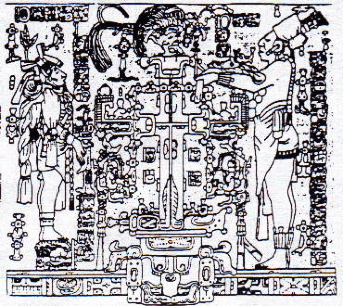
Figure 1 – The Cross of Palenque
As described by Callaway, the principal subject on this Mayan tablet is the cross, which is crowned by a strange bird, there are two human figures on the side of the cross, which appear to be important personages. The symmetry and proportion of the cross appears to be similar to carvings found in Egypt. While both human figures are looking toward the cross, one of them seems to be offering what appears to be a child in sacrifice (Callaway, 2006.)
While the immediate idea could be to find similarities between this symbol and the Christian cross, most archeologists believe that this symbol is the representation of a tree or a corn plant, with symbolism of the connections of the tree to mother earth and as part of the support of life in the world. What appears to be clear in this Mayan symbol, is the representation of mother earth, and the concept of sacrifice, which are in line with the Jungian symbology elements.
The concept of the Tree of Life is heavily present in Mexican culture. There are many examples of this symbol in Mexican ceramic pottery.

Figure 2.- Mexican Tree of Life
The Mexican trees of life normally depict a tree with human figures, and also animals and food, showing the abundance of life on earth and representing the strong ties and respect that indigenous groups from different areas of the country have for mother nature and mother earth.
Even in modern times, the Mexican culture gives a very special place to the mother figure, as the center of the family, and it is very common to find complete families getting together every Sunday to have lunch at home with mother. Most individuals in Mexico still keep strong ties to their place of origin, and many remain in their home towns, close to their parent’s home. When individuals travel and leave their hometowns to find work some place else, they always try to return as many times as possible, and aspire to return back to stay some day. Most of the Jungian symbology of the mother is found in Mexican culture, such as the case of the Trees of Life, the strong ties to the city of origin of the individual, and in religion, the strongest symbol is the Virgin of Guadalupe, known as the Mother of Mexico.
Reflections on C. G. Jung’s Red Book
Introduction
Jung’s Red Book is a description of his encounter with his soul, of struggling with the irrational and unconscious, and with the impossible task of describing it by the way of language and writing, therefore making it objective and somewhat rational in order to be read by others. One cannot avoid to imagine if this work was ever meant to be shared by others, because no matter what was the intent of Jung himself, his views to his soul and his documented experiences will always far short from the real experience. It is, however, a very courageous journey by a man of great sensitivity, allowing all of us to question our own soul, our own unconscious and our meaning. The soul, as Jung describes, possesses qualities that are complementary to the persona, containing those qualities that the conscious attitude lacked. The soul gives rise to images that while are assumed as worthless by the rational mind, they can be used in several ways, such as artistic, philosophical speculation, quasi-religious, and also by “employing the dynamis of these images to squander it in every form of licentiousness”, and also to have some type of psychological utilization of these images.
This paper takes just a few of the concepts presented by Jung in his path of encountering his soul, as described in the Red Book, and will describe some of my reflections and experiences as well, trying to walk the path of “philosophical speculation” which seems to be the path that serves my calling.
Liber Primus – The Spirit of this time and the Spirit of the depths
Very early in the Red Book, in the Liber Primus, Jung talks about the spirit of this time and the spirit of the depths. The description of the spirit of this time corresponds to the spirit of the material world, the modern world, in which technology and economics advances have given humanity the condition that we live today. But, Jung describes how he learned that there is another spirit at work, which “rules the depths of everything contemporary”. Jung describes how “Filled with human pride and blinded by the presumptuous spirit of the times, I long sought to hold that other spirit away from me. But I did not consider that the spirit of the depths from time immemorial and for all the future possesses a greater power than the spirit of this time, which changes with the generations. The spirit of the depths has subjugated all pride and arrogance to the power of judgment. He took away my belief in science, he robbed me of the joy of explaining and ordering things, and he let devotion to the ideals of this time die out in me. He forced me down to the last and simplest things. The spirit of the depths took my understanding and all my knowledge and placed them at the service of the inexplicable and the paradoxical. He robbed me of speech and writing for everything that was not in his service, namely the melting together of sense and nonsense, which produces the supreme meaning.” (Jung, 2009, p.229).
The previous reflection represents a very powerful detail of Jung’s struggle to deal with the scientific views and the forces of the spirit. Initially he uses a dualistic view, in which he implies the existence of the two sides, rational and irrational, possibly hinting on the practicality of one side and unknown value of the other. And in a very intimate way, he describes how the spirit of the depth robbed him of “the joy of explaining and ordering things.” In reality he continued explaining and ordering things all his life, just not all under the current scientific method structures, simply because the scientific method lacks a structure to fit the forces of the spirit. But the most important concept on these reflections is when he describes that the purpose of the spirit of the depths is the “melting together of sense and nonsense, which produces the supreme meaning.” Simply put, what is nonsense today is just something that science cannot yet explain, but is as much part of nature as what has been already explained. The irony of the spirit of this time is that humanity does not much care about explaining things as much as cares for the practical application of things. We do not care to understand how electricity works, but we care that electricity can be transported through wires, and provide light and heat and energy to houses. As long as the side effects of natural phenomena provide some practical application, we are happy. Perhaps the faster way for humans to accept the existence of the forces of the spirit is by showing simple and practical application of them, that can be used to make our world more confortable, and mostly that can generate economic value.
I have lived the same struggle that Jung describes, for more than 40 years in my life I have been living in the modern world, focused in working with technology and for technology, sometimes preferring to spend my days mostly with machines than with humans, and finding joy and comfort in order and structure. I have however always perceived that there is something else in nature, something powerful and invisible, and have even witnessed how the world of spirit influences the material world and technology itself, and how humans have much more power in our minds and consciousness than we even want to accept. I know that someday in the future, the spirit of this time will evolve and become one with the spirit of the depths, in which sense and nonsense are part of the same truth, and part of the same meaning, but in reality they already are, they are the same and part of the same, the spirit of this time and the spirit of all times are one with the spirit of the depth, is just the human ability to understand and to accept that is missing, and is through brave humans such as Jung that showed us the way to look for the truth in the invisible and irrational, that we have the opportunity to consider following the path of knowledge.
Liber Primus – The SoulWhen Jung was forty years old, at the peak of his career, and after having achieved power, wealth, knowledge and honor, as well as what he describes as every human happiness, he describes that his desire to continue increasing those things had ceased, and after having a vision of a flood, he felt he was in contact with the spirit of the depths. While being under this influence he said: “My soul, where are you? Do you hear me? I speak, I call you – are you there? I have returned. I am here again. I have shaken the dust of all the lands from my feet, and I have come to you. I am with you. After long years of long wandering. I have come to you again. Should I tell you everything I have seen, experienced and drunk in? or do you not want to hear about all the noise of life and the world? But one thing you must know; the one thing I have learned is that one must live this life.” And later on he continues: “ Life has led me back to you. Let us thank the life I have lived for all the happy and all the sad hours, for every joy, for every sadness. My soul, my journey should continue with you. I will wander with you and ascend to my solitude.” (Jung, 2009, p. 232)
With this description, written by Jung while under the influence of the spirit of the depths, he acknowledges several important aspects. First of all, he realizes that at some early point in time he was in contact with his soul, and then he lost this contact and became involved in the material world for many years. His wanderings through the material world were done out of touch with his soul. He talks to his soul as if this was a separate entity, and as if the soul had not been with him during his life. But one must wonder, was the soul separated from Jung at that time? Or was it just that Jung was not aware that his soul was with him? Most probably was his focus on the external world that made him blind and deaf to his own internal world, in which his soul had always been present. As he describes later in the book, the spirit of the depths considers the soul as a living and self-existing being, in contradiction with the spirit of the times which sees the soul as something that depends on man, which “lets herself be judged and arranged, and whose circumference we can grasp.”
On a later dialogue with his soul, Jung acknowledges that his soul had been with him all along his journey, he say: “I am weary, my soul, my wandering has lasted too long, my search for myself outside of myself. Now I have gone through events and find you behind all of them…. I found you where I least expected you. You climbed out of a dark shaft. You announced yourself to me in advance in dreams. They burned in my heart and drove me to all the boldest acts of daring, and forced me to rise above myself. You let me see truths of which I had no previous inkling. You let me undertake journeys, whose endless length would have scared me, if the knowledge of them had not been secure in you.” (Jung, 2009, p. 233). So with this reflection, Jung acknowledges that his soul had been with him all his life, silently
guiding him and giving him support to embark on his actions, and silently providing him with his internal compass to pursue his mission in life.
Liber Secundus – The Red One
In this section Jung describes a vision in which he is a tower guard, and is standing on the highest tower of a castle. From that place he sees a red horseman that is coming to the castle from afar, the red horseman enters the castle and gets up to the tower to meet Jung. At this point Jung describes that he feels fear and that he believes this red character must be the devil. They get into conversation about theology, Christianity and even the morality of dancing. At an important moment in the conversation, Jung tells the red character: “I would before God always like to be a serious and true to myself as I try to be. However, that certainty becomes difficult in your presence. You bring a certain gallows air with you, and you’re bound to be from the black school of Salerno.” Where pernicious arts are taught by pagans and the descendants of pagans.” (Jung, 2009, p. 259).
In the end, Jung concludes that this red devil represents joy. He describes: “Surely this red one was the devil, but my devil. That is, he was my joy, the joy of the serious person, who keeps watch alone on the high tower – his red-colored, red-scented, warm bright red joy.” (Jung, 2009, p. 260).
This description of Jung’s encounter with the red one describes several important aspects of Jung’s personality and thoughts. It is interesting to observe how he must relate joy with the devil, indicating a very rigid Christian idea that joy must me something bad. He describes his joy as “the joy of a serious person”, and how he always wants to be serious and true to himself before God. So, Jung is describing that he always wants to show himself as a serious person, with very little chance of achieving joy, because joy, including as an example the specific activity of dancing is something bad and must be limited. His conversation with the red one brings Jung to the conclusion that he is always rigid in his seriousness and his strict Christian disciplines and he gives little opportunity for enjoying the pleasures of life. However, even if in the end he reflects that joy is important to experience the wholeness of life, he concludes that joy is always “risky to accept because it leads us to life and its disappointments” (Jung, 2009, p. 261).
I can relate to Jung in regards to live always in a way that the rest of the people around me can perceive me as a serious person, as somebody that is reliable and that can be trusted. I can also see how trying to maintain such a rigid image can tend to generate that in many ways, joy is not part of the normal condition, but is something that occurs only in spare time and very seldom, and even believe that feeling joy is something that has no real practical use and can be considered a waste of time. In regards to relating joy with the devil, and to consider that joy is something bad, I believe this is strictly representative of Jung’s Christian tradition which is somewhat extremist, to the point in which dancing can be considered something that is bad, and that tends to involve negative feelings and emotions.
Divine Folly – Chaos and more conversations with the soul
In the Divine Folly section, and the Nox secunda, tertia and quarta, Jung starts by visualizing himself entering a library, and has a conversation with the librarian in regards to the book ‘The Imitation of Christ’” by Thomas a Kempis. Throughout these sections Jung’s unconscious struggles with the teachings of this book,
including detailed conversations with other characters, such as a fat woman cook, that describes how her mother use to read the same book and left it to her after she died. Jung deals with the issues of chaos, the past which he refers to as the dead, and many reflections in regards to Christianity and Christ himself. In Nox quarta, Jung has another important direct contact with his soul, and he mentions, “My soul speaks to me in a bright voice: ”The door should be lifted off its hinges to provide a free passage between here and there, between yes and no, above and below, between left and right. Airy passages should be built between all opposed things, light smooth streets should lead from one pole to the other. Scales should be set up, whose pointer sways gently. A flame should burn that cannot be blown out by the wind. A stream should flow to its deepest goal. The herds of wild animals should move to their feeding grounds along the old game paths. Life should proceed, from birth to death, from death to birth, unbroken like the path of the sun. Everything should proceed on this path.” (Jung, 2009, p. 302).
This is a very important passage in which Jung defines a dualistic paradigm, when he describes the different pairs of opposites, but the most important aspect here is to see how Jung describes that there must be free movement between the two opposites, rather than remaining tied to just one of the poles. He defines the need to find a balance even with the detailed use of a scale. This reflection determines how there is a continuous and smooth flow between the two opposites. When he describes the flow of life from birth to death but then from death to birth he is providing the idea that this flow can be in both directions, and not just in the direction of birth to death. In a way, Jung is raising the possibility that time flows in two directions, and not just only from past to present to future.
The Magician
In this section of the Red Book, Jung meets Philemon, who is an old magician, and enters in a conversation with him in regards to the nature of magic. Philemon describes magic as being “everything that eludes comprehension” and Jung struggles with this concept because he tries to use reason to understand it. Philemon tells Jung that reason declines with old age, therefore giving more space to magic later in life. After his meeting with Philemon, Jung continues to reflect about magic, and he says: “The practice of magic consists in making what is not understood understandable in an incomprehensible manner. The magical way is not arbitrary, since that would be understandable, but it arises from incomprehensible grounds. Besides, to speak of grounds is incorrect, since grounds concur with reason. Nor can one speak of the groundless, since hardly anything further can be said about this. The magical way arises by itself. If one opens up chaos, magic also arises.” (Jung, 2009, p. 314).
Philemon helps Jung to understand the existence of things outside of the explanations provided by science. Being that Jung was a scientist he tried to apply reason to any subject, and tried to always maintain the reference toward the scientific method when observing nature. This seems to be the paradigm in which young individuals operate in the world today. In today’s society, the rational view and scientific methods are needed for individuals to maintain credibility, grow, be accepted and achieve success, at least certain type of materialist success, as a natural expectation of a career path for most everyone.
Philemon indicates that magic tends to appear in individuals at an older age, once reason is not as important to compete in the world. It appears that with age the individual stops being concerned about his or her credibility, finding less necessary to prove anything to anybody and has less issues entering a space as subjective as magic. The older individual is more open to accept the existence of hidden things in the world, and does not seem the need to force the issue into reasoning and structure.
I have seen this pattern in the space of business education. In the traditional MBA programs, that are more directed toward younger students, the content of the classes follow traditional methods, and it is the strict transition of knowledge from teacher to student. However, in executive programs and seminars, which are directed toward older students, it is not unusual to find that some topics such as meditation, intuition and other subjective elements are part of the programs. These topics happen to be presented only to older audiences, which seem to have less trouble to learn them and use them, even if they don’t fit the objective view of the world. Top business programs at Stanford and MIT, presented by the leader professors in the field, approach creativity through meditation and inner awareness exercises, and promote the connection of the individuals to the larger community and to nature in a holistic way. It is most probable that these teachings and topics are not part of the standard study curricula for younger students because in general they might not be at a maturity level that is necessary to understand them. Perhaps this maturity comes only during the second half of life, in line with Jung’s observations.
Conclusion – My experience with the Red Book
Jung’s Red Book is a fascinating description of his contact with the soul, the unconscious and most certainly with the universal consciousness that is part of all humankind and that in the future perhaps could be accessible by every individual. With this in mind, Jung was a pioneer in discovering a new world, a world that is much more larger than the physical world. The Red Book is by far the most complicated work of Jung, and it shows some of the elements and characteristics of the work of individuals that through history might have been identified as being illuminated. This book has only been recently published and is just starting to be studied by the experts in the field, most probably it will take a few years to achieve understanding of it, but most certainly it will position Jung as one of the brightest minds in human history.
My experience with the Red Book has been complicated and confusing. Sometimes when trying to read it, has been a very easy engagement, and the reading has been clear and simple, perhaps too simple, as when reading a children’s book. Sometimes it has been extremely hard, and it has felt like hitting a stone wall, and I have been required to stop and leave the reading for some other time. Most of the time, however, when I have been able to focus and engage properly in the readings, I have felt a very close connection to Jung, and have become a participant in his journey, particularly when he describes his reconnection with the soul, and when he engages and has conversations with all the different characters. In all fairness, this is
just a humble beginning in a long process of learning from the Red Book. I am certain that it will require me to study it in much more detail, and that every time I will find many new things to understand and expand upon. I am certain that it will also be a guide for me to determine my own path in searching my own connection to the soul and to the collective unconscious.
References
Jung, C. G. (2009) The Red Book, Liber Novus, Edited by Sonu Shamdasani. New York, NY: W.W. Norton & Company
Jung’s Complementary Psyche
In order to understand in more detail the way our minds become polarized, and be able to define potential solutions to the problem of polarized minds, I will provide an analysis of the basis in which C.G. Jung described the way the human psyche is formed using a Complementarity-based approach.
It is important to address once again how Jung was paying attention to the opposites since his early writings. His book: Two Essays on Analytical Psychology (1953) includes, as its first essay: On the Psychology of the Unconscious, written in 1917, In which Paragraph 78 of the book approaches the opposites as follows:
“It has become abundantly clear to me that life can flow forward only along the path of the gradient. But there is no energy unless there is a tension of opposites; hence it is necessary to discover the opposite to the attitude of the conscious mind. It is interesting to see how this compensation by opposites also plays its part in the historical theories of neurosis: Freud’s theory espoused Eros, Adler’s the will to power. Logically, the opposite of love is hate, and Eros, Phobos (fear); but psychologically it is the will to power. Where love reigns, there is no will to power; and where the will to power is paramount, love is lacking. The one is but the shadow of the other: The man who adopts the standpoint of Eros finds his compensatory opposite in the will to power, and that of the man who puts the accent on power is Eros.
Seen from the one-sided point of view of the conscious attitude, the shadow is an inferior component of the personality and is consequently repressed through intensive resistance. But the repressed content must be made conscious so as to produce a tension of opposites, without which no forward movement is possible. The conscious mind is on top, the shadow underneath, and just as high always longs for low and hot for cold, so all consciousness, perhaps without being aware of it, seeks its unconscious opposite, lacking which it is doomed to stagnation, congestion, and ossification. Life is born only of the spark of opposites.” (Paragraph 78).
The importance of the relationship between pairs of opposites is here confirmed, as a necessary condition for movement, activity, and for life itself. The consistent theme with previous observations is the activity between conscious and unconscious, which form a complementary pair of opposites, and the existence of the shadow as an element of the unconscious part, which has a part that is unknown to the conscious and needs to be brought to the front of consciousness in order for the individual to go through the action of processing the opposites and grow and mature towards individuation. This description provides us with the basis to look at the overall human psyche according to Jung, and to evaluate it in complementary terms.
A Complementary View of Jung’s Psyche
One of Jung’s main developments to psychology is his work on a model of the psyche. As Jung’s basis to the structure of Analytical Psychology, he gives the unconscious a very important place in the framework of the psyche. On his book: The Archetypes and the Collective Unconscious (1959, 1), he describes his basic thoughts about the unconscious and the concept of “analytical treatment” as follows:
“The relation between the conscious and the unconscious on the one hand, and the individuation process on the other, are problems that arise almost regularly during the later stages of analytical treatment. By ‘analytical’ I mean a procedure that takes account of the existence of the unconscious.” (Paragraph 489).
We observe here the importance that Jung gives to his concept of Individuation, which he defines in the next paragraph of the book:
“I use the term ‘Individuation’ to denote the process by which a person becomes a psychological ‘in-dividual,’ that is, a separate, indivisible unity or ‘whole.’ It is generally assumed that consciousness is the whole of the psychological individual. But knowledge of the phenomena that can only be explained on the hypothesis of unconscious psychic processes makes it doubtful whether the ego and its contents are in fact identical with the ‘whole.’ If unconscious processes exist at all, they must surely belong to the totality of the individual, even though they are not components of the conscious ego. If they were part of the ego, they would necessarily be conscious, because everything that is directly related to the ego is conscious. Consciousness can even be equated with the relation between the ego and the psychic contents.” (Paragraph 490).
Being Jung’s model of the psyche of such importance for all the framework of Analytical Psychology, and given my thesis that the human psyche is a complementary structure, I will analyze next his model with the lens of Complementarity philosophy, while at the same time, attempting to simplify and clarify Jung’s model:
The model of the human psyche developed by Jung appears to be a set of complementary elements formed by several layers having structured simple complementary pairs, and higher levels of “complementary pairs of pairs,” which previously I described as “complex complementary pairs.”
Prior to the definition of the layers, I would suggest the clarification of what Jung calls “consciousness” which he seems to equate just to the portion considered “conscious” of the psyche. I propose that “Consciousness” is the high-level entity, which includes both the “conscious” and the “unconscious” elements of the psyche.
Then, the first, or ‘top’ layer is the overall entity of Consciousness, which is built by the pair of opposites: conscious ~ unconscious, forming a binary relationship.
The second layer consists of two groups of parts, one group forming the conscious element, and another group forming the unconscious element.
The Conscious Element
The conscious element is formed by a complementary relationship of three parts: The Persona, the ego and part of the Self, or the triad: Persona ~ Ego ~ Self. Parts that are defined as follows:
Persona – The “I,” usually ideal aspects of ourselves, that we present to the outside world. As pointed by Jung on his book: Psychological Types (1971):
“The Persona is …a functional complex that comes into existence for reasons of adaptation or personal convenience, but is by no means identical with the individuality. The persona is exclusively concerned with the relation to objects” (Paragraph 801).
And on the book: The Archetypes and the Collective Unconscious (1959, 1), Jung says:
“Every calling or profession, for example, has its own characteristic persona…. One could say, with a little exaggeration, that the persona is that which in reality one is not, but which oneself as well as others think one is.” (Paragraph 221).
Hence, Persona is the face that we present to the world, but this face is not the totality of who we are as individuals.
Ego – The central complex in the conscious field. The ego comes into existence as a complex quantity which is constituted partly by the inherited disposition (character constituents) and partly by unconsciously acquired impressions and their attendant phenomena.
On Jung’s book: Civilization in Transition (1964), he mentions:
“Most people confuse ‘self-knowledge’ with knowledge of their conscious ego-personalities. Anyone who has any ego-consciousness at all takes it for granted that he knows himself. But the ego knows only its own contents, not the unconscious and its contents. People measure their self-knowledge by what the average person in the social environment knows of himself, but not by the real psychic facts which are for the most part hidden from them.” (Paragraph 491).
Jung considered the Ego as the center of the conscious. The ego is important for the person to compete in the world, and is the source of motivation and success in life, however, when the person is excessively focused on the ego, a negative phenomena called “inflation” occurs.
Self – For purposes of this model, the Self is an element of the psyche that is formed by a part of the conscious and a part of the unconscious, being the center of the psyche. However, in Jung’s definitions, the Self is considered the archetype of the Wholeness, and is closer to what we have defined as “Consciousness” above. Being the most complex of all of the elements of the psyche, the Self is defined by Jung, on his book: Psychological Types (1971), as:
“… an empirical concept, the self designates the whole range of psychic phenomena in man. It expresses the unity of the personality as a whole. But in so far as the total personality, on account of it unconscious component, can be only in part conscious, the concept of the self is, in part, only potentially empirical band is to that extent a postulate. In other words, it encompasses both the experienceable and the inexperienciable (or not yet experienced).” (Paragraph 789).
And also:
“Just as conscious as well as unconscious phenomena are to be met with in practice, the self as psychic totality also has a conscious as well as an unconscious aspect. Empirically, the self appears in dreams, myths, and fairytales in the figure of the ‘supraordinate personality’ (v. EGO), such as a king, hero, prophet, saviour, etc., or in the form of a totality symbol, such as the circle, square, quadratura circuli, cross, etc. When it represents a complexio oppositorum, a union of opposites, it can also appear as a united duality, in the form, for instance, of tao as the interplay of yang and yin, or in the hostile brothers, or of the hero and his adversary (arch-enemy, dragon), Faust and Mephistopheles, etc. Empirically, therefore, the self appears as a play of light and shadow, although conceived as a totality and unity in which the opposites are united.” (Paragraph 790).
An important characteristic of the Self is the condition that some of its experiences have “a numinous element,” which connects with spiritual and religious revelations. Jung believed that there is a correlation between the Self as a psychological reality and the concept of a “supreme deity.” In Two Essays on Analytical Psychology (1953), Jung says:
“(The Self) … serves to express an unknowable essence which we cannot grasp as such, since by definition it transcends our powers of comprehension. It might equally well be called the “God within us.” The beginnings of our whole psychic life seems to be inextricably rooted in this point, and all our highest and ultimate purposes seem to be striving towards it. This paradox is unavoidable, as always, when we try to define something that lies beyond the bourn of our understanding.” (Paragraph 399).
In summary, the Conscious part of the psyche is the triad: Persona ~ Ego ~ Self. The Persona is the main element in contact with the material world, together with the Ego, while the Self is at the center of the Conscious, and having a part of itself in the Conscious, it is also present on the Unconscious, so for practical purposes we can say that half of the Self is on the Conscious side, and half of the Self is on the Unconscious side. Using Jung’s concepts, we can assume that the Self is the element that manages the relationship between Conscious and Unconscious through the action of the Transcendent Function.
Transcendent Function – A psychic function that arises from the tension between consciousness and the unconscious and supports their union … In a conflict situation, or a state of depression for which there is no apparent reason, the development of the transcendent function depends on becoming aware of unconscious material. This is most readily available in dreams, but because they are so difficult to understand, Jung considers the method of active imagination – giving “form” to dreams, fantasies, etc. – to be more useful, (Sharp, 1991).
The Unconscious Element
The Unconscious element is much more complicated than the Conscious. In following Jung’s models, we find at least two possible options of groups of parts that can be included in the Unconscious, both group options are different complementary relationships. The first option is simpler, and considers the complementary relationshipof the Shadow, the Anima/Animus, and a portion of the Self (the unconscious portion of the Self), being the triad: Shadow ~ Anima/Animus ~ Self. However, there are at least two other parts that appear to be part of the Unconscious: Personal Unconscious and Collective Unconscious. The graphical depictions of Jung’s models, show the simpler triad of Shadow ~ Anima/Animus ~ Self, embedded into larger elements for the Personal and Collective Unconscious, however, my suggestion is to consider the Unconscious as an element that consists of a complementary relationship of at least five parts: Shadow ~ Anima/Animus ~ Self ~ Personal Unconscious ~ Collective Unconscious. These five, or in reality six (considering Anima and Animus as separate items) parts, combine together and all are necessary to form the Unconscious. The definitions for these parts are the following:
Shadow – Hidden or unconscious aspects of oneself, both good and bad, which the ego has either repressed or never recognized (Sharp, 1991), and as per Jung’s definition, on his book: Aion: Researches into the Phenomenology of the Self (1959, 2):
“The shadow is a moral problem that challenges the whole ego personality, for no one can become conscious of the shadow without considerable moral effort. To become conscious of it involves recognizing the dark aspects of the personality as present and real. This act is the essential condition for any kind of self-knowledge, and it therefore, as a rule, meets with considerable resistance. Indeed, self-knowledge as a psychotherapeutic measure frequently requires much painstaking work extending over a long period.” (Paragraph 14).
Anima – The inner feminine side of a man. The anima is both a personal complex and an archetypal image of woman in the male psyche. It is an unconscious factor incarnated anew in every male child, and is responsible for the mechanism of projection. Initially identified with the personal mother, the anima is later experienced not only in other women but as a pervasive influence in a man’s life. (Sharp, 1991).
The Anima (and the Animus) are one of the most complicated parts of the human psyche. We can determine that the Anima and Animus, such as the dichotomy male ~ female, form the complementary pair of opposites: Anima ~ Animus.
The simplest description provided by Jung on The Archetypes and the Collective Unconscious (1959, 1) is as follows:
“… she is not characteristic of the unconscious in its entirety. She is only one of its aspects. This is shown by the very fact of her femininity. What is not-I, not masculine, is most probably feminine, and because the not-I is felt as not belonging to me and therefore as outside me, the anima image is usually projected upon women.” (Paragraph 58).
The Anima, being such a complicated element, needs its own section to analyze all of its details. For now we can summarize it as being everything that is not masculine in a man (or whatever is feminine in a man), and even if it is part of the individual’s unconscious, given that it is perceived as not being part of the male individual, being the feminine part of the male individual, it is projected into other women.
Animus – To provide the required balance to the dichotomy male ~ female, the Animus is the inner masculine side of a woman. Similarly to the Anima in men, the Animus is both a personal complex as well as an archetypal image in women. The Anima in men functions as their soul, but the Animus in women functions as an unconscious part of the mind. It has a negative manifestation in fixed or stubborn ideas, or a priori assumptions that lay claim to absolute truth. “In a woman who is identified with the Animus (called animus possession), Eros generally takes second place to Logos. (Sharp, 1991). Here, we see the appearance of one more complementary pair: Eros ~ Logos, which we will analyze later.
Self – As described in the Conscious section, the Self is an element of the psyche that is formed by a part of the conscious and a part of the unconscious. The part of the Self that is unconscious is hidden from the Ego and from the overall Conscious, and interacts with the Unconscious elements of the Shadow and the Anima/Animus.
Personal Unconscious – The personal layer of the Unconscious, distinct from the Collective Unconscious (Sharp, 1991). The Personal Unconscious keeps everything that is in the psyche of the individual and that is not accessible to the conscious. Items like lost memories, repressed memories, painful ideas that get ignored and hidden (forgotten or purposely ignored), subliminal information, and anything that is in the psyche that is not accessible to the conscious mind.
Collective Unconscious – The layer of the human psyche that contains elements that are available to all other humans, elements that are part of the culture, that cannot be explained on the basis of personal experience, such as “the whole spiritual heritage of mankind’s evolution.” (Sharp, 1991).
On Jung’s book: The Structure and Dynamics of the Psyche (1970), he mentions:
“The collective unconscious – so far as we can say anything about it at all – appears to consist of mythological motifs or primordial images, for which reason the myths of all nations are its real exponents. In fact, the whole of mythology could be taken as a sort of projection of the collective unconscious … We can therefore study the collective unconscious in two ways, either in mythology or in the analysis of the individual.” (Paragraph 325).
In general terms, the personal unconscious is individual, while the collective unconscious is universal. The contents of both are unreachable to the conscious mind, they can influence the individual’s behavior in an unconscious way, through dreams, psychosis, or more complex psychological issues.
In addition to all of these parts that form the psyche, there are two components that do not form complementary relationships in the psyche, but they are important because they can influence behavior is the personality of the individual and affect the psyche. These are the Complexes and the Archetypes.
Complex – An emotionally charged group of ideas or images (Sharp, 1991).
As described by Jung on his book: The Structure and Dynamics of the Psyche (1970):
“Complexes interfere with the intentions of the will and disturb the conscious performance; they produce disturbances of memory and blockages in the flow of associations; they appear and disappear according to their own laws; they can temporarily obsess consciousness, or influence speech and action in an unconscious way. In a word, complexes behave like independent beings.” (Paragraph 253).
The Complexes exist mainly in the Personal Unconscious, but they influence the individual behavior in a way that cannot be controlled consciously. They can develop psychosis in the individual, and they cannot be eliminated but only identified and compensated through therapy.
Archetypes – Primordial, structural elements of the human psyche (Sharp, 1991).
Regarding the Archetypes, on his book: Civilization in Transition (1964), Jung indicates:
“… the archetypes are as it were the hidden foundations of the conscious mind, or, to use another comparison, the roots which the psyche has sunk not only in the earth in the narrower sense but in the world in general. Archetypes are systems of readiness for action, and at the same time images and emotions. They are inherited with the brain-structure – indeed, they are its psychic aspect. They represent, on the one hand, a very strong instinctive conservatism, while on the other hand they are the most effective means conceivable of instinctive adaptation …. The psychic influence on the earth and its laws is seen most clearly in these primordial images.” (Paragraph 53).
The Archetypes are present in the Collective Unconscious, but similarly to the Complexes, they have unconscious influence over the individual’s behavior. In normal life, archetypal patterns can be identified in individuals, such as the behavior patterns of the hero, the child, the wise old man (or woman), the trickster, etc.
Summary of the Complementary Psyche
We have provided a summarized description of the elements of the human psyche, showing its different layers, consisting of different levels of complementary relationships. The following is the summarized complementary structure of the psyche:
Jung’s Model of the Psyche (A Complementary View)
Layer 1 – Consciousness
Conscious ~ Unconscious
Layer 2 – Conscious: Persona ~ Ego ~ Self
Unconscious: Shadow ~ Anima/Animus ~ Self
Layer 3 – Personal Unconscious ~ Universal Unconscious
A more summarized model of the psyche shows the three layers as:
Layer 1 – Conscious (or Consciousness)
Layer 2 – Personal Unconscious
Layer 3 – Universal Unconscious
The complementary nature of the psyche is shown when evaluating the different elements and observing how they, being opposites, form complementary relationships, such as the case of the Consciousness, which is formed by the relationship of Conscious and Unconscious. These being opposites, both being required to form the Consciousness and both being invisible to each other, same as the nature of light, being formed by waves and particles, each one unaware of the other.
I have performed this summarized analysis of the psyche model developed by Jung, to suggest its complementary nature and to provide an operational explanation. One thing is true, the psyche and the nature of the behavior of its different components is quite complex, and it requires more than just a binary (Boolean) relationship to understand.
Jung’s Interpretation of Fairytales – The Spirit in the Bottle by Jakob and Wilhelm Grimm
Introduction
Carl Jung spent a good amount of time studying fairy tales, he believed that they are the purest and simplest expression of collective unconscious psychic processes, and that they represented the archetypes in their simplest, barest, and most concise form (Von Franz, 1970). Since there is no possibility of translating the content of every archetype into intellectual terms, the fairy tales is one of the best explanations available for the study of the unconscious, and they describe the same psychic facts, repeated throughout many different variations of the same tales in different cultures and geographies.
This paper performs the interpretation of one example fairy tale, “The Spirit in the Bottle” by Jakob and Wilhelm Grimm, following the method defined by Jung’s heir, Marie-Louise von Franz.
Von Franz’s Method of Psychological Interpretation
In Von Franz’s method, the archetypal story is divided into the four stages of the classic drama, the exposition, the people involved or dramatis personae, the naming of the problem, the ups and downs of the story or peripeteia. After these stages are determined, a comparison is made to determine if this theme occurs in other tales, including a process of amplification by enlarging through collecting a quantity of parallels, then construct the context of the story and then the last essential step of performing the interpretation, or translating the amplified story into psychological language.
It is important to note, however, that the interpretations of fairy tales are relative, and the psychological language to be used is about what the story might seem to represent, trying to find agreement with other people’s interpretation and also with our own dreams. In the end, for the interpretation to be satisfactory, it must generate a validating answer from the psyche.
Summary of the Tale
A poor woodcutter had an only son, and he saved some money to send the son to school, so the son could support him when he got old. The son went off to school and was a good student who received praise from his teachers, but after two classes the money his father gave him ran out, and the boy was required to return home. The father told him that he was not able to earn more money than to pay for their daily bread, but the son told him, “Dear father, don’t trouble yourself about it, if it is God will, it will turn to my advantage.” The father wanted to go into the woods to chop and stack wood and earn more money, and the son wanted to go with him and help him. The father did not want the son to go, arguing that he was not accustomed to rough work, and besides he did only have one axe, but the son said that he could borrow an ax from the neighbor until he could earn enough money to buy his own.
During the first day of work the son was quite merry and brisk, and at noon, the father said they should rest and have their meal, and then get back to work. The son said that rather than resting, he wanted to go into the forest and look for bird’s nests, and the father told him that he would be a fool by doing that, since he would be tired and he would not be able to work in the afternoon, and told his son to sit besides him.
The son went into the forest anyway and after a while he found a very old and dangerous-looking oak tree. When he got closer to the tree he heard a voice saying: “Let me out, let me out!. He followed the voice and found that it came from the ground, amongst the roots of the oak-tree. The boy began to loosen the earth under the tree and after a while he found a glass bottle, and inside the bottle he saw a creature shaped like a frog. The creature continued to yell “Let me out, let me out! And the boy without thinking anymore removed the cork and immediately a spirit ascended from the bottle until it grew as big as half the tree. Once out, the spirit told the boy that he would give him the reward for having letting him out, and this reward was to strangle him. The boy told the spirit that he should have told him that sooner, and he should have let the spirit inside the bottle. The spirit said that he was the mighty Mercurius, and that he was shut up inside the bottle for a long time as a punishment, but regardless he should strangle whoever released him from the bottle. The boy told the spirit that first he wanted to be sure that he was the right spirit, and that he should verify that he could fit inside the bottle, so he asked the spirit to prove it and get back inside the bottle. The boy deceived the spirit and as soon as the spirit got into the bottle he thrust the cork back into the bottle and threw the bottle amongst the roots of the tree. The boy was about to leave but the spirit told him once again to release him, but the boy told the spirit that he would not release him twice since he wanted to take his life. The spirit, however, told him that if he was released, he would give the boy so much that he would have plenty all the days of his life. The boy insisted he would not release the spirit but the spirit said again that he would not do the boy any harm but reward him richly. The boy decided to take the chance, and released the spirit once again. The spirit went out of the bottle and grew again as big as a giant. The spirit gave the boy a little rag, just like sticking-plaster, and told him that if he spread one end of the rag over a wound it would heal, and if he rub steel or iron with the other end it will be changed into silver. The boy tested the rag by tearing off a piece of bark from a tree and then using the rag to heal the wound and it did heal. So they thanked each other and the boy went back to his father. His father gave the boy a hard time because he had been away for so long, and had some hard words for the boy about “he always knowing that the boy would never come to anything”. The boy wanted to get back to work and he swiped his axe with the rag and hit the tree, but since the axe turned into silver its edge bent, and the father was angry again since he was required to pay the axe back to the neighbor. The boy wanted to leave the forest but he did not know his way out and he asked the father to go with him. Then the father got angry again because the boy did not want to work anymore but finally he agreed and they went back home. When they got back home the father told his son to go and sell the damaged axe, so he would kmnow how much more money would he have to earn to pay back the neighbor, but the boy went and sold the axe to a goldsmith, and since it was made of silver, he got plenty of money to pay back for the axe and to live well. The father was surprised to find out that the boy had so much money and the boy told him his story. With the money he got left, the boy went back to school and since he could use the rag to heal wounds, he became the most famous doctor in the world.
Interpretation of Grimm’s The Spirit in the Bottle
The exposition – the definition of time and place, mostly defining a situation of timelessness and spacelessness. In this tale, time is defined by “There was once” at the beginning of the story, and place is somewhat undetermined. After further reading, it can be implied that the people involved lived in a small town that did not have a High School, and that the town is somewhat close to a forest.
The People Involved (Dramatis Personae) – With the recommendation of counting the number of people at the beginning and at the end of the story. For our tale, there are two persons involved at the beginning, the Woodcutter and his son. Later in the story the spirit appears, in the shape of a frog, trapped inside a bottle. Some secondary characters are mentioned, such as the neighbor who owns the axe borrowed by the father so they can go to the forest to chop and stack wood, and later a goldsmith, who bought the silver axe from the son. The story ends with the same two main characters, the father and the son. In reality, the two main characters of the story are the father and the son, and the way the relationship is among them.
The naming of the problem – The story describes two different problem conditions, the first problem was that the father and son were very poor, and the father gave the little money he had to send his son to High School. The boy went to school and returned home when the money ran out. The father said that he could not give the son any more money since he could only earn enough for the daily bread. The second problem occurs when the boy releases the spirit and he is threatened by the spirit with stranglement , so the problem is that the boy is in risk of losing his life. However, this represented mostly an opportunity in which the boy’s intelligence made things change in his favor and he ended up finding solution to their economic problems forever.
The peripetia, or ups and downs of the story – The story seems to have a few peripeteiai. First in the economic sense, the boy was given money to go to school, then the money ran out and he was required to leave school, next the boy was required to help his father and by doing this he was able to find the spirit. The spirit ended up rewarding him economically such that the boy was able to get back to school and the economic problems of both the boy and the father were gone forever. A second thread occurs with the relationship between the father and the boy. First of all, the father seemed to want his boy to succeed and live a different life than his own, and he gave the boy his savings for the boy to go to school. However, when the boy came back after the money ran out, he consistently gave negative messages to the boy, saying things like “I always said that you would never come to anything” and “Do you think I will sit with my hands lying in my lap like you?” which appears to mean that he had lost hope in his son and his abilities to succeed. The boy, however, consistently maintains a positive attitude and even at a key moment, he says: “ Dear father, don’t trouble yourself about it, if it is God’s will, it will turn to my advantage” which demonstrates that he had a strong faith in things getting better. Also, at the end the story takes a positive turn, since the boy was able to find a way out of the economic problems, but most importantly, he used the reward given by the spirit to do good deeds for others, becoming the most famous doctor in the whole world since he could heal all wounds with his plaster.
Psychological interpretation of the story
This story has comparative tales, mainly the one about Aladdin and the magic lamp, in which a genie is released from inside a lamp by a boy, and the genie ends up giving three wishes to the boy as a reward. Also, the stories describing a father and son, or sons relationship seems to have parallel in several other stories.
I believe one of the main psychological symbols described in the story is the hero archetype. The boy represents the hero, and he proceeds through his life and conditions with a clear optimism and without being affected by the negative or pessimistic comments of his father. As described by Samuels, “the image of the hero embodies man’s most powerful aspirations and reveals the manner in which they are ideally realized (Samuels et. al., 1986). The boy demonstrates always a good disposition on things, and his positive attitude ends up in the universe delivering fortune and all benefits to him. One very important note to me is that he maintains humility and never complaints about the need to work hard, to have limited resources, etc. and in the end he uses the gifts he received for the benefit of others, which appears to me as the real reason why he was awarded the gifts. It might be that if he would have been after fortune for his own personal benefit, he would have found himself with nothing in the end. The hero figure represents the WILL and capacity to seek and undergo repeated transformations in pursuit of WHOLENESS or MEANING (Samuels et. al., 1986).
The character represented by the father is to me a changing archetype, symbolizing a shift between a “good” father and a “bad” father symbol, but mainly representing the symbol of a “maternal monster” giving pressure to his son, “the hero” and risking his regression (Samuels, et. al, 1986). First he seems to have a sincere interest in his son’s well being and improvement for the future when he sends his son to school by sacrificing all his savings, but later, when the son comes back home and they end up working together, the father consistently gives the boy negative feedback, and even some comments that could have affected the boy greatly, such as telling him things like “I always said that you would never come to anything”. It is only the boy’s consistent positive attitude that makes him immune to these comments.
Finally, an important symbol in the story is that of the trickster archetype, represented by the spirit in the bottle. The spirit introduces himself in the story as Mercurius, who Jung found to have the closest resemblance to the trickster figure, “having a fondness for sly jokes and malicious pranks, power to change shape, a dual nature (half animal/half divine), the urge for unremitting exposure to privation and torture as well as an approximation to the figure of a savior” (Samuels et. al., 1986).
Since the spirit first begs to be released, and then he wants to punish his savior, the boy, to end up agreeing with the boy and delivering gifts in exchange for his second release. He falls into the boy’s game when he gets back into the bottle because he needed to demonstrate his power by doing this, without stopping to think that he was being tricked by the boy. In this particular point of the story, the boy demonstrated a level of mental sharpness as he was able to beat the spirit tricks, but also he demonstrated a level of willingness to take risks, weighing his odds and his current conditions vs. the risk of being punished by the spirit in the end. Finally, the spirit demonstrated honesty by complying with his part of the deal after being released a second time.
References
Grimm, J. & Grimm W. (1944) The Complete Grimm’s Fairy Tales, New York, NY: Pantheon Books
Von-Franz, M.L. (1970) The Interpretation of Fairy Tales, Boston, MA: Shambala Publications Inc.
Samuels, A., Shorter B. & Plaut F. (1986) A Critical Dictionary of Jungian Analysis, New York, NY: Routledge
David Bohm’s Fragmentation and Social Polarization
As a follow up on the analysis of Complementarity, I will expand the limits of the concept from the traditional view to a much wider application. The idea behind this effort is to maximize the opportunities that integration and addition provide us, in comparison to differentiation and substraction, trying to describe the power of “building from” or “building upon” instead of falling in the trap of breaking down everything into smaller parts, minimizing each one of those parts. In a literal way, but also in a metaphorical way, I will make my best effort in showing that human progress will be much faster and greater by collaborating and adding strengths, than by embracing conflict and competition as is the rule of the dominating paradigm. A few years back, I found a T-shirt that I really liked. It had an image of a forest, and the message: “Forget the box, just think outside”. This is a great message to represent this effort, let’s think outside, no box, no dogma, no artificial limitations. Walk ahead with curiosity, imagination and most of all, open minds.
Wilczek (2021) has shown an open mind that is uncommon in science, particularly in Physics, and this is a reason to have hope, to see a crack in the hard shell of the scientific dogma, through which the light of a new paradigm might have a chance to appear.
Some scientists in history have been rebels against the established dogma. The few brave ones have normally lived their lives under pressure and with little recognition, if any, from the scientific communities. One of the main examples is David Bohm. A first class mind, described by Einstein as his successor while working together in Princeton, Bohm was victim of the political anti-communist hysteria of the 1950’s, and when he refused to declare against Robert Oppenheimer, accusing him of communist, when they worked together at UC Berkeley, Bohm was dismissed from Princeton University and was required to leave the US to Brazil and then to England, and being isolated from the mainstream of scientific advances. His work being ignored by other physicists of his time. After his death, the work of David Bohm has been recognized as the work of a real genius, including his own quantum theory works in opposition to the then accepted Copenhagen Interpretation, his theory of the Implicate Order and his view of a holographic universe.
One of Bohm’s publications is Thought as a System, which is a book based on a seminar that he held in Ojai, CA in 1990. On this book, Bohm reflects on the relationship between mind ~ matter and the way that our thoughts participate actively in creating our perceptions, guide our actions and provide our sense of meaning. About the relationship of his work in this publication and complementarity, Bohm describes the way in which everything in nature is interdependent, but how humans use the element of fragmentation, in the way we approach the world and society. In the first part of the book, Bohm offers a description of the world conditions in the early 90’s, his comments being applicable even more in today’s world:
“By way of review, we all know that the world is in a difficult situation and has been basically for a long time; that we now have many crises in various parts of the world. We have the fact that there is nationalism all over. People seem to have all sorts of hatreds, such as religious hatred or racial hatred and so on. There is the ecological crisis, which goes on and off the back burner, and there is continuing economic crisis developing. People seem unable to get together to face the common problems, such as the ecological one or the economic one. Everything is interdependent; and yet the more interdependent we get, the more we seem to split up into little groups that don’t like each other and are inclined to fight each other and kill each other, or at least not to cooperate.” (Bohm, 1992, p. 1).
Today, unfortunately the divisions among human beings have expanded. It has been said that if humanity got into a condition of having a common enemy, it would tend to unite and work together with a similar goal. Even this appears to be difficult, since the recent COVID-19 global pandemic is impacting all humanity the same, and even this situation has not been able to unite the different factions to work together in solving the problem, if anything, the pandemic has had the effect of separating and polarizing the different groups even more, as it has been the case of the United States and its growing internal divisions.
In Bohm’s view, the main issue with humanity’s limitation in solving its problems has to do with the fact that the source of these problems is not clearly seen, given that “the source is basically in thought…the means by which we try to solve (the problems) are the source” (Bohm, 1992, pp. 2-3). Thought under the materialist paradigm breaks things up in small pieces, some of which should not be broken up. Nationalism, racism, and economic inequalities, under the materialistic paradigm creates greater division among humans and make conflicts grow. The example in science is that every specialty of knowledge is fragmented from all others, even if the division generated is artificial. The fragmentation problem, as mentioned, is directly tied to the materialistic paradigm that has dominated the world. This paradigm is what Bohm describes as thought, and the systemic way that thought works. Bohm indicates:
“Thought has produced tremendous effects outwardly (in reference to the individuals). And, as we will discuss further on, it produces tremendous effects inwardly in each person. Yet the general tacit assumption in thought is that it is just telling you the way things are and that is not doing anything – that ‘you’ are inside there, deciding what to do with the information. But I want to say that you do not decide what to do with the information. The information takes over. It runs you.”(Bohm, 1992, p. 5)
This is an extremely important point to take in consideration. Basically, it explains how the information that is available to the individual is shaping the way he or she thinks, which explains the reason why there is so much people believing that COVID vaccines are bad, and choosing to die, rather than get the vaccination, as well as explaining how is possible for so many fringe conspiration theories are believed and acted upon.
Bohm proposes the concept of explaining the thought as a system, generating these radical behaviors in people. In order to be able to assist in the solution of the problems of fragmentation, a new paradigm is needed. A paradigm that integrates, and builds the value of collaboration, based in the reality that we are all interdependent. Complementarity as a new paradigm can take this role. To build upon the concepts defined by Bohm, in addition to analyzing the thought as a system, I propose that we study the complementary pair of thought, which is emotion. In the next chapters, I will expand on the nature of emotions, and the correlations of the complementary pair emotion ~ thought, and the behaviors this generate in individuals.
Gustav Theodor Fechner and his Mind ~ Body Philosophy
Gustav Theodor Fechner was a 19th Century German Medical Doctor, Philosopher and Physics Professor who was the creator of Psychophysics, or the relationship between psyche and matter. Most of his life, Fechner spent being a professor of physics at the University of Leipzig, in Germany.
The main element of Fechner’s philosophy is categorized as nonreductive materialism, providing his description of “life and consciousness as having an independent, original nature that cannot be further reduced to physical phenomena, or reduced to the “mechanics of atoms” presenting the nonreductive element, while he also believed that any change in the physical world as wholly explicable by the laws of nature, and any mental change having a corresponding change in the physical world, connecting mind and matter. These are the most important elements of Fechner’s philosophy, connecting the mind and matter realms, and getting “these two seemingly contrary tendencies of non-reducibility and materialism to harmonize.” (Heidelberger, 2004, p. 73).
This connection of the mind and matter realms in Fechner’s reflections of nature gives us an indication that he was approaching the analysis of these elements using a mindset similar to complementarity, showing the harmonization of “two seemingly contrary tendencies,” also, in his development of Psychophysics, Fechner distinguishes psychical and physical phenomena, and the difference between phenomena that are perceived only by one particular individual, and phenomena that are perceived by the individual and others as well. He provides the distinction of phenomena that are perceived by one individual as Psychical phenomena, and if they are perceived by others as being Physical phenomena. Another important element raised by Fechner is the issue with language and its limitations when describing the different phenomena, an issue that remains being of concern even today. Heidelberger (2004) presents Fechner’s analysis on the topic as follows:
“Ultimately, we can view the whole aforementioned thesis [that physical phenomena are extraneous phenomena and psychical phenomena are self-phenomena] as a generalized expression of our experience; but from a certain viewpoint, it can be seen as a mere clarification of how we customarily use speech.
Of the former we say: it is a common fact of experience that when we think of something as bodily, material, corporeal, or physical, we find ourselves either wholly, or in terms of a particular organ, capable of perception, really or imaginably, from an external standpoint; but when we think of it as mental, or psychical, we find ourselves at a standpoint of inner self-phenomena.
In the latter we say: we call something bodily, material, corporeal, physical, or mental, or psychical, depending on whether it appears to someone else or to oneself, but we call it that in such a way, that even these last expressions ‘appear to oneself’ and ‘appear to others’ according to linguistic custom refer to experience, whereby, naturally, a certain fixation of usage that allows for various idiomatic expressions is necessary for scientific stringency.” (pp. 77-78).
Fechner is categorizing the psychical as phenomena that is “inside a person, and the physical having an outer standpoint…the form of bodily-material expressions.” (Heidelberger, 2004, p. 79).
Fechner’s Body-Soul Relation
To arrive to Fechner’s description on the relation between body and soul, is important to understand first that for Fechner, the concept of soul does not have mystical or metaphysical implications, but for him soul is equivalent to mind. His definitions are: “Mind, or soul, means something that is comprehensible only in its appearance for itself, a unified being characterized only by self-phenomena and the rules of self-appearance; corpus, or body, is merely a system of external appearance, grasped via the senses, and characterized by relations and rules of external phenomena. Nature is the whole system of physical things, of which our bodies are only a small part.” (Heidelberger, 2004, p. 94).
The description provided by Fechner for the body ~ soul relation indicates that these two elements are identical, being “two different ways of saying that two phenomena are identical to each other, which is the concept that he identifies as an “identity view” claiming that body and soul refer to the same context of “one and the same identical thing,” and arriving to the following important conclusion:
“The whole world involves such examples; they prove that what appears to be a single thing seems – when viewed from two different standpoints – to be two separate things, and one does not make the same observations from one standpoint as one does from another. Applied to the body and soul, means that the phenomenon “body” and the phenomenon “soul” are to such extent “one single thing” – their appearances being so tightly interwoven – that we cannot really say they are two separate things, it only makes sense to say they are one thing, as it were: a ‘body-soul thing.’” (Heidelberger, 2004, p. 95).
This rationale is at the center of Fechner’s Psychophysics, connecting the mind and body elements into one single item. Without using the specific wording, we can see that Fechner is applying the concept of Complementarity in this situation, and the closeness to imply Complementarity, shows up even more in Heidelberger’s (2004) comment as follows:
“It is not simply one system comprised of two parts. We say a ‘machine’ is one single thing, although all of its parts are themselves things. But the relation that Fechner sees between body and soul is much closer. It is the relationship between the ways of appearing (classes of characteristics) that make up a single thing. We never simultaneously see both sides of a coin on the table (without using auxiliary equipment), no matter how hard we try. We have only one view from one limited class of possible views (i.e. one view from the class of views of the heads side, or one view from the class of views of the tails side). The views of one side of the coin are views from one way of appearing (or from one context). If we turn the coin over, another way of appearing (or, another context) is given, namely the class of views of the coin’s other side. Although we have never seen both sides at once (except indirectly in a mirror), we still say is one single coin. We do not claim to see at two different things, even though every aspect we observe about the coin can always only belong to one of two possible classes of perspective (or, ways of appearing).” (pp. 95-96).
The way that Fechner presents a view of body and soul as being “two different manners in which one and the same being appears, one way perceived from the inside, the other from the outside” (p. 97) is what he calls the identity view. This definition of Fechner’s “identity view” is a concept that closely resembles the principle of Complementarity which will appear later in the works of William James, raising the possibility of the exchange the ideas between Fechner and James. While there is no clear evidence of direct influence, it is a fact that James met Fechner when he travelled to Germany, and they maintained a long term friendship, including at least one visit by Fechner to James at his home in New Hampshire. In their exchange of ideas it is quite possible that Fechner discussed his “identity view” concept with James, as this was central to his psychophysics theory, and James himself indicates that he read Fechner’s book Zend-Avesta at least twice, later in his life. This might be another example of the power of the dialogues between different fields of knowledge, which was much less of a problem in the 19th Century, particularly because Fechner and James where both involved in several fields of science and philosophy themselves. The central definition of Fechner’s Psychophysics, which very probably was shared with James, is described by Heidelberg (2004) as follows:
“The most general law is this: Nothing can exist, develop or move, within the mind, without there being something in the body that exists, develops or moves, whose effects and consequences reach into the present and future physical world. In short: All that is mental is borne by or expressed in something physical and by this means has physical effects and consequences.
Proportionate to the degree of similarity among mental circumstances, the same degree of similarity will be evident for the corresponding material phenomena. In other words: For whatever is the same or different in the mental realm, there is always something equally similar or different in the physical realm.” (p. 98).
It is quite interesting how Fechner works his concept of Psychophysics under a nonreductive, but integrative paradigm, which drives him to describe the otherwise thought pair of opposites mind ~ body as one same element observed from two different perspectives. This non-reductive (and non-dualistic) approach was not widely present in the traditional science of the time, or even for traditional science of most of the 19th and 20th centuries, which makes Fechner’s vision and philosophy quite remarkable and ahead of his time.
In James’s writings about Fechner and his works, we can observe James’s admiration, allowing us to imagine the influence that Fechner had on James. James writes that in reference to Bain, a definition of genius includes “the power of seeing analogies.” Analogies are to thinking what metaphor is to poetry – its inner life – but one must respect differences as much as samenesses. “Through his writing, Fechner makes difference and analogy walk abreast.” Says James,“ and by his extraordinary power of noticing both, he converts what would ordinarily pass for objections to his conclusions into factors of their support.” (Richardson, 2006, p. 502).
This description of Fechner’s way of thinking in noticing the power of differences ~ analogies, shows that Fechner’s mind worked under a complementary structured paradigm, which is a completely different approach than most scientists in the 19th Century, and even later. Fechner’s indicated ability to use “objections to his conclusions into factors of their support” is quite uncommon in science, but it shows the power of integrating opposite views, as a complementary paradigm would do, providing a method of thinking that most probably had a positive impact on William James’s philosophy.
Newton, the last Alchemist
As mentioned previously, Newton is considered as the first of the formal scientists of the new technological era, and at the same time, given his deep interests in alchemy and the hermetic works, some consider him the last of the alchemists. In reality, Newton himself, is a Complementary figure in the transition of paradigms, and the major shift that occurred between a world that was religion centered and a world that became science centered. It is impossible to consider that Newton’s scientific works in Optics, Mathematics and Gravitation were free of the philosophical influences of the alchemists. In reality, the correct view of Newton’s work should be, like any other complementary set of elements, a combination of the two paradigms, merging into one, which became the Mechanistic view of the universe. The great influence of Newton on science and in the world is undeniable, and he still is listed as number two of the most influential persons in human history, second only to Mohamed and ahead of Jesus Christ who is in third place of the list. However, it is important to notice, that as it is normal to occur with the great influential individuals in history, after his death, his biographers and the powers at the time took the opportunity to build an image of Newton that fit the intentions of the keepers of power. For generations, his disciples protected his image as being the “pure, distilled essence of scientific inquiry – genius unsullied” (White, 1997, p. 1) which resulted in the formalization of the “Newtonian Paradigm,” the “Newtonian Science,” etc. Elements that are present in humanity’s mental model to this day. As is normally the case, the keepers of the dogma become their most fervent defenders, even more than the originator, who many times was not even aware that a dogma was emerging. These keepers of the dogma, as mentioned before, took ownership of Newton’s ideas and made them fit into the way of thinking that was to support their power status and domination, since the 17th century until today.
Michael White (1997) describes how the real story of Isaac Newton, and not the idealization created by its early biographers, emerged in 1936, at the time that a collection of Newton’s papers having “no scientific value” were purchased at an auction at Sotheby’s London by the known economist John Maynard Keynes, who also was a student of Newton’s works. Once he studied the contents of Newton’s papers, Keynes delivered a lecture in 1942 at the Royal Society Club. In this lecture, Keynes provided a different image of Newton for the first time, delivering the following message:
“In the eighteenth century and since, Newton came to be thought of as the first and greatest of the modern age of scientists, a rationalist, one who taught us to think on the lines of cold and untinctured reason. I do not see him in this light. I do not think that any one who has pored over the contents of that box which he packed when he left Cambridge in 1696 and which, though partly dispersed, have come down to us, can see him like that. Newton was not the first of the age of reason. He was the last of the magicians, the last of the Babylonians and Sumerians, the last great mind which looked out on the visible and intellectual world with the same eyes as those who began to build our intellectual inheritance rather less than 10,000 years ago. Isaac Newton, a posthumous child born with no father on Christmas day, 1642, was the last wonder-child to whom the Magi could do sincere and appropriate homage.” (White, 1997, p. 3)
Several of the new bibliographies of Newton, like White’s, Dobbs’ and others, provide the new image that changes the description of the originator of the Mechanistic paradigm of nature. However, once again, as the either ~ or dualistic approach has proven inaccurate so many times, it is my reflection that in reality, Newton was most probably somebody that would fit the both ~ and paradigm. Somebody that in order to create such an important piece of work, was required to have the ability to handle both the spiritual and the material/scientific view of nature. If we were to analyze in more detail his life and his work, and also those of other key scientists, philosophers and thinkers in human history, we could probably find the same characteristics of open mind, lack of interest in dogmas, and pure curiosity. Elements that remain so important for the development of human knowledge even today.
References:
White, M. (1997) Isaac Newton: The Last Sorcerer, London, England: Fourth Estate Limited
The Influence of Psychology in Modern Physics: Analysis of the philosophy of William James and Niels Bohr
Introduction
In the time period between 1913 and 1930, Niels Bohr and his team of scientists at the Copenhagen Institute developed the theories of Quantum Physics, one of the most complete and complicated set of knowledge regarding the way the Universe behaves. This work is known as the Copenhagen interpretation of Quantum Theory. In order to develop the quantum theories, they were required to break the dogma and paradigms of classical physics, and enter in a strong debate with Einstein and other leader scientists of the time. Bohr’s atomic theory from 1913 and his views on complementarity from 1927 conform a radical separation from the previous Newtonian paradigm. For this reason, great interest has been placed in trying to understand how Bohr was able to develop these ideas and think what others were not able to think. Historians of science have tried to look for Bohr’s sources of inspiration, even outside of the domain of pure science, and the most accepted belief is that Bohr was able to achieve this task because he had a special philosophical background, very different from his contemporary peers (Favrholdt, 1992, p. 6).
There is some evidence that seems to point out that Bohr received influence from the works of William James, particularly in regards to the development of complementarity. Holton (1973) indicates that among German scientists Bohr used to mention James but only a few other philosophers, and his 1929 work The Quantum of Action and Description of Nature “could well refer directly to William James’ chapter on the ‘Stream of Thought’ in James’ book, The Principle of Psychology (1890).” (Holton, 1973, p. 122). The physicist Leon Rosenfeld, close colleague of Bohr’s, points out that Bohr became interested and excited about James’ work until around 1932, many years after the completion of Bohr’s theories. Rosenfeld also says that Bohr himself told him one time that “you must not forget that I was quite alone in working out these ideas, and had no help from anybody.” (Holton, 1973, p. 122).
On an interview with Bohr, held on November 17, 1962 by T.S. Kuhn, A. Petersen and E. Rudinger one day before Bohr’s death, Kuhn asked Bohr whether he actually read some of the works of various philosophers. Bohr recollects that with intervention of his friend Rubin, who was a psychologist, he read the work of William James, and specifically mentions The Steam of Thought. From this interview, the exact time when Bohr read James’ work is not clear, and this interview only adds to the debate between the believers of James’ influence on Bohr and the believers of Bohr’s independent work. (Holton, 1970, p. 1035).
Regardless if James was an influence to Bohr and his team or not, Stapp (2007) shows that by reading James’ work, we can clearly see how he foresaw the fall of classical physics, which does not allow for any involvement of the mind on its precepts, while the connections described in James’ works provide an explanation that supports the belief that the same dynamical principles that explain atomic phenomena are shown in the mind-brain dynamics, when the world is seen not as made of matter, but rather “as an informational structure that causally links the two elements that combine to constitute actual scientific practice, namely the psychologically described contents of our streams of conscious experiences and the mathematically described objective tendencies that tie our chosen actions to experience.” (Stapp, 2007, p. 38).
The Concept of Correspondence
One of the areas where there is great similarity in the works of Bohr with the earlier philosophy of James is in the concept of correspondence, when applied to “transitive parts” or “leaps”. Holton (1970) describes how, during Kuhn’s interview with Bohr, he mentions that after reading the chapter “The Stream of Thought” from James’ book The Principles of Psychology (1890), one can find that James establishes that thoughts can exist only in relation to the specific owner of that thought, making the thought and the thinker, subject and object, tightly coupled (Holton, 1970, p. 1036). If we read the works of James, we found how he describes that “Consciousness does not appear to itself chopped up in bits……It is nothing jointed; it flows. A ‘river’ or a ‘stream’ are the metaphors by which it is most naturally described. In talking of it thereafter, let us call it the stream of thought, of consciousness, or of subjective life.” (James, 1890, p. 239).
Furthermore, Holton (1970) describes the following metaphor presented by James: “Like a bird’s life, (thought) seems to be made of an alternation of flights and perchings. The rhythm of language expresses this, where every thought is expressed in a sentence and every sentence closed by a period…..Let us call the resting places the ‘substantive parts’ and the places of flight the ‘transitive parts’, of the stream of thought.” (Holton, 1970, p. 1036).
Since his early work on the atomic theory, Bohr (1935) became aware that was not possible to carry out a “coherent causal description of atomic phenomena.” (p.7). The theory that he and his team were developing was not explainable by the use of classical, or causal terms. Bohr was required to introduce to his theory Heisenberg’s element of uncertainty, in which any measurement aimed to trace the motion of elementary particles brings an interference determined by the magnitude of the quantum of action, which applies to the “agencies of observation as well as to the phenomena under investigation….. The finite magnitude of the quantum of action prevents altogether a sharp distinction being made between a phenomenon and the agency by which it is observed.” (Bohr, 1935, p. 11).
Later on, around 1929, Bohr (1935) writes about the general conditions that are present during the creation of man’s concepts (p. 15), again as an explanation of the need to leave the causal modes of classical physics. He writes: “The impossibility of distinguishing in our customary way between physical phenomena and their observation places us, indeed, in a position quite similar to that which is so familiar in psychology where we are continually reminded of the difficulty of distinguishing between subject and object.” (Bohr, 1935, p. 15). In these two parts of Bohr’s work we can see the similarities with the concepts used by James as part of his description of the relationship between thought and thinker, and the relationship of the observer and the observed.
In addition, Bohr’s first postulate of quantum theory indicates: “An atomic system possesses a certain manifold of states, the ‘stationary states’, to which corresponds in general a discrete sequence of energy values and which have a peculiar stability. This latter shows itself in that every change in the energy of the atom must be due to a ‘transition’ of the atom from one stationary state to another.” (Bohr, 1935, p. 31). We can see here, how the concepts of stationary and transitional states by Bohr used in his atomic theory show great similarity with the concepts introduced by James in his theories of thought.
The Concept of Complementarity
In the chapter “The relations of minds to other things”, found in James’ book The Principles of Psychology (1890), he describes how it was shown by Janet and Binet that in times of anesthesia, “and coexisting with it, sensibility to the anesthetic parts is also there, in the form of a secondary consciousness entirely cut off from the primary or normal one, but susceptible of being tapped and made to testify to its existence in various odd ways.” (James, 1890, p. 203). Later in the same chapter, James describes that in some individuals their consciousness might be split into “parts that coexist but mutually ignore each other, and share the objects of knowledge between them. More remarkable still, they are complementary.” (James, 1890, p. 206).
In September 1927 in Como, Italy, during the International Congress of Physics, Niels Bohr for the first time introduced to the public his formulation of complementarity (Holton, 1973, p.99). In tackling the behavior of particles at the quantum level, Bohr was required to move away, once again, from classical physics by using a different philosophical basis. The problem was in regards to how to explain the behavior of some fundamental properties of matter at the elementary particle level, such as momentum and position, in a way that Heisenberg’s Uncertainty Principle is maintained. Classical theories indicate that the behavior of particles can be completely described in terms of “suitable dynamical variables which are all, in principle, capable of being defined at the same time with arbitrarily high precision” (Bohm, 1951, p. 158) but according to the uncertainty principle, momentum and position cannot be known at the same time, and should be considered “interwoven variables” or more accurately, “interwoven potentialities” representing opposing properties that can be comparatively well defined under different conditions. Per Bohm (1951), these potentialities complement each other, since each is necessary in a complete description of the physical processes through which the electron manifests itself; hence the name ‘principle of complementarity.’ “ (p. 159).
As shown in the presented evidence, similar to the concept of split consciousness in some individuals during anesthesia, described as being “complementary” by James in his work published in 1890, Bohr later provides in his works a description of momentum and position properties in elementary particles as “complementary” to each other, raising the possibility that it was James’ philosophy that influenced Bohr in the development of his quantum theories.
General Concepts in Pragmatism
One of the elements of the philosophy of Pragmatism that seems to be found in Bohr’s philosophy is the Principle of Peirce, which estates that “To attain perfect clearness in our thoughts of an object, then, we need only consider what conceivable effects of a practical kind the object may involve – what sensations we are to expect from it, and what reactions we must prepare.” (James, 1907, p. 20). Another important element is the concept of unity, including the elements of continuity, causal unity, generic unity and unity of purpose. In this regard, James (1907) summarizes that “The oneness of things, superior to their manyness, you think must also be more deeply true, must be the more real aspect of the world. The pragmatic view, you are sure, gives us a universe imperfectly rational. The real universe must form an unconditional unit of being, something consolidated, with its parts co-implicated through and through.” (p. 65).
Bohr orientation seems to be strongly pragmatic. Plotnitsky (1994) cites Murdoch in describing how “Bohr was agreeing that whether or not electrons have such conjunctive property (simultaneously existing position and momentum) (even though we cannot measure it) is a metaphysical question in the pejorative sense which positivists are wont to give this term…..The basis of Bohr’s agreement however, was not positivism, but pragmatism.” (Plotnitsky, 1994, p. 84). Also, Beller (1999) writes that Bohr’s concept of wholeness goes back to James’ analysis of mental phenomena, in which Bohr connects to the idea of wholeness expressed by James: “If you have some things…. They are so connected that if you try to separate them from each other, it just has nothing to do with the actual situation.” (Beller, 1999, p. 255). Stapp (1972) writes that Bohr believed that there is an element of wholeness in the atomic process, which is related to the quantum of action, and completely unknown to classical science, which rejects the classical beliefs of having the measuring instruments and the atomic objects as separate from each other, and that “the resulting inseparability of the atomic object from the whole phenomenon renders statistical description unavoidable.” (Stapp, 1972, p. 1109).
Stapp (1972) also makes a strong point regarding the pragmatic orientation of the Copenhagen interpretation (p. 1105), referencing the opening words of Bohr’s first book: “The task of science is both to extend the range of our experience and reduce it to order….In physics our problem consists in the co-ordination of our experience of the external world…. In our description of nature the purpose is not to disclose the real essence of phenomena but only to track down as far as possible relations between the multifold aspects of our experience.” (Bohr, 1934, p. 1). Boh’r pragmatism is demonstrated in the way that he developed his theories with a focus in what worked and made sense first, having a strong basis on the experience itself, and then in searching for the detailed theoretical and mathematical explanation.
The connection: James-Bohr
Exactly how did Bohr was made aware of James’ theories and philosophies is not known. There are several possible explanations that historians have identified, based on the known fact that Bohr read the chapter “The Steam of Thought” from James’ book The Principles of Psychology, and he was very enthusiastic about it (Favrholdt, 1992, p. 64). The issue is to identify exactly when did Bohr read James’ works, so it can be determined if his theories developed in the early years of the Copenhagen Institute, between 1913 and 1927, could already have been influenced by James’ philosophies. There is no evidence of direct contact between Bohr and James, but it is possible that Bohr’ read James’ works as early as 1905. The way this possible connection is explained occurs through Bohr’s teacher and friend Harald Hoffding, who attended a conference in St. Louis in 1904, and later visited James at his home in New Hampshire. Bohr, his friend Rubin, a psychologist, and Hoffding, all frequently attended talks at a group called the Ekliptika-circle, and it is very possible that Hoffding brought up the works of James in these conversations, raising Bohr’s awareness and interest. (Favrholdt, 1992, p. 64). However, Leon Rosenfeld, who collaborated with Bohr later, strongly suggests that Bohr did not read James until 1935 or 1936 even if he might have heard about him in 1905 (Favrholdt, 1992, p. 67).
Holton (1973) describes two possible sides of the story, either Bohr read James early enough to be directly influenced by his ideas, or as Rosenfeld claims, Bohr independently arrived to similar thoughts and conclusions, and only later became enthusiastic about James works (p. 123). There are defenders on both sides of the debate, such as Meyer-Abich (2004), who shows how Bohr studied and appreciated James’ works as part of the development of the complementarity concept (p. 95), and how Bohr’s philosophy of knowledge “may be denoted as pragmatic in the Greek sense. As William James, one of the founding fathers of modern pragmatism, put it: ‘Man engenders truth upon’ the world.” (Meyer-Abich, 2004, p. 96). On the other hand, we find some extreme explanations, as in the case of Favrholdt (1992) who indicates that “Bohr was a completely independent thinker; from early youth, he developed his epistemological ideas single-handed and with no more philosophical preparation than Hoffding’s elementary course of lectures.” (p. 40). This seems to be an aggressive attempt on defending Bohr’s capabilities but does not have any real and sustainable basis.
Another potential lead in finding the connection of Bohr with James could be the search for young physicists that could have been in contact with James between 1890 and 1907, and that later participated with Bohr in Copenhagen. That could indirectly the case of J.C. Slater, an American physicist that worked with Bohr in Copenhagen and co-authored the famous paper known as “the BKS paper” in 1924. (Beller, 1999, p. 23). Slater did graduate studies in Physics at Harvard, and was assistant to Professor Percy Williams Bridgman (Kuhn, T. & Van Vleck, J., 1963, p. 12). Bridgman arrived to study physics at Harvard in 1900 and later became a distinguished physicist known for his interest in philosophy and pragmatism (Kremble & Birch, 1970, p. 24). Exactly how much, if any, contact did Bridgman had with James and how much of the philosophy could have been transferred to Slater and eventually to Bohr is unknown, but it might be worth analyzing as a potential source of connection between James and Bohr.
Conclusion
With the development of the quantum theory, more than any other pioneers, Niels Bohr participated in the development of a general philosophical point of view that broke old paradigms of the classical science and provided a brand new understanding of physical reality. Bohr ‘s essays and lectures led up to the explanation of the concepts such as complementarity through an historical survey of the development of quantum physics, using a “rational reconstruction” of the stories, selecting the events with the philosophical objective of making the complementarity viewpoint appear as inevitable and best possible answer (Faye, J. & Folse, H., 1998, p. 2). The rational reconstruction of this development of scientific knowledge deserves a detailed analysis in the attempt to understand the genesis of ideas, and in the case of Bohr and his ideas on complementarity and correspondence, there seems to be wide evidence of the influence of William James.
Beller (1999) indicates, quoting Werner Heisenberg, that “Science is rooted in conversations.” (p. 1) So a good question to analyze is how much of an extended and indirect conversation occurred between William James and Niels Bohr in the development of quantum physics. This paper has presented some evidence of that conversation, but there is much more analysis required to be able to reach a solid conclusion.
References
Beller, M. (1999). Quantum Dialogue: The Making of a Revolution. Chicago, IL: The University of Chicago Press.
Bohm, D. (1951) Quantum Theory. New York, NY: Dover Publications.
Bohr, N. (1934) The Philosophical Writings of Niels Bohr, Volume I: Atomic Theory and the Description of Nature. Woodbridge, CT: Ox Bow Press.
Favrholdt, D. (1992) Niels Bohr’s Philosophical Background. Copenhagen, Denmark: Det Kongelige Danske Videnskabernes Selskab.
Faye, J. & Folse, H. (ed) (1998) The Philosophical Writings of Niels Bohr, Volume IV: Causality and Complementarity. Woodbridge, CT: Ox Bow Press.
Holton, G. (1970). The Roots of Complementarity. Daedalus, Vol. 99, No. 4, pp. 1015-1055.
Holton, G. (1973). Thematic Origins of Scientific Thought: Kepler to Einstein. Cambridge, MA: Harvard University Press.
James, W. (1890) The Principles of Psychology. New York, NY: Dover Publications, Inc.
James, W. (1907) Pragmatism. Los Angeles, CA: Indo-European Publishing Co.
Kremble, E. & Birch, F. (1970). Percy Williams Bridgman 1882-1961, A Biographical Memoir. Washington DC: National Academy of Sciences.
Kuhn, T. & Van Vleck, J. (1963) Interview with Dr. John Clarke Slater. Oral History Transcript. Niels Bohr Library & Archives, College Park MD: American Institute of Physics.
Meyer, Abich, K. (2004) Bohr’s Complementarity and Goldstein’s Holism in Reflective Pragmatism Mind and Matter 2 (2) p. 91-103.
Plotnitsky, A. (1994). Complementarity. Durham, NC: Duke University Press.
Stapp, H. P. (1972) The Copenhagen Interpretation, AJP Vol. 40 p. 1098-1116.
Stapp, H. P. (2007) Mindful Universe: Quantum Mechanics and the Participating Observer. New York, NY: Springer.
Dialogues between Psychology and Modern Physics: The possible influence of William James’ philosophy on the work of Percy Williams Bridgman
Research Practicum
Abstract
In the time period between 1913 and 1930, Niels Bohr and his team of scientists at the Copenhagen Institute developed the theories of quantum physics, one of the most complete and complicated set of knowledge regarding the way the universe behaves. This work is known as the Copenhagen Interpretation of quantum theory. In order to develop this work, they were required to break the dogma and paradigms of classical physics, and enter in a strong debate with Einstein and other leading scientists of the time. Bohr’s atomic theory from 1913 and his views on complementarity from 1927 conform a radical separation from the previous Newtonian paradigm.
Bohr’s quantum theory and Einstein’s theories of relativity generated one of the major paradigm shifts in the history of human knowledge. These theories changed drastically the way that objective reality is perceived, moved around the place of humans in the universe, and made the scientific community enter into a long philosophical discussion. One of the main concepts introduced by Bohr as part of the Copenhagen Interpretation of Quantum Mechanics is the concept of complementarity, which appears to be a concept that had been proposed earlier by William James. Also, in other parts of the evolution of modern physics, there is evidence of the influence of psychology, such as the case of the works of Percy Williams Bridgman, Harvard physicist and philosopher with a strong pragmatist background that seems to have been influenced by William James and C. S. Peirce while Bridgman was a student at Harvard in the early 1900’s.
The understanding of where new ideas come from in any scientific field is important, and given the impact on human knowledge brought about by the changes introduced by modern physics, it is especially important to understand the root and genesis of these ideas. Also, finding evidence of the influence of psychology on the development of the main theories in physics, even if this has been informal and indirect, will provide an indication that science and humanism are not completely separated, and need each other to develop new knowledge.
Purpose
The purpose of this historical research focuses in understanding how psychology influenced modern physics at the philosophical level, particularly by analyzing the philosophy behind the works of P. W. Bridgman, as a possible initial connection to the works of Bohr. Evidence of this influence might provide information of how the humanistic and scientific fields interact with each other, and need each other to grow their knowledge, demonstrating that neither field works isolated from each other.
Background
Historians of science have tried to look for Bohr’s sources of inspiration, even outside of the domain of pure science, and the most accepted belief is that Bohr was able to achieve this task because he had a special philosophical background, very different from his contemporary peers (Favrholdt, 1992, p. 6).
There is some evidence that seems to point out that Bohr received influence from the works of William James, particularly in regards to the development of complementarity. Holton (1973) indicates that among German scientists Bohr used to mention James but only a few other philosophers, and his 1929 work The Quantum of Action and Description of Nature aligns perfectly to William James’ chapter on the ‘Stream of Thought’ in James’ book, The Principle of Psychology (p. 122). The physicist Leon Rosenfeld, close colleague of Bohr’s, points out that Bohr became interested and excited about James’ work until around 1932, many years after the completion of his theories. Rosenfeld also says that Bohr himself told him one time that “you must not forget that I was quite alone in working out these ideas, and had no help from anybody.” (Holton, 1973, p. 122).
On an interview with Bohr, held on November 17, 1962 by T.S. Kuhn, A. Petersen and E. Rudinger one day before his death, Kuhn asked him whether he actually read some of the works of various philosophers. Bohr recollects that with intervention of his friend Rubin, who was a psychologist, he read the work of William James, and specifically mentions “The Stream of Thought” chapter from James’s book. From this interview, the exact time when Bohr read James’ work is not clear, and this interview only adds to the debate between the believers of James’ influence on Bohr and the believers of Bohr’s independent work. (Holton, 1970, p. 1035).
One possible way to connect James to Bohr is by looking for physicists that could have been in contact with James between 1890 and 1910, the time in which James developed most of his important philosophical work, and later could have participated and influenced Bohr in Copenhagen. The possibility of a transfer of ideas and knowledge could have occurred at Harvard, given that at the specified period of time Harvard was a very small community and could have been the perfect environment for this type activity among scholars from the fields of psychology and physics. There is a possible connection between physicists at Harvard and the works of James through the American physicist J. C. Slater who worked in Bohr’s team in Copenhagen, and in 1924 co-authored with Bohr and Kramers the famous “BKS” paper. (Beller, 1999, p. 23). Slater did graduate studies in Physics at Harvard, and was an assistant to Professor Percy Williams Bridgman (Kuhn, T. & Van Vleck, J., 1963, p. 12). Bridgman arrived to study physics at Harvard in 1900 and later became a distinguished physicist known for his interest in philosophy and pragmatism (Kremble & Birch, 1970, p. 24). Exactly how much, if any, contact Bridgman had with James and how much of the latter’s philosophy could have been transferred to Slater and eventually to Bohr is unknown, but this might be worth analyzing as a potential source of connection between James and Bohr.
Percy Williams Bridgman
Percy Williams Bridgman started his studies of physics, mathematics and chemistry at Harvard College in 1900, and graduated summa cum laude in 1904. He stayed at Harvard through all his life, working in the department of physics first as a graduate student, obtaining his Ph.D. degree in 1908, becoming first a Research Fellow, and obtaining progressive academic positions until his retirement and appointment as professor emeritus in 1954. (Kremble & Birch, 1970, p. 26). His main area of work was in the field of high pressures, and in 1946 he was awarded the Nobel Prize in Physics.
In addition to his technical work, Bridgman wrote several books and papers about the philosophical concepts behind the work of scientists. He recognized that the discoveries of relativity and quantum phenomena generated a crisis in the community of physicists, requiring a review of concepts as basic as meaning, the nature of knowledge, and the place for the human being in the universe. In 1926, Bridgman published his book The Logic of Modern Physics, in which he presents an analysis of the new views of physical concepts brought about by the newly developed theories of relativity and quantum physics. As part of this review, Bridgman developed a theoretical concept known as Operational Analysis, which has a very strong pragmatist basis, therefore indicating the possible influence from William James. (Bridgman, 1955, p. vii).
As described by Holton (2002), Bridgman had a “deeply rooted affinity with the American empiricist philosophers. Here too, was the source of his sympathy with the philosophy of the displaced Vienna Circle, as brought by refugee scientists and philosophers who began to come to the United States in the 1930’s (p. 4).
William James
William James was a professor of psychology at Harvard from the early 1870’s until his death in 1910. He was the most influential psychologists in the history of the field and is considered the father of American psychology. James was a philosopher and a very prolific author as well, who wrote extensively about many subjects regarding mind and body, religion, and other scientific and non-scientific topics. It is considered that James’ work marked the real beginning of our age of neurophysiology and neurobiology (Richardson, 2010, p. 1). James did extensive studies on consciousness, and he is one of the two founders of pragmatism.
As described by Richardson (2006), there are at least three reasons to remember James: First, he was a scientist, a medical doctor, working as an experiential physiologist and psychologist, performing experimental work at the laboratory. On this role he was key in developing the modern view of consciousness, in parallel to Freud’s work on the unconscious. He did extensive research in how the mind works, and how mental states are connected to bodily states that can be demonstrated experientially. James second role was as a philosopher, being one of the main figures in the concept of pragmatism, which places more interest in the “fruits than in the roots of ideas and feelings” (p. 5). And the third of James’ roles was that of writer, particularly about religious studies. His book, The Varieties of Religious Experience was the founding text of the modern studies of religion. In this book, James points out that the religious source resides not in books, bibles, buildings, creeds, prophets or popes, but in the individual’s religious experiences, which vary from person to person and from culture to culture. This work by James is attributed the inspiration behind the foundation of the Alcoholics Anonymous movement. (p. 6).
James was influenced by reading about chemistry and physics when he was a student, and he became interested in the concepts of energy and force, which he used later as part of his research about consciousness and the development of his “radical empiricist” ideas, which argue against monism and materialism. James was particularly interested in the works of the German physicist Gustav Fechner, the founder of psychophysics, which studied the empirical measurement and correlation of mental states with sensory experience (Hawkins, 2011, p. 1).
Charles S. Peirce
Another potential link between Bridgman’s philosophies and pragmatism can be found in the similarities with Charles S. Peirce’s works. Peirce was according to James the first creator of the philosophy of pragmatism, and he believed that the meaning of thought is the production of belief, in which beliefs are “rules for action” therefore allowing us to evaluate actions much better by their results than by their origins (Richardson, 2010, p. 183). Peirce was a close friend and collaborator of James, it is believed that it was Pierce who persuaded James to give up medicine and enter into the field of psychology. While Peirce was not part of Harvard’s faculty, two of the most important lectures that he gave in his career were held at Harvard in 1898 and 1903, this last one dedicated to the concept of pragmatism (Houser, 2010, p. 40).
Peirce had a difficult life due to inner instability and neurotic traits which prevented him from having a consistent academic career, but yet his work is considered a set of guiding principles for a large number of philosophers (Konvitz & Kennedy, 1960, p. 79).
Bridgman’s Philosophical Background
Bridgman became interested in the philosophical concepts regarding the “existence of things” since he was a student at Harvard. Between 1902 and 1904, he took, or at least audited, courses on the History of Philosophy and Metaphysics: ‘The fundamental problems of theoretical philosophy’ given by Santayana, assistant professor to William James, and also, the course ‘Philosophy of Nature’, taught by James, was offered every year while Bridgman was an undergraduate student. He did not officially registered for these courses; he only formally took the course on ‘General Introduction to Philosophy’ between 1902 and 1903, which assigned James’ Psychology, The Briefer Course, as one of the textbooks. (Moyer, 1990, pp. 246-247).
Bridgman was a Harvard physics student, with clear interests in the philosophy regarding the nature of reality, at a period in which Harvard had three of the main pragmatists of all time: William James, C.S. Peirce, and John Dewey. James being the most popular of them, so this points out to the probability of Bridgman having the opportunity to have actual contact with James and his philosophy. James B. Conant cites: “to what extent William James’ interpretation of the ideas of Peirce may have subtly influenced a young physicist in the early 1900’s no one can safely say. Of direct connection there is no evidence as far as I can tell but one may be permitted to believe that the intellectual atmosphere which a man breathes when he is young may have influences of which he himself is quite unaware.” (Moyer, 1991, p. 246)
Philosophical Concepts
One of the main tasks that Bridgman had in his career, was to analyze and try to solve the difficulties brought about by relativity and quantum physics, which require great attention to the concept of ‘factuality.’ In the first phase of the development of human knowledge, facts were always experienced, as far as an individual observer was concerned, always assuming that the observer was a reliable point of reference. The conceptual discrepancies brought to physics by relativity and quantum theory motivated Bridgman to formulate “something approaching more closely to a systematic philosophy of all physics which shall cover the experimental domains already consolidated as well as those which are now making us so much trouble” (Moyer, 1991, p. 237).
As part of Bridgman’s effort to give an operational view to the new theoretical knowledge introduced by relativity and quantum physics, he appears to have used several philosophical elements in line with pragmatism, reflecting about the meaning of things, the nature of the observer, and the definition of concept. He also did extensive work of operational analysis in the field of thermodynamics.
Pragmatism
In his book, Reflections of a Physicist, Bridgman (1955) published a collection of his main papers, and in the introduction he describes how “The operational approach will be found explicitly and consciously in a number of the papers, but I think that it is implicit on all of them, and that none of them could have been written before I become operationally self-conscious.” (p. viii). Bridgman describes how he realizes that he is using a “new way” in how he handles his mind, and he recognizes that his thinking has a “different feel”. The analysis of the process that made Bridgman “operationally self-conscious” and change the way he felt about his thinking is of major importance to determine the possible influence that pragmatist philosophies might have had on him.
Meaning
In many of his works, Bridgman focuses a great effort in discussing the concept of meaning, which James does as well as part of his psychological writings. Bridgman approached the concept by describing how in order to know the meaning of a term it is required to know the conditions under which the term will be used, therefore making this an analysis of operations that conclude that meanings are operational. He indicates that “unless one knows the operations one does not know the meaning” and “what a man means by a term is to be found by observing what he does with it, not by what he says about it” (Bridgman, 1955, p. 4). All these are profoundly pragmatic ideas, that describe how actions or “operations” as Bridgman describes, are the important aspects when describing any type of condition.
These ideas by Bridgman have great resemblance to the pragmatic views by Peirce. Houser (2011) describes Peirce’s emphasis on the “conceptual groundedness of pragmatic meaning”, and quotes: “Our conception of an object involves our conception of effects which might conceivably have practical bearings. Meaning concerns the relation of objects to experiential consequences, to be sure, but it does so only in the context of a network of conceptions or beliefs.” (p. 44).
Konvitz & Kennedy (1960) also find Bridgman’s operational analysis model in line with Peirce’s definition, in which Peirce works his definition in terms of the behavior of the object of our conception, while Bridgman “by formulating his as an activity of the subject who is doing the conceiving, in effect points out a necessary presupposition of Peirce’s statement. The two definitions are complementary.” (p. 282).
The Nature of the Observer
Bridgman (1955) describes that the operational method requires the participation of an observer, or a “performer of the operations.” He indicates that this needs to be a “human performer” so that “the nature of meaning itself makes it impossible to get away from a reference system (the operator)” (p. 111). This concept is in line with the role of the observer in quantum physics, and is in conflict with Einstein’s General Theory of Relativity which eliminates any measurement reference. It is also compatible with James’ views on the nature of reality, which he relates to the ego, as described by Richardson (2010) quoting James: ”Reality, starting from our ego, thus sheds itself from point to point – first, upon all objects which have an immediate sting of interest for our ego in them, and next, upon the objects most continuously related with these. It only fails when the connecting thread is lost” (p. 57). This is an important concept raised by James, in which our ego is essential for the existence of reality, and at the same time, describes a connection among all things in the world in order to build reality.
Bridgman (1958) describes how, in the context of quantum theory, “the observer is highly specialized and is essentially the measuring instrument”. He makes the point that quantum theory makes us realize that we cannot have information without the use of some method, requiring us to explain “what we know and how we know it”, making us remember that we always need an observer, and this observer is ourselves, with no opportunity to get away from ourselves, even if humanity has been trying to get away from itself ever since humans “started philosophizing and worshipping” (p. 88).
Concept
Bridgman developed his method of operational analysis as a way to deal with the context of the conceptual revolutions that modern physics theories were generating in the early 1900’s. The main shift of thinking created by these theories was the change from taking concepts as descriptions of the properties of objects to taking concepts as descriptions of the activities of the researcher, therefore, as an example, length and velocity are achievements of the activity of humans on the world, and not direct properties of the world. In this approach, the concepts are not fixed items, but are constantly changing in reference to the changes that are introduced by the evolution of measurement and experimental techniques that humans are using to observe the physical world. Bridgman believed that with the introduction of Einstein’s Special Theory of Relativity the criteria on which concepts were based was changed by “showing that the meaning of a concept was relative to the physical operations of the observer in determining its values and conditions of occurrence” (Ribes-Iñesta, 2003, p. 112).
Bentley (1938) describes that concept is something that a physicist has or does, and involves empirical experiencing. “Operation and concept, therefore, exhibit the characteristics of a common psychological world and a common empirical world, so that some real possibility exists of development in a common system. They represent, nevertheless, different phases or aspects, of the types most commonly spoken of as ‘fact’ and ‘knowledge of fact.’ For the term ‘concept,’ its extension, the range of its meaning, is plain enough in Bridgman’s use; the sum total of concepts is the sum total of knowledge existing at any time” (p. 140). Bridgman concludes that “New experience can demand only an extension of previously held concepts, not a fundamental revision” (Bridgman, 1980, p. 9).
Thermodynamics and Human Limitations
Classical thermodynamics provided Bridgman with the best example of operational attitude, representing the most general principles in all of science, and describing the necessary conditions to which all other branches of science need to align. Thermodynamics helped Bridgman to affirm his moral position. Given that the first law of thermodynamics (the conservation of energy) determines that perpetual repetition of mechanical motion cannot produce any useful work, and the second law (entropy) indicates that it is impossible to make a cyclically operating machine that returns repetitively to its original condition without having outside work done on it, these laws therefore summarize the limits of human ability to exploit natural motion (Walter, 1990, p. 225).
Bridgman (1941) says: “It must be admitted, I think, that the laws of thermodynamics have a different feel from most of the other laws of the physicist. There is something more palpably verbal about them – they smell more of their human origin. The guiding motif is strange to most of physics: namely, a capitalizing of the universal failure of human beings to construct perpetual motion machines of either the first of the second kind. Why should we expect nature to be interested either positively or negatively in the purposes of human beings, particularly purposes of such an unblushingly economic tinge?” (p. 4).
Research Question
How much influence did the field of psychology had on modern physics, particularly in regards to the works of quantum physics? Did the work and philosophy of William James, and potentially of other pragmatists, have an influence in the development of P.W. Bridgman’s work and some of his Harvard students, like J.C. Slater? Is there evidence of a potential connection to Niels Bohr and his Copenhagen team to James via the Harvard physicists of the time?
Rationale
The development of early 20th century physics and psychology seem to have several analogous implications. On one side, psychology has found in the depths of the psyche a very strong connection to matter, and physics has found a strong connection of matter with psyche. While the nature of these connections remain unknown and elusive, the possibility of transcending the dualism of mind and matter gives motivation to develop a more unified view of the universe (McFarlane, 2000, p. 2).
Another connection between psychology and physics is described by von Franz (1992), who writes about the concept of matter and psyche from the point of view of Jung’s psychology, describing Jung’s concept of the unus mundus, psyche and matter in alchemy and modern science, and discussing the history of the development of synchronicity, and the concept of time in psychology. Von Franz also writes that “the notion of complementarity introduced by Niels Bohr to provide a better explanation for the paradoxical relationship between waves and particles in nuclear physics can also be applied to the relationship of conscious and unconscious states of a psychic content, This fact was discovered by Jung, but it was particularly elaborated by Wolfgang Pauli. (Von Franz, 1992, p. 246).
Learning Objectives
The main objective of this research is to understand one more possible way in which the field of psychology could have influenced the development of modern physics by the introduction of the pragmatism philosophy of William James and others into the philosophical concepts used by P. W. Bridgman in his work as a physicist, identifying a new possibility of connection to the work of Niels Bohr in Quantum Physics.
Literature Review
Beller’s book covers the scientific dialogues that occurred around the development of the quantum theories, particularly in regards to the development of the Copenhagen Interpretation of quantum physics. It is an historian’s view of the evolution of quantum ideas, describing the different actors and their interrelation. The book discusses the Bohr-Kramers-Slater work on the Compton Effect and provides a description of the similarities between Bohr and James’ views on the concept of wholeness and its relation to quantum entanglement or inseparability. It also discusses the comments of John Slater about Bohr’s work style, more based on an intuitive, “analogy-based” approach to science, than following mathematical formalism.
Bentley’s paper Physicists and Fairies is a description of how the works of physicists and psychologists are drawing closer given the increase of the difficulty of the new problems of science. Bentley states that psychologists deal with a world of fairies, spirits and spooks, reminiscent of the work of alchemists, and then proceeds to analyze the concept, as one particular “spook” that requires clarification. The paper provides a detailed discussion of what are facts, and how facts are used in the physical interpretation of the world. In describing the work of physicists when being faced with fairies and spooks, Bentley enters into a detailed description of the works of P.W. Bridgman and Margenau.
In the book The nature of thermodynamics, Bridgman analyzes the concepts of thermodynamics, such as the concept of energy in the first law and the concept of entropy in the second law, through his operational method. He describes the way that these laws behave at the macroscopic level, and theorizes about their implications at the atomic levels.
Bridgman’s Reflections of a Physicist is a compilation of most of his non-technical papers. Most of these papers were written after 1923, and they cover in great detail Bridgman’s points of view on Operational Analysis, the operational aspect of meaning, and the application of these philosophical concepts to the scientific evolution of the time. Bridgman also writes about his struggle with Einstein’s theories of relativity and tackles some humanistic concepts like the social responsibility of scientists, materialism and human spirit, and intellectual integrity. In this book, Bridgman also presents some prophetic ideas about the evolution of intelligence and the future place for science.
Bridgman’s article Quo Vadis, published in Daedalus in 1958, rejects the general opinion that the sciences and humanities are in conflict with each other, identifying the need to recognize that each one’s portion of the world view is incomplete, requiring to have interest and sympathy with each other, and re-establishing a learning community that recognizes the binding need of paying attention to the integrity of each individual concern.
The book Philosophical writings of Percy Williams Bridgman, consists of two of Bridgman’s major philosophical works, The Nature of Physical Theory, written in 1936, and The Nature of Some of our Physical Concepts, written in 1952. The Nature of Physical Theory is an expanded work based on three Vanuxem lectures held at Princeton University in December of 1935, in which Bridgman tackles the possibilities of experimental physics in regards to the recent developments of physics of the time. He acknowledges the increased complexity of the “purely factual knowledge” of the time, and the intense theoretical development of ideas. He also continues to discuss the operational meaning approach to science, and even covers some philosophical views about the use of thought, language and logic, in the work of science. In The Nature of some of our Physical Concepts Bridgman discusses Einstein’s Special Theory of Relativity and Quantum Mechanics from the standpoint of Operational Analysis. It provides an expanded view from the work presented in The Logic of Modern Physics about some concepts like empty space, and the nature of light, using the operational approach from the instrumental and verbal component views, in the study of thermodynamics and electromagnetism.
Favrholdt’s book Niels Bohr’s Philosophical Background provides a summary of Bohr’s biography, and discusses Bohr’s early studies in psychology, such as his participation in the group called “The Ekliptika-circle”, which had great philosophical influence from Hoffding. The book provides great details about the possible sources of Bohr’s philosophy, and while focusing mostly on Hoffding, it tackles what the author calls the “myths” of Kierkegaard, James and Hoffding, trying to debunk the ideas that these three philosophers could have influenced Bohr in his work on quantum physics. In summary, the author offers the thesis that Bohr did not have any strong external influence that impacted the result of his work on the Copenhagen Interpretation of quantum physics, but mostly acted from his own original ideas.
Hawkins paper describes some aspects of the influence that the physicist Gustav Fechner had on his works, particularly in regards to the transmission theory of consciousness, and the related concept of the compounding of consciousness. It provides a view of the evolution of James philosophy since his days as student in Germany, under professors Wundt and Helmholtz, going from an earlier dismissal by James of Fechner’s philosophies in his book Principles of Psychology (1890), to a later support and adherence to Fechner’s ideas by the time James wrote A Pluralistic Universe in 1904.
Holton’s paper The Roots of Complementarity provides a detailed description of the formulation of the Principle of Complementarity by Niels Bohr, with an historical context that describes the historical evolution of the ideas prior to Bohr’s 1927 conference in Como, Italy, when he described the principle for the first time. Holton brings up the possible connection to William James philosophy, and describes in detail the interview by Kuhn and Petersen to Niels Bohr one day before Bohr’s death, in which interview Bohr mentions having read the works of William James, particularly The Stream of Thought, without giving much detail as to when exactly Bohr did read James works, but only indicating that this happened about the time when Bohr was working on surface tension, which Holton assumes that could be around 1905.
In his book Thematic Origins of Scientific Thought: Kepler to Einstein, Holton gives an historical view of science using a “thematic” content, rather than an empirical or analytical approach. He pays great attention to what he calls “the nascent phase”, described as “the interval of science-in-the-making before the finished work is assembled and, more often than not, is made to look inevitable.” Holton dedicates one full chapter to the topic of Bohr’s Complementarity and its roots, and provides the description of potential influence by James as he does in his 1970 paper. As part of a chapter on the quantum physics research in the United States, he describes Bridgman’s activities regarding the evolution of the theoretical work in physics at Harvard.
Holton’s paper Candor and Integrity in Science gives a description of the way scientists rely on the truthfulness that researchers need to embrace in order to maintain credibility in science. The paper gives Holton’s personal experience working with P.W. Bridgman, first as his dissertation student in experimental physics, later as a colleague, and finally, after Bridgman’s death, as the person responsible to archive his laboratory notebooks and papers. The second half of the paper is dedicated to give a clear picture of the integrity that Niels Bohr demonstrated in his scientific work, as well as in all aspects of his life, including his efforts regarding world peace after the end of World War II. Holton describes the efforts of Bohr of expanding the concept of complementarity to the fields outside physics, such as biophysics, and mainly to the understanding and toleration of differences between traditional cultural systems.
Houser’s paper discusses the philosophical connection between Peirce and James, describing their views on pragmatism, their differences and similarities. It provides a chronological description of their parallel careers and friendship, and raises questions about how much they influenced each other intellectually, what did they learn from each other, and how did they help in shaping each other’s ideas. This paper also references Bridgman’s operational account of meaning, and its similarities to Peirce’s pragmatic views.
James’ book The Principles of Psychology summarizes a great part of his most influential and transformational work. It is based on his classroom lessons first published in 1890, and covers many topics such as the functions of the brain, mind-body relationship, thought, consciousness, association, the concept of time, sensation, emotion, imagination, perception of reality, instinct, etc. Bohr references the chapter titled “The Stream of Thought”, which talks about the continuity of consciousness, the substantive and transitive parts of consciousness, and the thought stream, as having been important in his philosophical view that resulted in the development of the Principle of Complementarity.
William James’ Writings 1902-1910 are a compilation of several of his works, including The Varieties of Religious Experience, Pragmatism, A Pluralistic Universe, The Meaning of Truth, Some problems of Philosophy and Essays. In the section about pragmatism, James deals with the concepts of truth, the one and the many, the growth of knowledge, the mental evolution, and pragmatism and humanism, which can be directly related to the concepts used by Bridgman in his operational method.
Konvitz & Kennedy book, The American Pragmatists, is a collection of selected writings of the main group of American pragmatists, including Emerson, Peirce, James and Dewey. This collection of writings is examples of pragmatist application on religion, metaphysics, science, education and social philosophy. This book includes a chapter on Percy W. Bridgman, who while being a physicist, is considered a philosopher that according to Konvitz & Kennedy belongs in the distinguished group that includes Mach, Poincare, Einstein and Born.
Kremble and Birch’s book provide a biography of Percy Williams Bridgman, focusing on his career at Harvard, and his work on experimental physics, mainly in the field of high pressures. It provides a complete bibliography of Bridgman’s works in chronological order.
Kuhn and Van Vleck’s interview with Dr. John C. Slater covers his biography, his student days and his professional career. It covers in great detail questions about the type of readings that Dr. Slater did, the seminars he attended, and the scientists of the time that were of Slater’s most interest while he was a student at Harvard. He describes how he chose Dr. Bridgman to be his thesis advisor after having worked as Bridgman’s assistant for two years, and how Bridgman suggested that he dedicated his career to theoretical physics. Slater also discusses his experiences working with Bohr in Copenhagen, and details about the development of quantum theory, including details about the collaboration with Bohr and Kramers in the writing of the “BKS” paper about the Compton Effect.
McFarlane’s paper provides a very simple description and background of the main concepts of quantum physics and Jungian psychology, trying to identify the similarities and parallel ideas among the two fields of knowledge. It provides a clear definition of the concept of Complementarity from the point of view of wave and particle. It has a chapter dedicated to the analysis of psyche and matter and the connections between them, providing a summary of the correspondence between complementarity principles in psyche and matter. From the psychological standpoint, the paper approaches the concepts of archetype, logos, the ego, and Jung’s concept of the unus mundus.
Moyer’s paper P.W. Bridgman’s Operational Perspective on Physics provides a detailed description of the origins and development of Bridgman’s operational method. It describes the background details regarding Bridgman’s student years, his studies at that time, and the philosophical influences that he received. The paper provides details about the psychology and philosophy classes that Bridgman could have taken and audited during his undergraduate years, and later the approach taken by Bridgman towards Special Relativity and Dimensional Analysis.
In the book William James, In the Maelstrom of American Modernism, Richardson writes an intellectual biography of James, trying to understand his life through his work. It provides an extensive view of James works on consciousness, psychology and religion, and performs a deep analysis in James’ role as a philosopher.
Ribes-Iñesta’s paper describes the influences of S.S. Stevens’ and P.W. Bridgman’s operationism on psychology, as well as the role of operationism on the scientific method. The paper provides a comparison of Stevens and Bridgman’s views on operational theory and how these views influenced the work of B.F Skinner. It describes a summary developed by Houts on the relevance and context of Bridgman’s operational analysis and his debate about Einstein’s Special Theory of Relativity in regards to the meaning of a concept and the role of the observer. The paper also discusses how Bridgman provides a pragmatic view of operationism, while Stevens approaches the concept with a basis on semantics. The conclusion given by this paper is that Skinner’s work received the most influence from Stevens’ philosophy, rather than from Bridgman’s.
Richardson’s book The Heart of William James provides a brief biography and a summary of some of the most important pieces found on the nineteen-volume The Works of William James published by Harvard University Press between 1975 and 1988. Some of the most important subjects related to this study include the chapter on The Perception of Reality, in which James analyzes the concepts of belief, the various orders of reality, the many worlds, the influence of emptions and impulses on beliefs, and the belief in objects of theory, and the chapter on Philosophical Concepts and Practical Results, based on a talk given by James at Berkeley, CA in 1899, and is the basis for his work on Pragmatism published in 1907. In this chapter, James analyzes Peirce’s philosophy on soul and meaning of thought, our thoughts and conceptions of an object, and the impact of the object’s positive significance, and describes the principle of Peirce, as the Principle of Pragmatism.
In Psyche and Matter, von Franz writes about the concept of matter and psyche from the point of view of Jung’s psychology, describes Jung’s concept of the unus mundus, psyche and matter in alchemy and modern science, and has a detailed discussion in regards to the history of the development of synchronicity, and the concept of time in psychology.
Walter’s book provides a detailed biography of Percy W. Bridgman, including his family, educational and religious background, and going through his career as a physicist involved on a field that was going through a major evolution. The book describes Bridgman’s strong work ethics and structure in the importance of the experimental and measurement methods as the building blocks of physical reality. It also describes Bridgman’s strong reaction against Einstein’s change of point of view towards the place of human beings and human experience from the Special Theory of Relativity to the General Theory of Relativity, which eliminates physical objectivity from the concept of space and time. Walter’s book also describes Bridgman’s thoughts regarding quantum physics and the nature of the observer, as well as dedicates a chapter to the field of thermodynamics, which is essential to the connection with the philosophical views of the objective universe.
Method
The research method to be used for this study will be historical and archival analysis. The strategy will be to request permission to perform research at the archives of William James unpublished works at Harvard University, as well as archives of Neils Bohr works. There is also the possibility to identify relevant correspondence between the main participants in the fields of psychology and quantum physics. The joint work of Jung and Pauli, as well as the correspondence between them and between Pauli and Marie-Louis von Franz will be used as reference only, having the main focus in the direct or indirect interaction that could have occurred at the philosophical level between William James and P. W. Bridgman, identifying potential connection to the works of Neils Bohr and his Copenhagen team.
References
Beller, M. (1999) Quantum Dialogue: The Making of a Revolution. Chicago, IL: The University of Chicago Press.
Bentley, A. (1938) Physicists and Fairies, Philosophy of Science, 5 (2) 132-165
Bridgman, P. W. (1941) The nature of thermodynamics. New York, NY: Harper & Brothers
Bridgman, P.W. (1955). Reflections of a physicist. New York, NY: Philosophical Library
Bridgman, P. W. (1958) Quo Vadis. Daedalus, Journal of the American Academy of Arts and Sciences, 87 (1) 85-93.
Bridgman, P.W. (1980) Philosophical Writings of Percy Williams Bridgman. New York, NY: Arno Press.
Favrholdt, D. (1992) Niels Bohr’s Philosophical Background. Copenhagen, Denmark: Det Kongelige Danske Videnskabernes Selskab.
Hawkins, S.L. (2011) William James, Gustav Fechner, and early Psychophysics. Frontiers in Psychology, 2 1-10.
Holton, G. (1970). The Roots of Complementarity. Daedalus, 99 (4) 1015-1055.
Holton, G. (1973). Thematic Origins of Scientific Thought: Kepler to Einstein. Cambridge, MA: Harvard University Press.
Holton, G. (2002) Candor and Integrity in Science. Cambridge, MA: Harvard University. Retrieved from: http://www.physics.harvard.edu/holton/CandorIntegrity.pdf
Houser, N. (2011) Peirce’s Post-Jamesian Pragmatism. European Journal of Pragmatism and American Philosophy, 3 (1) 39-60.
James, W. (1890) The Principles of Psychology. New York, NY: Dover Publications, Inc.
James, W. (1987) William James, Writings 1902-1910. New York, NY: The Library of America.
Konvitz, M. & Kennedy, G. (1960) The American Pragmatists. New York, NY: New American Library
Kremble, E. & Birch, F. (1970). Percy Williams Bridgman 1882-1961, A Biographical Memoir. Washington DC: National Academy of Sciences.
Kuhn, T. & Van Vleck, J. (1963) Interview with Dr. John Clarke Slater. Oral History Transcript. Niels Bohr Library & Archives, College Park MD: American Institute of Physics.
McFarlane, T. (2000) Quantum Physics, Depth Psychology and Beyond. Integral Science. Retrieved from: http://www.integralscience.org/psyche-physis.html
Moyer, A. (1991) P.W. Bridgman Operational Perspective on Physics. Studies in History and Philosophy of Science, 22 (2) 237-258.
Ribes-Iñesta, E. (2003) What is defined in operational definitions? The case of operant psychology. Behavior and Philosophy, 31 111-126.
Richardson, R. (2006) William James, In the Maelstrom of American Modernism, A Biography. Boston, MA: Houghton Mifflin Company.
Richardson, R. (2010). The Heart of William James. Cambridge, MA: Harvard University Press.
Von Franz, M.L. (1992) Psyche and Matter. Boston, MA: Shambala.
Walter, M.L. (1990) Science and cultural crisis: An intellectual biography of Percy Williams Bridgman (1882-1961). Stanford, CA: Stanford University Press.
 Quantum Drummer