Introduction
This paper describes and expands on some ideas that I have found interesting after reading Carl Jung’s “Symbols of Transformation”, book 5 of the Collected Works. In this book, written around 1909, Jung describes the mythology of different ancient cultures, and how these cultures have used symbols to represent elements or aspects of the world that have a large importance and impact. Through the book, Jung maintains focus in describing his theory about libido, and how this concept has evolved in history and is largely present in the symbological representations of the different mythologies, and how these conditions are still present in the human unconscious as archetypes, and are part of human psyche, requiring detailed understanding by Psychology professionals when dealing with cases of neurosis or other mental ailments in patients.
In this book, Jung also differentiates himself and his theories from those of Sigmund Freud, particularly in regard to the concept of libido and the impact of sexuality in psychoanalysis. Jung is clear to define in which parts of Freud’s theories he agrees with and in which parts he believes Freud to be wrong.
Among all the ideas and topics present in the book, the ones that I have found more interesting to expand in this paper are the symbol of the mother and the concept of fear. Also, I will analyze and expand in relation to cultural conditions in Mexico.
General Observations
The first observation that I have after reading Symbols of Transformation is that Jung was an extraordinary and prolific writer, with a very solid research and knowledge background. He seems to have strong Christian background, even though by reading his biography, around the time he was writing this book, he and his family attended services at the Swiss Reformed Church and he described himself as a “Christian-minded agnostic” for which God was a certainty as well as a Mystery “ (Bair, 2003).
The way the writings are presented mainly using male terms, focusing the ideas mostly in how the man’s psyche works. He uses female concepts but when explaining the psychological processes in the human psyche, he mainly refers to these processes as applied to male humans. While this seems to be consistent with the way science and western European culture thought in the early 1900’s, I am curious to learn if Jung modified his focus in later works to approach issues from both male and female points of view and or describe processes from the female point of reference. I think it would be very interesting to approach the same concepts presented in this book from a female reference point.
When Jung approaches the mythologies from the different ancient cultures, he seems to have very strong background in Germanic, Greek, Egyptian and Roman mythologies, which makes sense for a Western European scientist of the time. He also seems to have a strong background in Hindu mythology, culture that had expanded in Europe at the time probably more than other eastern cultures. In his works, Jung also mentions middle eastern and Tibetan culture aspects, and introduces American Indian and Pre-Hispanic American mythological concepts as well, including some Mayan and Aztec topics, however, these mythologies are not covered in the writings at the same depth as the Germanic, Greek, Roman and Hindu mythologies, providing an opportunity to expand and analyze the same topics of symbology and cultural evolution in more depth for mythologies found in Chinese and all the different Pre-Hispanic cultures in America.
The Symbol of the Mother
One of the main topics found in the book is the symbology of the Mother, as found in the different cultures and mythologies analyzed. The archetypes present in the human psyche and the collective unconscious that appear in the form of dreams or fantasies in individuals that might have certain levels of neurosis or certain mental conditions. It seems that when the individual finds him/herself in a situation in life in which there is a mental and/or emotional unbalance created by physical or emotional trauma, there is a mental element that resets the mind to a basic point of reference, which appears to be mainly the idea of going back to the maternal womb, when everything is going to be safe and comfortable, a place from which a new “me” can be re-born into the world to get a second try in life with preferably a better outcome. It really would be nice for every individual to have such a place to get back to when things get out of control and we need to rest and replenish our strengths, surrounded by unconditional love and care. This description appears very similar to the description given by individuals when practicing meditation.
In his writings, Jung differentiates himself from Freud in the concept of the individual wanting to get back to his mother based on the element of libido for pure sexual motivation, and focuses more in the individual wanting to get back to his mother’s womb in order to be re-born, more as a symbolical expression rather than a real physical condition that might imply the concept of incest, with all its implications. It is in this analysis of the individual wanting to get back to his mother’s womb that I find the use of the male figure more puzzling, since it is understandable to me how the male relates himself to his mother and how there might be an attraction between mother and son that is present in this concept, but I find interesting to approach this same concept from the point of view of the daughter. On a general human point of view I believe that the emotional need for the individual to get back to the mother’s womb to find rest and be re-born into the world is a need that is present both in male and female. I wonder what would be Freud’s and Jung’s reflections if the culture at that time would not have been so much male-centered and would approach the same concept from the female perspective. Would the concept of incest could have taken place in the analysis the same way? Would the relationship analyzed could have been between the daughter and the father? If the emotional need to get back to the mother’s womb is the same for male and female, and understanding this concept helps in approaching mental illnesses of emotional or physical trauma sources, the sexual aspect and its implications still remain to be analyzed.
The Concept of Fear
In several places of the book, Jung approaches the concept of fear. The main idea is given when describing that the strongest force that motivates the individual to get back to his mother’s womb is the fear of dying. Apparently, the individual, when feeling away from his comfort zone (the mother’s womb) consistently lives in fear generated by being in a world of uncertainty. He feels that the separation from his origins will place him in danger and will eventually kill him. In contrast, the concept of the hero appears in the symbology, and describes an individual that sacrifices himself (exposing himself to the risk of dying) and cuts the ties to his origins in order to find his own life and identity. An individual that separates himself from the “norm” of maintaining the primal ties to his origins and leaves the comfort zone entering in areas of uncertainty will find his own identity and evolve to a highest consciousness level.
It seems that fear, being the main motivation for the individual to return to his mother’s womb, or to stay close to the mother figure, is a very strong primal instinct of the human being. I find interesting to understand and analyze what would be the motivation of the individual that is strong enough to conquer the fear and make him break the ties and evolve into his own identity. In section 258 of the writings, Jung says that “The individual content of consciousness is the most unfavourable object imaginable for psychology precisely because it has differentiated the universal to the point of unrecognizability. The essence of conscious process is adaptation, which takes place in a series of particulars. The unconscious, on the other hand, is universal; it not only binds individuals together into a nation or race, but unites them with the men of the past and their psychology.” From this description it appears that consciousness is pushing the individual towards separating himself from others and find his own identity, while the unconscious is working on the individual to maintain his ties to the universal. Perhaps this means that when there is an unbalance between the forces of consciousness and the unconscious in the individual, there is propensity to develop into a neurosis that might generate illness. In the case of fear, the unconscious is delivering symbols to the individual’s mind that will generate in him the need to get back to his roots, and maintain the survival of the tribe and the individual as a part of his tribe, while the conscious mind is working in the opposite direction.
In the modern age, I believe the concept of remaining close to mother and home is different depending on the culture, and it shows how the family ties are maintained from people of different cultures and countries. For some countries it is customary for the children to leave home at a relatively young age and make their own separate lives, with minimal returns to the parents and home, while in other countries children stay at the maternal home longer and they do not go away too far or return often and maintain close family ties through their lives.
Reflections of Jungian Symbology in the Mexican Culture
In the book, Jung makes reference in several occasions to the symbology found in pre-hispanic cultures, mainly Mayan and Aztec. The symbology of the mother seems to be tied closely to earth, and how these cultures perceived the earth as the mother of all living things. In the Mayan archeology, one of the aspects that I found most interesting is the representation of the Cross of Palenque, a Mayan relief in stone found inside a pyramid in the city of Palenque.
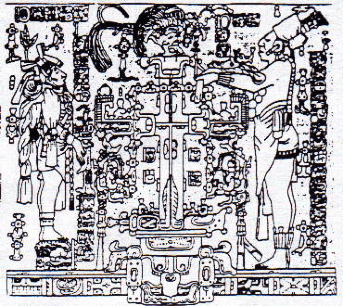
Figure 1 – The Cross of Palenque
As described by Callaway, the principal subject on this Mayan tablet is the cross, which is crowned by a strange bird, there are two human figures on the side of the cross, which appear to be important personages. The symmetry and proportion of the cross appears to be similar to carvings found in Egypt. While both human figures are looking toward the cross, one of them seems to be offering what appears to be a child in sacrifice (Callaway, 2006.)
While the immediate idea could be to find similarities between this symbol and the Christian cross, most archeologists believe that this symbol is the representation of a tree or a corn plant, with symbolism of the connections of the tree to mother earth and as part of the support of life in the world. What appears to be clear in this Mayan symbol, is the representation of mother earth, and the concept of sacrifice, which are in line with the Jungian symbology elements.
The concept of the Tree of Life is heavily present in Mexican culture. There are many examples of this symbol in Mexican ceramic pottery.

Figure 2.- Mexican Tree of Life
The Mexican trees of life normally depict a tree with human figures, and also animals and food, showing the abundance of life on earth and representing the strong ties and respect that indigenous groups from different areas of the country have for mother nature and mother earth.
Even in modern times, the Mexican culture gives a very special place to the mother figure, as the center of the family, and it is very common to find complete families getting together every Sunday to have lunch at home with mother. Most individuals in Mexico still keep strong ties to their place of origin, and many remain in their home towns, close to their parent’s home. When individuals travel and leave their hometowns to find work some place else, they always try to return as many times as possible, and aspire to return back to stay some day. Most of the Jungian symbology of the mother is found in Mexican culture, such as the case of the Trees of Life, the strong ties to the city of origin of the individual, and in religion, the strongest symbol is the Virgin of Guadalupe, known as the Mother of Mexico.
 Quantum Drummer
Leave a comment